The Latin-Portuguese grammarian Manuel Álvares (1526-1583) and his De institvtione grammatica libri tres

Rolf Kemmler
University of TrĂĄs-os-Montes e Alto Douro

A little more than 440 years ago, in September 1572, the Portuguese typographer João da Barreira printed the first edition of a quite elaborate grammar of the Latin language. Little did the printer as well as the author, the Madeiran Jesuit Manuel Álvares (1526-1583), know that this first print of Emmanvelis Alvari e Societate Iesv de institvtione grammatica libri tres would constitute a momentous event in modern grammar history world-wide. With hundreds of editions throughout the following centuries, this grammar would become the Latin grammar with the greatest overall editorial and grammaticographical impact of all time.

Following the establishment of the Society of Jesus in September 1540, young Manuel Álvares was one of the first generation Portuguese Jesuits, acquiring his vast knowledge of Humanist studies in the classes of the Jesuit College of Arts (ColĂ©gio das Artes) in Coimbra that had been founded in 1548. As soon as 1552, he began teaching Latin grammar in the Portuguese Jesuit Colleges in Coimbra, Lisbon and Évora, occupying several positions of importance during the following decades. As a result of the fame for his mastery of Classical Latin that he achieved during the course of his teaching activities, the Jesuit Superior Generals Diego LaĂ­nez (1512-1565) and St. Francis Borgia (1510-1572) commissioned in 1564 the elaboration of a Latin Grammar by Álvares, to be used by the Society of Jesus:
Read more ›


Tagged with: , , , , , , ,
Posted in 16th century, Article, Europe, Grammars, History, Portugal

Exclamatives: a grammatical category?

Els Elffers
University of Amsterdam

1. Introduction

In most Western European grammars, sentences such as Hurrah!, How very curious!, or Vienna is so dull! are categorized as exclamatory sentences or exclamatives. Next to declaratives, interrogatives and imperatives, exclamatives are usually regarded as a separate sentence type.

However, as a grammatical category, exclamatives are more problematic than other sentence types. More often than other sentence types, exclamatives are omitted from grammars, or they are dealt with very succinctly, and/or in a rather ambiguous way.

During the last decades, there has been a cry for more research into exclamatives. This is mainly due to a growth of interest in themes such as “language and emotion” and “the expressive function of language” (cf. e.g. Foolen 1997). Below, I will briefly discuss the history of thought about exclamatives. Special attention will be paid to some early insights into the problematic character of the category. I will argue that, despite some theoretical improvements, the category has remained problematic up until the present day. Solutions are within reach only if two long-standing ideas are given up: (i) the idea that exclamatives constitute an independent category, (ii) the idea that research of exclamatives exclusively belongs to the “language and emotion” area. Read more ›

Tagged with: , , , , , ,
Posted in 19th century, 20th century, Article, History, Linguistics, Syntax, Uncategorized

Dr JosĂ© Rizal and the making of a modern linguistic Messiah

Piers Kelly
Australian National University

Describing the preeminent Filipino national hero Dr. Jose Rizal as a linguist is a little like referring to Thomas Jefferson as a horticulturalist. The statement may be true, but the many other talents that Rizal developed in his short life have tended to overshadow his extraordinary flair for language. After all, it was not for his linguistic achievements that his statue stands in every town plaza of the Philippines, nor was it the motive for his execution at the hands of Spanish authorities in 1896. Rizal is renowned as a legendary defender of civil and democratic rights, and parenthetically as a political scientist, historian, novelist, poet, sculptor, journalist, linguist and eye surgeon. It is for this last accomplishment that he is always conventionally known as Doctor Jose Rizal (a distinction he shares with another great civil rights leader, Dr Martin Luther King).

Dr José Rizal

Dr José Rizal. Source: Pinoy Etchetera

Born in 1861 to wealthy Tagalog-speaking parents in Calamba, a town situated 50 kilometres south of Manila, Rizal was to be educated in Spanish—a language that less than ten percent of native Filipinos would have access to in his lifetime.[1] In fact, it was only as late as 1863 that a royal decree mandated the establishment of a universal primary school system with Spanish as the sole medium of instruction.[2] In the linguistically diverse Philippines it was the policy of Spanish missionaries to communicate in the language of the region in which they were stationed. Educational reforms issuing from the motherland were ignored, resisted or poorly implemented since universal literacy and linguistic competence in Spanish threatened the mediating role of the friar orders.[3] For this reason, among others, the Spanish language was never to diffuse widely across the Filipino population in the same way that it did in Latin America.[4]

Read more ›

Tagged with: , , , ,
Posted in 19th century, Article, History, Linguistics, Philippines, Phonology

SHLP4 Call for Papers

Society for the History of Linguistics in the Pacific SHLP4

The fourth biennial conference of the Society for the History of Linguistics in the Pacific will take place in Alice Springs, Australia, 22-23 September 2014.

Papers on any aspect of the history of linguistics are welcome, especially those relating to the history of linguistics in Australia and the Pacific. Please send abstracts of no more than 300 words to David Moore (moored03@bigpond.com) by 31 July.

Tagged with: , , , , , ,
Posted in Announcements, Conferences and workshops

La historiografĂ­a mexicana en el contexto de los estudios lingĂŒĂ­sticos actuales

Ana Balderas GarcĂ­a
Universidad Nacional Autónoma de México

El quehacer lingĂŒĂ­stico en MĂ©xico se remonta al encuentro entre culturas que se dio en el siglo XVI. La imperiosa necesidad de convertir a los nativos al cristianismo, llevando el desconocimiento de las lenguas de Ă©stos a cuestas, dio como resultado que los religiosos comenzaran a internarse en el anĂĄlisis sistemĂĄtico del nĂĄhuatl, tarasco, totonaca, zapoteco, etc. AsĂ­, las gramĂĄticas y vocabularios hacen su apariciĂłn abriendo paso al conocimiento de nuevos sistemas comunicativos y, por ende, a paradigmas culturales inimaginables.

Arte en lengua zapoteca de fray Juan de CĂłrdova 1578

Arte en lengua zapoteca de fray Juan de CĂłrdova
1578

Andrés de Olmos

Vocabulario de la lengua mexicana y castellana de fray Andrés de Olmos 1547

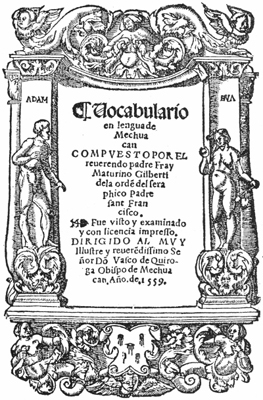
Arte de la lengua de MichuacĂĄn de fray Maturino Gilberti 1558

Arte de la lengua de MichuacĂĄn de fray Maturino Gilberti
1558


Read more ›

Tagged with: , , , ,
Posted in 20th century, Article, Field linguistics, History, Linguistics

Empirical methods in language construction

Baßak Aray
UniversitĂ© Paris I – PanthĂ©on-Sorbonne, EXeCO (PHICO)

Efforts to establish an international auxiliary language (IAL) have a long history. Projects to overcome ethnic languages flourished in the 17th century Britain. Creators of these “philosophical languages” (Descartes, Dalgarno, Wilkins, Leibniz) stressed the shift between the structure of spoken languages and the structure of nature, and consequently the view that the former leads to a distorted understanding of the latter. To replace imperfect natural languages – they are inefficient, at best, if not obviously misleading, so they claimed – they devoted their efforts to designing a transparent medium to represent the real structure of things adequately.

The history of the universal languages took a new turn towards the end of the 19th century. With Schleyer’s VolapĂŒk (1879) emerged a new goal for constructed languages: unlike their Enlightenment-era predecessors, the new constructed languages had a practical focus on international communication. Most of them integrated a posteriori elements in their grammar and vocabulary in order to maintain a continuity with natural languages, which ensured that they were more accessible to learners (Couturat and LĂ©au 1903: 113). This period may be characterized as a pragmatic turn. Epistemic ambitions of reflecting the real structure of things were discredited, and “universal language” was replaced by “international auxiliary language”. On the methodological side, conceptual analysis left its place to empirical observation of existing languages.

The new paradigm bore humanistic and cosmopolitan tendencies combined with a technophilia that inspired the extension of engineering to the linguistic field. Esperanto, the most emblematic – and, so far, most successful – IAL was accompanied by rhetoric from its creator, Zamenhof (1906: 1154), encouraging pacifism and promoting international brotherhood. The Delegation for the Adoption of International Auxiliary Language presented IAL as a historical necessity. In their history of the universal language, the leaders of the Delegation, Couturat and LĂ©au, mention the ongoing rapid globalization of the world as the background to the IAL (Couturat and LĂ©au 1903: VII). They explain this development by the exponential growth of transport and telecommunication technologies. These raised global mobility and revived international commerce, making the need for an IAL to facilitate international communication more important than ever. Read more ›

Tagged with: , , , , , , ,
Posted in 20th century, Article, Constructed languages, Europe, History, Linguistics

Language and smell: traces of synesthesia in premodern learning

Raf Van Rooy
PhD fellow of the Research Foundation – Flanders (FWO)
University of Leuven

It is well known that, in present-day English, the verb ‘smell’ can obtain a negative connotation when used intransitively; the adjective derived from it, ‘smelly’, is even lexically restricted to the meaning ‘having a bad smell’. By contrast, speakers of English tend to allot more positive interpretations to the sense adjective ‘tasty’ (cf. Krifka 2010). That is to say: everybody with a healthy appetite would prefer ‘tasty’ to ‘smelly’ food. Another example, from a rather unexpected corner, is the association between stench and syntax errors in computer terminology. It appears that the terms CodeSmell (alternative terms: CodeStench and CodePerfume) and LanguageSmell refer to the use of erroneous codes in computer programming (see http://c2.com/cgi/wiki?CodeSmell). ‘If it smells, it’s bad’, appears to be the maxim of olfactory imagery in English. Things seem to have been quite different in some premodern Latin and Italian texts I encountered during my research on the history of the ‘dialect’ concept. In these writings, the image of ‘smell’, always expressed by means of the Proto-Indo-European root *od- (cf. ancient Greek áœ€ÏƒÎŒÎź), seems to be usually tied up with more positive features, such as antiquity, purity, and naturalness, especially with reference to linguistic contexts. Since no studies on this topic are known to me, I would like to briefly explore some of these passages in the present contribution, so as to shed a little more light on this peculiar aspect of premodern language attitudes.

Read more ›

Tagged with: , , , , ,
Posted in Article, Europe, History, Linguistics, Semantics

Program March-May 2014

[Updated 22 May 2014]

12
March
Language and smell: traces of synesthesia in premodern learning
Raf Van Rooy
PhD fellow of the Research Foundation – Flanders (FWO)
University of Leuven
26
March
Empirical methods in language construction
Baßak Aray
UniversitĂ© Paris I – PanthĂ©on-Sorbonne, EXeCO (PHICO)
9
April
La historiografĂ­a mexicana en el contexto de los estudios lingĂŒĂ­sticos actuales
Ana Balderas GarcĂ­a
Universidad Nacional Autónoma de México
23
April
Dr José Rizal and the making of a modern linguistic Messiah
Piers Kelly
Australian National University
7
May
Exclamations: a grammatical category?
Els Elffers
University of Amsterdam
22
May
The Latin-Portuguese grammarian Manuel Álvares (1526-1583)
Rolf Kemmler
Universidade de TrĂĄs-os-Montes e Alto Douro (UTAD)
Posted in Programs

New dating of the Iloko manuscript lexicography

Rebeca FernĂĄndez RodrĂ­guez
Centro de Estudos em Letras (CEL)
Universidade de TrĂĄs-os-Montes e Alto Douro (UTAD)

Missionary lexicography in the Philippines is extensive and exhaustive. Dozens of grammars and vocabularies have been written since the Spanish arrival in the Philippines in 1565. In many cases they have remained in manuscript form. However, in the last decade, some scholars have focused their research on specific languages and documents. Quilis edited Blancas de San José’s Arte y Reglas de la lengua Tagala (1661) in 1991; GarcĂ­a-Medall edited Alonso de MĂ©ntrida’s Diccionario de la lengua bisaya, hiligueina y haraya de la Isla de Panay in 2004; Zwartjes edited Melchor Oyanguren’s Tagalysmo elucidado (1742) in 2010; and I am working on an edition of manuscript Calepino Ilocano.

Even though there is an increasing number of papers and books on Philippine linguistic documentation, there is no study on how dictionaries were compiled and finally printed. Missionaries worked on previous dictionaries, improving them by making amendments, adding new terms and examples. Authorship was not regarded as it is today. Grammars and dictionaries were kept in libraries or passed from hand to hand and were constantly improved.

So we might ask what work Spanish missionaries in the Philippines did on their field notes to prepare printed dictionaries. We can begin to answer this question by looking at three different Ilocano manuscripts kept in the Library of the Estudio TeolĂłgico Agustiniano de Valladolid (Spain) and comparing them to the first printed Ilocano dictionary of 1849. Read more ›

Tagged with: , ,
Posted in 17th century, 18th century, Article, Europe, Field linguistics, Lexicography, Linguistics, Philippines

Bloomfield : Du mentalisme au behaviorisme

Jean-Michel Fortis
Laboratoire d’histoire des thĂ©ories linguistiques, UniversitĂ© Paris-Diderot

On peut s’interroger sur l’évolution qui voit Bloomfield passer de la psychologie Ă  dominante wundtienne, qui imprĂšgne son Introduction de 1914, au behaviorisme, et d’une linguistique “mentaliste” Ă  une linguistique psycho-abstinente et centrĂ©e sur l’analyse des formes. Une version simple de cette Ă©volution est celle que dĂ©crit Langendoen (1998): de conceptualiste, Bloomfield devient behavioriste et structuraliste.

Je voudrais donner ici une image plus complexe de cette transition, en insistant sur le dĂ©couplage entre la conversion au behaviorisme et l’évolution des idĂ©es linguistiques de Bloomfield. Cette Ă©volution est Ă  mon avis graduelle, et entretient des rapports complexes avec la psychologie de l’époque (celle de Wundt, essentiellement, mais aussi de Hermann Paul). Trois examples, qui sont autant de rapports Ă  la psychologie, peuvent l’illustrer.

Dans un premier cas, Bloomfield donne un soubassement psychologique Ă  des phĂ©nomĂšnes linguistiques, pour n’en garder que ce qui est compatible avec des critĂšres distributionnels d’analyse. Ici, le mentalisme embraye la discussion, donne un fondement psychologique Ă  l’explication, pour se trouver recyclĂ© en approche distributionnelle. La discussion partira de ce que dit Bloomfield Ă  propos de la distinction analytique / synthĂ©tique.

Un autre cas concerne la rĂ©interprĂ©tation par Bloomfield de l’analyse wundtienne de la proposition. En l’occurrence, dĂšs l’Introduction de 1914, Bloomfield reprend Wundt en l’édulcorant, c’est-Ă -dire en restant plus prĂšs des formes de surface que Wundt. L’origine de l’analyse en constituants peut donc ĂȘtre cherchĂ©e chez Wundt, mais chez un Wundt en partie dĂ©psychologisĂ©.

Enfin, dans un troisiĂšme type de cas, la psychologie mentaliste ne joue qu’un rĂŽle insignifiant dans la description linguistique, et ce Ă  l’époque mĂȘme oĂč Bloomfield dĂ©fend une linguistique psychologique. Ce cas est illustrĂ© par les prĂ©coces Tagalog Texts (1917).

Bien sĂ»r, il ne s’agit pas ici de prĂ©senter Bloomfield et son Ă©volution, mais de donner quelques coups de sonde historiques dans certains domaines. Read more ›

Tagged with: , , , , , ,
Posted in 19th century, 20th century, America, Article, History, Linguistics, Structuralism

Upcoming events


2-4 September 2026
Nottingham (UK)
Henry Sweet Society Colloquium 2026
(Non-)Native Speakers in the History of Linguistic Ideas


10-11 September 2026
Fribourg (Switzerland)
The Prague Linguistic Circle in Geneva and Paris: Circulations and Decenterings


19-21 November 2026
Sofia (Bulgaria)
La linguistique ‘fonctionnelle’ cent ans aprùs la fondation du Cercle linguistique de Prague


28-29 January 2027
Paris (France)
SHESL Conference 2027
History of terminology – Diachronic terminology The emergence of a terminological conscienceness


31 March–3 April 2027
Vigo (Spain), Vila Real (Portugal)
13th International Conference on Missionary Linguistics


23-27 August 2027
NiterĂłi, Rio de Janeiro (Brazil)
ICHoLS XVII