Toponymy and ecolinguistics

Joshua Nash
University of Adelaide

Ecolinguistics can be divided into two strands. The first deals with environmental discourse analysis, often termed eco-critical discourse analysis, critical ecolinguistics, or the language of ecology and environmentalism, while the second, language ecology, which deals with interactions between humans, mind, and environment, is often expressed through lexico-grammatical studies of how humans talk about and adapt linguistically to new and foreign environments. This second strand is also referred to as the ecology of language. I will not be overly concerned with the first strand.

Since its beginnings in the 1980s and 1990s, ecolinguistics has grown into a research field in its own right, although the boundaries of what ecolinguistic analysis is and how one should go about doing ecolinguistic research have not been made explicit by scholars working in the field. The linguistic community has also questioned the relevance of ecolinguistics as a subdiscipline and on what theoretical ground ecolinguistics actually stands (e.g. Edwards 2008; Ostler 2001; Owen 2004). There have also been several critical voices concerning various aspects of ecolinguistic research (e.g. Goddard 1996; Siegel 1997). With the exception of Garner (2005), scholars and theoreticians have not been explicit enough in stating the theoretical breadth of ecolinguistics and its practical implications for general linguistic theory.

Ecolinguistics provides several conceptual questions. I am concerned with one major empirical question: How can relationships involving people, language, place, and names be measured empirically? Research in linguistics has generally focused on linguistic structure decontextualised from the environment in which the language is spoken. Sociolinguistic research has contributed significantly to an understanding of language use and language in social context just as ecolinguistics has created awareness of language as an ecological phenomenon (Haugen 1972).

Read more ›

Tagged with: ,
Posted in Article, Ecolinguistics, Linguistics, Toponymy

Teaching language to a boy born deaf in the seventeenth century: the Holder-Wallis debate

Jaap Maat
University of Amsterdam

1. The Popham notebook
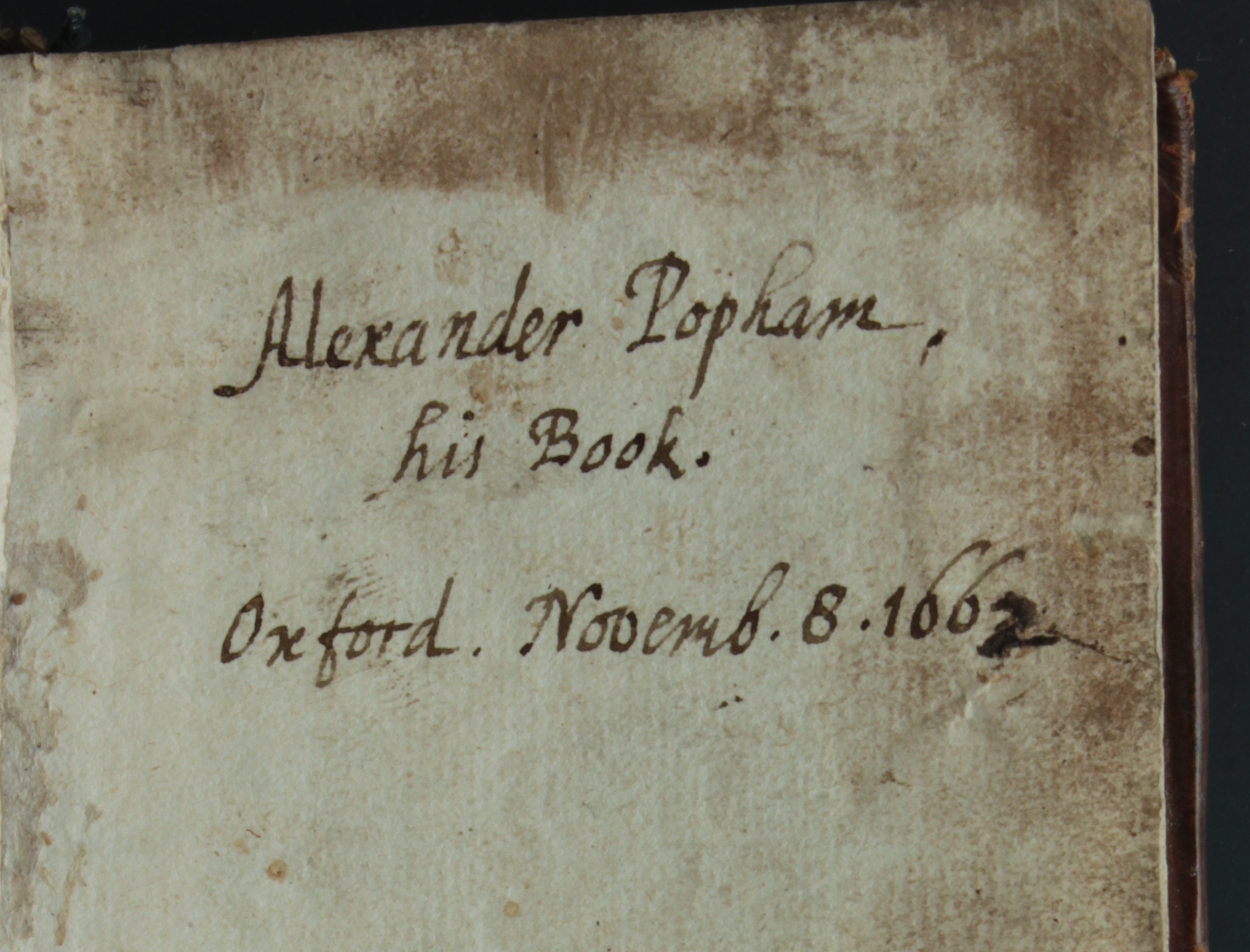
Title pageIn the summer of 2008, a leather-bound booklet attracted the attention of a member of staff of Warner Leisure Hotels in Littlecote House, near Hungerford, Wiltshire, UK. It looked old, and in fact it was. It turned out to be a seventeenth-century notebook, filled for the most part with hand-written text. On the title page it said: “Alexander Popham, his book. Oxford, Novemb. 8. 1662”.

It soon became clear that this notebook was a fascinating find, as it promised to shed light on a famous case in the history of teaching language to the deaf. Littlecote House used to be the home of the Pophams, a wealthy family whose members were admirals and judges playing an important role in early modern political history. Alexander Popham was born deaf, and remained mute until he was about ten years old.

AlexanderHe then was taught, at least in part successfully, how to speak, read and write, by two teachers: first by William Holder (1616-1698), and subsequently by John Wallis (1616-1703). The recently discovered notebook is written in the hand of Wallis, Popham’s second teacher, and it is obvious from its contents that it was composed by Wallis specifically for the purpose of instructing Popham.

The case of Alexander Popham has primarily become famous for two reasons. First, although he was not the first person born deaf in Western history to succeed in acquiring command of a language of the hearing, to do so was certainly a rare and remarkable achievement. Until the sixteenth century, it was generally considered impossible to cure deafness or to find a remedy for muteness other than to have recourse to signing, which was typically seen as at best a very deficient substitute for spoken language. In 16th-century Spain, the first systematic attempts were undertaken to teach written and spoken language, in this order, to deaf-mutes (Plann, 1997). These attempts reportedly succeeded, and although Holder and Wallis must have been aware of this, they  considered themselves pioneers. Secondly, both teachers of Popham afterwards claimed the credit for this success, which led to a bitter dispute between them. The dispute attracted more attention from historians than the average petty quarrel between rival scholars as it was fought out in print, and took place within the early Royal Society, involving as it did two of its prominent members, who both appealed to other fellows in support of their claims.

In what follows, I summarize the debate between Holder and Wallis before briefly returning to the Popham notebook.

Read more ›

Tagged with: , , , ,
Posted in 17th century, Article, Europe, History

Hendrik Pos and the epistemological foundations of structuralism

Patrick Flack
Charles University, Prague

The name of Dutch linguist and philosopher Hendrik Josephus Pos (1898-1955) is not one that rings many bells today, except perhaps in the Netherlands and the (growing) circles of Merleau-Ponty specialists. But to the keen student of the history of the language sciences who does accidentally bump into him and decides to lend his work some attention, Pos will reveal himself as a fascinating source that offers an intriguing new perspective on the development of linguistics in the first half of the 20th century.

Read more ›

Tagged with: , , , , , , , ,
Posted in 20th century, Article, Europe, History, Linguistics, Phenomenology, Philosophy, Structuralism

A uniform orthography and early linguistic research in Australia

David Moore
University of Western Australia

Introduction

A Uniform orthography can be defined as one which is segmental and phonographic. Each graphic segment is pronounced and has a distinct value. Internal consistency in transcription is achieved by defining each segment and the sound that it represents in the orthography. Each sound of a language is assigned a segment: a letter or a combination of letters which is outlined in statement of the orthography or ‘phonetic key’. By contrast, a non-uniform writing system involves writing languages where the value of each segment is unspecified. If the language of transcription is English, there is a poor correspondence between the letter and sound. The problem is particularly acute with English vowels. The five vowel letters of English are polyvalent; that is they each represent a number of English phonemes. Ten English phonemes are represented by <a> in English (Coulmas 2003: 186). Also, each English vowel phoneme can be represented by different graphemes. The spelling may be at the word level and based on what Dench (2000:59) says is ‘subjective impression of similarity to particular English words’. Individual segments in this ‘logographic’ spelling have little or no phonetic interpretation.

Uniform orthographies were the forerunners of the International Phonetic Alphabet (IPA). The first Australianist linguist to use the IPA appears to have been John McConnell Black (1855-1951), for a language of the Western Desert (Black 1915). I claim that some early investigators of Australian languages used Uniform orthographies in their writing of Australian Aboriginal languages and avoided the problems of English-based spelling.

Read more ›

Tagged with: , ,
Posted in 19th century, 20th century, Article, Australia, Field linguistics, History, Linguistics, Phonology

Program October-December 2013

[Program updated 27 October 2013]

16
October
A uniform orthography and early linguistic research in Australia
David Moore
University of Western Australia
23
October
Break
30
October
Hendrik Pos and the epistemological foundations of structuralism
Patrick Flack
Charles University, Prague
6
November
Teaching language to a boy born deaf in the seventeenth century: the Wallis-Holder debate
Jaap Maat
University of Amsterdam
13
November
Toponymy and ecolinguistics
Joshua Nash
University of Adelaide
20
November
Break
27
November
El Sermonario de fray Bernardino de SahagĂșn y los fondos en lenguas indĂ­genas de la Biblioteca Nacional de MĂ©xico
Pilar MĂĄynez
Universidad Nacional Autónoma de México
4
December
Bloomfield: du mentalisme au behaviorisme
Jean-Michel Fortis
Laboratoire d’histoire des thĂ©ories linguistiques, UniversitĂ© Paris-Diderot
11
December
New dating of the Iloko manuscript lexicography
Rebeca FernĂĄndez RodrĂ­guez
Universidade de TrĂĄs-os-Montes e Alto Douro
Tagged with:
Posted in Programs

Emile Benveniste et les langues amĂ©rindiennes.

Chloé Laplantine
Laboratoire d’Histoire des ThĂ©ories Linguistiques
CNRS-Université Paris Diderot

Frances Densmore with Blackfoot chief Mountain Chief during a recording session for the BAE

Frances Densmore et le chef Blackfoot, Mountain Chief, pendant une session d’enregistrement au Bureau of American Ethnology

Les langues amĂ©rindiennes ont une place critique dans la linguistique d’Emile Benveniste (1902-1976). A deux reprises dans les ProblĂšmes de linguistique gĂ©nĂ©rale, il explique l’importance pour l’histoire de la linguistique des recherches engagĂ©es Ă  la fin du 19e siĂšcle, sous l’impulsion de Franz Boas peut-on supposer, parce qu’elles mĂšnent le linguiste Ă  se faire l’analyste de son propre regard, de ses propres catĂ©gories de langue-pensĂ©e comme non-universelles, pour finalement devenir capable d’une analyse des langues. Ainsi Benveniste, en 1968, dans un entretien  avec Pierre Daix fait ce rĂ©cit :

Vers 1900, des hommes, et tout particuliĂšrement des AmĂ©ricains, ont dit : « Vos conceptions sont irrĂ©elles ou, en tout cas, trĂšs partielles, vous ne tenez compte que d’une partie du monde linguistique : le monde indo-europĂ©en. Il y a une foule de langues qui Ă©chappent Ă  vos catĂ©gories ». Cet avertissement a Ă©tĂ© trĂšs utile et ces langues, notamment les langues indiennes d’AmĂ©rique que j’ai personnellement Ă©tudiĂ©es, sont trĂšs instructives, parce qu’elles nous font connaĂźtre des types de catĂ©gorisation sĂ©mantique et de structure morphologique nettement diffĂ©rents de ceux que les linguistes formĂ©s dans la tradition classique considĂ©raient comme inhĂ©rents Ă  l’esprit humain[1].


Read more ›

Tagged with: , , , ,
Posted in 20th century, America, Article, Field linguistics, History, Linguistics, Structuralism

The social cognition of linguists

Andrea C. Schalley
Griffith University

It is social cognition which enables us to construct functioning societies sharing knowledge, values and goals, and to undertake collaborative action. It is also crucial to empathising and communicating with others, to enriching imprecise signs in context, to maintaining detailed, differentiated representations of the minds and feelings of those who share our social universe, to coordinating the exchanges of information that allow us to keep updating these representations, and to coopting others into action.
(Evans 2012)

What about the linguistic research community – is this a “functioning society”, to use Evans’ notion? Which knowledge, values, and goals are we (and I consider myself a member of this “society”) aiming to share? What are our goals? In this post, I will try to look at “the linguists” as a “society” and discuss whether it is “functioning” from a “social cognition” point of view. I hope that a meta-discussion on the state of linguistics may result, potentially benefitting the further progress and development of the field.

Read more ›

Tagged with: , , , ,
Posted in Article, Linguistics, Philosophy, Psycholinguistics, Sociolinguistics

No beetle? Wittgenstein’s ‘grammatical illusions’ and Dalabon emotion metaphors

MaĂŻa Ponsonnet
Australian National University and Dynamique du Langage (CNRS/Université Lyon 2)

Apart from a few fruitful but pointed encounters, linguistics and philosophy of language often talk past each other. In this post, I try and establish a dialogue between these two disciplines, around the question of private states (or inner states) and their linguistic descriptions. I suggest a ‘translation’ of Wittgenstein’s stance on private states into more technical linguistic terms, and I show how empirical description of the way private states are described in various languages may relate to some of Wittgenstein’s philosophical questions.

Read more ›

Tagged with: , , , , , , , ,
Posted in Article, Australia, Linguistics, Philosophy, Semantics

From Inductivism to Structuralism: the ‘method of residues’ goes to the field

Michael Silverstein
University of Chicago

It should be clear to anyone who surveys the historical record that the “discovery” of the phoneme – that is, the codification of phonological theory and method – was key in linguists’ consciousness of a new disciplinary era, one that retrospectively ascribed a conceptual revolution to the sainted figure of Ferdinand de Saussure (1857-1913). The analysis of every plane of language, from word morphology to phrasal, clausal, and sentential syntax (and for some hardy structuralist souls, to stretches of discourse beyond) has been calqued from linguists’ experience of working with the phonological plane. The ironies of all this are supreme in relation to the available text of the 1916 Cours de linguistique gĂ©nĂ©rale, where “Saussure” – as reconstituted d’outre tombe by Bally and Sechehaye – has nothing of interest to say about synchronic sound systems as such, but really concentrates on the analysis of lexical and grammatical symbols.1

But the ironies do not cease there. The live and youthful Saussure of all of about 19 years of age had, in fact, glimpsed what morphological and morphophonological structure in the modern sense was all about in his MĂ©moire (1879) on the Proto-Indo-European vowel system. Working backwards from attested forms in the various branches he demonstrated that the logic of the phonological combinatorics of word-roots in their various derivations and inflections pointed unerringly to the prior existence of now-lost phonemic segments that left their traces in at first seemingly irregular vowel correspondences in the daughter dialects, at once made regular by the presumption of these “coefficients sonantiques” (later identified as “laryngeals”) that were absorbed by adjacent vowels, “coloring” them.2 Amazingly, despite the indirect confirmation by Jerzy Kuryƚowicz in his famous 1927 paper on Hittite áž« (which occurs, for the most part, in several of the predicted syntagmatic positions), and despite the typological parallelisms in American Native languages such as Tonkawa, Nootka, and certain Salishan languages, “Laryngeal Theory” was still highly controversial among Indo-Europeanists down to my undergraduate days in the 1960s!

The point is, in a diachronic framework, Saussure’s brilliant youthful insight at once implicitly created, through a kind of convergent internal reconstruction, a model of the (morpho)phonological structure of the ancestral language at the same time he explicitly did what any Leipzig Neogrammarian – among whom he was at that very moment matriculated – would aspire to do: to render otherwise “irregular” correspondences “regular.” The first is the pre-condition for the second: some kind of abstract structural unit in syllabically framed distributions turned out to be the hero of “sound” change. Neogrammarianism and diachrony thus form the real framework we must consider to understand both the roots of synchronic structuralism and the profound continuities notwithstanding the reorientation of the disciplinary focus in method, in models, and (as my old teacher Van Quine used to say) in “ontic commitments” about language.

The story to be told here, thus far to my mind not clearly enough articulated, is the gradual emergence and Kuhnian “normalizing” of the mode of inductive study of the Indo-European languages individually and as members of a language family sparked by, and institutionally increasingly focused upon the facticity of autonomous phonological change, a.k.a. Lautgesetz ‘sound law’ (see Jankowsky 1972; Wilbur 1977; Morpurgo Davies 1994). Lautgesetze had both an epistemological and an ontological manifestation, not carefully enough distinguished either in the instance or in the later historiographic accounts of the late 19th century. To be sure, the continued disciplinary focus on the plane of phonology served as the work-space in which the transition without a rupture of discipline was effected between the comparative-historical linguistics of etymological forms-over-time and the descriptive-structural linguistics of system-internal relations-of-forms.

Read more ›

Tagged with: , , , , , , , , , , , , ,
Posted in 19th century, 20th century, America, Article, Europe, History, Linguistics, Structuralism

Historical Chinese phonology as a meeting ground for the Indian, the Chinese, and the Western linguistic tradition

Lei Zhu
Shanghai International Studies University

The speech sound, being the most important medium between our physical body and linguistic mind, is one of human beings’ oldest objects of study. In different cultures, it has been understood in different ways, depending on the role it plays in social life (e.g. in religious activities), the technologies available, the dominant philosophy, and various other factors. If we take the position that each writing system is a preliminary analysis of the speech sound, even more varieties may be considered.

The above having been said, one might assume that the Chinese, with a long history, an autonomous culture, and a unique writing system, must have a rather independent tradition in the study of the speech sound. Indeed, this is the belief of many Chinese scholars as well, to whom the fact that speech sound study (yinyunxue éŸłéŸ»ć­ž, literally “pronunciation and rhyme study”) makes one of the three branches of the “basic learning” (xiaoxue 氏歾, somewhat similar to the Western trivium) in traditional Chinese scholarship and played a leading part in its culmination during the Qing Dynasty (1616-1911, the last Chinese dynasty) is enough to support the view.

In this post, I will show that the above view is at least partly wrong. At the heart of the speech-sound branch of the “basic learning,” a tension between the Chinese and the Indian approach has existed since the 2nd century A.D. Moreover, as the branch started to be modernised at the beginning of the 20th century, since which time it has been customarily called “historical Chinese phonology” (hanyu lishi yinyunxue æŒąèȘžæ­·ćČéŸłéŸ»ć­ž), the tension has been further complicated by the introduction of the Western approach. Throughout the process, the Chinese approach has never been really dominant, but it has never been dispensable, either. This poses a problem for those who argue for the independence of traditional Chinese scholarship, because “speech sound study” is regarded as a core component of the scholarship (in much the same way as philology is the basis for classical studies). On the other hand, this is also problematic for the modern linguists, who often feel that the modernisation of historical Chinese phonology is not enough.

Read more ›

Tagged with: , , , , , , , , ,
Posted in Article, China, Europe, History, India, Linguistics, Phonology

Upcoming events


21-23 January 2026
Paris
SHESL Conference 2026
Versification and the History of Linguistic Ideas


17–20 March 2026
Universitat Pompeu Fabra, Barcelona (Spain)
XV Congreso Internacional de la Sociedat Española de HistoriografĂ­a LingĂŒĂ­stica
Prescriptivism and descriptivism from the peripheries


23–25 March 2026
Montpellier (France)
Asian Languages in the History of Lexicography


2-4 September 2026
Nottingham (UK)
Henry Sweet Society Colloquium 2026
(Non-)Native Speakers in the History of Linguistic Ideas


10-11 September 2026
Fribourg (Switzerland)
The Prague Linguistic Circle in Geneva and Paris: Circulations and Decenterings


19-21 November 2026
Sofia (Bulgaria)
La linguistique ‘fonctionnelle’ cent ans aprùs la fondation du Cercle linguistique de Prague


23-27 August 2027
NiterĂłi, Rio de Janeiro (Brazil)
ICHoLS XVII