
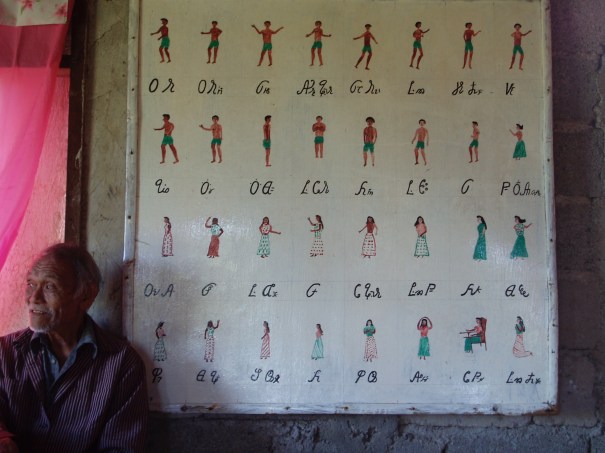
Chief Juan Datahan (†) in front of a chart showing Eskayan ancestors labelled in the Eskayan script.
Piers Kelly
University of New England
In recent years, there has been increasing interest in the study of writing systems. Much of the new impetus has come from linguists investigating the interactions between graphic structure and linguistic structure. Yet practitioners hailing from classics, archaeology, anthropology and elsewhere are examing writing as a social as much as a linguistic phenomenon. These developments have not been universally welcomed. In his introduction to An exploration of writing (2018), Peter Daniels wrote that “area specialists seem to have abandoned questions of how writing relates to language in favor of how writing relates to society. I find this move to be premature: the comparative and typological exploration of the connections between writing and language is far from completed […]” (Daniels 2018, 5). Here I want to lend weight to Daniels’ observation that a perceptible shift in focus has been unfolding in the study of writing systems, and to agree that we are far from having exhausted traditional grapholinguistic questions. What I reject, however, is the assumption that the social realities of writing are of secondary importance to linguistic analysis, or that a synthesis cannot be imagined until we’ve sorted out the nuts and bolts of how writing systems work.
As it happens, anthropologists and archaeologists were once seriously invested in the relationship of writing to society, a relationship that was (unfortunately) theorised and systematised to support 19th-century social evolutionist theory. While this progressivist paradigm has long been discredited, it is only recently that researchers have returned to the social dimension of writing with fresh eyes, better information and new theoretical insights. In this blog post I want to try to make sense of this positive moment and to try to chart a way forward.
Read more ›





 History and Philosophy of the Language Sciences