New book: HPLS 3 – Historical journey in a linguistic archipelago: Descriptive concepts and case studies

HPLS 3 cover

The third book in the gold open access HPLS series has just appeared, Historical journey in a linguistic archipelago: Descriptive concepts and case studies, edited by Émilie Aussant and Jean-Michel Fortis. The volume contains a selection of papers from the International Conference on the History of the Language Sciences XIV, which was held in Paris in 2017.

Get your free PDF copy from Language Science Press!

Posted in Announcements, Publications

Recent publications in the history and philosophy of the language sciences – December 2020

Ferdinand de SAUSSURE. 2020. Recueil des publications scientifiques de Ferdinand de Saussure. EditĂ© par Ch. Bally et L. Gautier, rĂ©vision d’A. Meillet. Reprise fac-similĂ© de l’édition de 1921. Limoges : Lambert-Lucas. 656 p. ISBN : 978-2-35935-331-0
Publisher’s website

Voici tous les textes Ă©crits par Saussure, signĂ©s par Saussure et publiĂ©s par Saussure, repris en 1921 dans un recueil posthume exhaustif par Charles Bally et LĂ©opold Gautier – rĂ©visĂ© par Antoine Meillet. Ce recueil entrait, en son temps, dans la mĂȘme intention scientifique que la publication du Cours de linguistique gĂ©nĂ©rale. Pour l’éditeur d’aujourd’hui, il s’agit d’achever de rendre disponible en librairie l’essentiel de ce qu’il faut avoir lu du maĂźtre de GenĂšve.

Read more ›
Posted in Publications, Uncategorized

A Danish Framing of Roman Jakobson’s American Years – Review of From the early years of Phonology

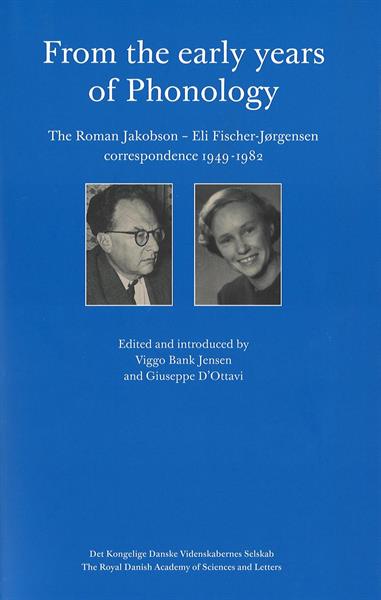
Book cover: From the Early Years of Phonology

Patrick Flack
University of Fribourg

Over the last decade or so, we have been treated to a steady succession of book-length publications dedicated to the intellectual legacy of Roman Jakobson. This near continuous stream started with the release of the long-awaited volume 9/2 (part I & II) of Jakobson’s Selected Writings (ed. Toman 2012–13), quickly followed by the massive 4-volume Roman Jakobson anthology of critical essays in the series Critical assessments of leading linguists (Thomas 2014). Up next came a number of proceedings from conferences held respectively in Olomouc, Moscow and Milano/Vercelli: Roman O. Jakobson: a work in progress (Kubiček & Lass 2014), Jakobson Today [Jakobson segodnja] (Avtonomova 2015) and Roman Jakobson, linguistics and poetics [Roman Jakobson, linguistica e poetica] (Esposito, Sini & Castagneto 2018). To these were added an Italian monography, Roman Jakobson and the foundations of semiotics [Roman Jakobson e i fondamentati della semiotica] (Ponzio 2015) as well as the Roman Osipovič Jakobson volume in the landmark Russian series The Philosophy of Russia in the first half of the 20th Century [Filosofija Rossii pervoj poloviny XX veka] (Avtonomova, Baran & Ơčedrina 2017). Finally, the last few of years have brought us new editions of Jakobson’s short writings and letters:[1] first, an Anthology of Roman Jakobson’s engaged writings [AngaĆŸovanĂĄ čítanka Romana Jakobsona] (ed. Toman 2017), followed by his extensive correspondence with Claude LĂ©vi-Strauss in Correspondance 1942–1982 (ed. Loyer & Maniglier 2018), and now the Russian philologist’s epistolary exchanges with Danish phonologist Eli Fischer-JĂžrgensen in From the early years of phonology (Bank Jensen & D’Ottavi 2020).

Beyond bearing witness to Jakobson’s continued relevance, these publications highlight together some interesting features of the current state and scope of research on his work and life. A very encouraging sign, on the one hand, is that this research is being carried out by a new generation of scholars (along, of course, with a few senior Jakobson experts), whose interests and specialisations are decidedly interdisciplinary. Among the editors of the above-mentioned volumes, one finds not only linguists and historians of the language sciences, but also literary theorists, philosophers, anthropologists, semioticians and historians proper. The international, multilingual nature of the research into Jakobson’s work and legacy is another heartening aspect, especially given the fact that the various national and linguistic research contexts seem quite porous and aware of each other (many scholars are active cross-linguistically in several of these contexts). Further, one is struck not only by the sheer amount of new material published for the first time, but also by the prevalent role that the task of editing unpublished sources still takes up in comparison to the share of critical or interpretative studies of Jakobson’s ideas. As many researchers are happy to point out (Sorokina 2018, Testenoire 2019, D’Ottavi 2020), much more archival, edition and translation work awaits, be it in relation to the Jakobson Papers at MIT, to relevant archives in Moscow and Prague or to the many significant articles still only available in Russian, Czech or even Polish. Read more ›

Posted in Article

Podcast episode 11: Interview with Floris Solleveld on disciplinary linguistics in the 19th century

Floris Solleveld

In this interview, we talk to Floris Solleveld about the character of linguistic research in the 19th century.
Read more ›

Posted in Podcast

Recent publications in the history and philosophy of the language sciences – November 2020

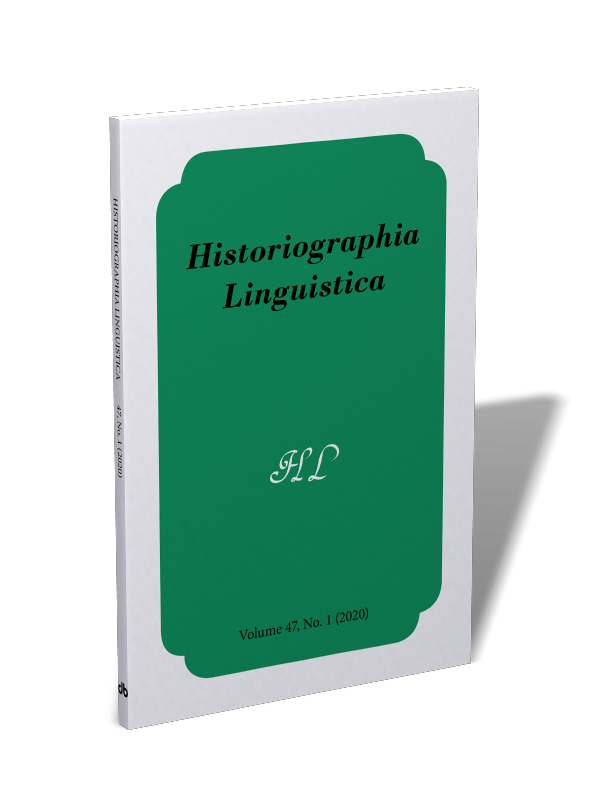
Historiographia Linguistica 47-1. 2020. Amsterdam : Benjamins. 195 p. ISSN 0302-5160
Publisher’s webpage

Table of contents

Articles:
Manuel Sartori – Une cause et ses raisons d’ĂȘtre Solution latine Ă  un problĂšme de terminologie arabe.

Marco Spreafico – Diglossia and language ideology Petrarch on linguistic variation and differentiation.

Floris Solleveld – Expanding the comparative view: Humboldt’s Ăœber die Kawi-Sprache and its language materials.

Read more ›
Posted in Publications, Uncategorized

CfP: Documentation and Description of Asian Languages – History and Epistemology

Paris

January 2022

Proposal submission deadline: 15 March 2021

This conference proposes to address, from a historical and/or an epistemological point of view, the ways in which Asian languages have been documented and described. “Asia” is used here in the wide sense which the French SociĂ©tĂ© asiatique gives to it, that is to say as designating an area going from the Maghreb to the Far East.

Conference languages: English, French, German, Italian or Spanish.

Further information at the SHESL website in English and French.

Posted in Announcements, Conferences and workshops

The return of the human in the study of writing

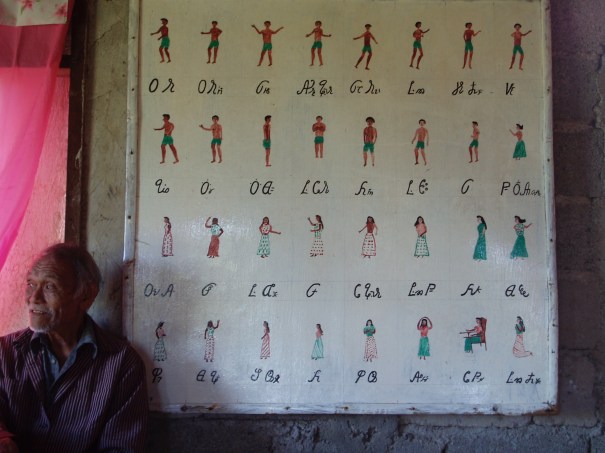
Chief Juan Datahan (†) in front of a chart showing Eskayan ancestors labelled in the Eskayan script.

Chief Juan Datahan (†) in front of a chart showing Eskayan ancestors labelled in the Eskayan script.

Piers Kelly
University of New England

In recent years, there has been increasing interest in the study of writing systems. Much of the new impetus has come from linguists investigating the interactions between graphic structure and linguistic structure. Yet practitioners hailing from classics, archaeology, anthropology and elsewhere are examing writing as a social as much as a linguistic phenomenon. These developments have not been universally welcomed. In his introduction to An exploration of writing (2018), Peter Daniels wrote that “area specialists seem to have abandoned questions of how writing relates to language in favor of how writing relates to society. I find this move to be premature: the comparative and typological exploration of the connections between writing and language is far from completed [
]” (Daniels 2018, 5). Here I want to lend weight to Daniels’ observation that a perceptible shift in focus has been unfolding in the study of writing systems, and to agree that we are far from having exhausted traditional grapholinguistic questions. What I reject, however, is the assumption that the social realities of writing are of secondary importance to linguistic analysis, or that a synthesis cannot be imagined until we’ve sorted out the nuts and bolts of how writing systems work.

As it happens, anthropologists and archaeologists were once seriously invested in the relationship of writing to society, a relationship that was (unfortunately) theorised and systematised to support 19th-century social evolutionist theory. While this progressivist paradigm has long been discredited, it is only recently that researchers have returned to the social dimension of writing with fresh eyes, better information and new theoretical insights. In this blog post I want to try to make sense of this positive moment and to try to chart a way forward.

Read more ›
Posted in Article

Podcast episode 10: Neogrammarian critics – Hugo Schuchardt and Karl Vossler

Rheinprovinz, Wenker 1877

In this episode, we examine some of the major critiques directed against the Neogrammarians and see what they tell us about the state of linguistics around the turn of the nineteenth to the twentieth century. We focus in particular on the arguments made by Hugo Schuchardt and Karl Vossler.
Read more ›

Posted in Podcast

Recent publications in the history and philosophy of the language sciences – October 2020

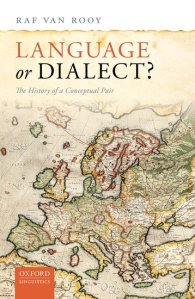
Raf van Rooy. 2020. Language or Dialect? The History of a Conceptual Pair. Oxford : Oxford University Press. 384 p. ISBN 9780198845713
Publisher’s website

This book provides a historiographic study of the distinction between language and dialect, a puzzle which has long fascinated linguists and laypeople alike. It offers a comprehensive account of the intriguing and complex history of the language-dialect pair, and shows that its real origins can be found in sixteenth-century humanist scholarship. The book begins with a survey of the prehistory of the language/dialect distinction in antiquity and the Middle Ages. Raf Van Rooy then provides a detailed investigation of the emergence, establishment, and development of the conceptual pair during the early modern period, from the Renaissance to the Enlightenment, when linguistic diversity was first studied in depth. Finally, the much-debated and ambiguous fate of the language/dialect opposition in modern linguistics is explored: although a number of earlier ideas were adopted by later scholars, many linguists today question the notion of a seemingly arbitrary and subjective distinction between language and dialect.

Read more ›
Posted in Announcements, Publications, Uncategorized

Death of a purist or how Dutch appeared to be a dangerous mother tongue

Camiel Hamans
University of Amsterdam/Adam Mickiewicz University PoznaƄ

27 June 1668, the Amsterdam prosecutor demanded a remarkable punishment: the accused should be displayed on the scaffold, his right thumb should be cut off, his tongue should be pierced with a glowing poker, his books and all his writings should be burned, all his property should be confiscated and he himself should be imprisoned for thirty years. The court, made up of the mayors of the city of Amsterdam, and the public gathered in one of the torture chambers of Amsterdam’s town hall, now the royal palace on Dam Square, must have been shocked. After all, the accused was not a mass murderer, thief, or otherwise known criminal, but an esteemed intellectual, with two doctorates from Leiden University, in both law and medicine, and someone who had friends in the College of Mayors. Moreover, his crime involved a book. Luckily, when the sentence fell, it was only ten years in prison, a huge fine and subsequently ten years in exile. In the end, he served only one of these ten years in captivity. He passed away in prison in the early days of October 1669.

Read more ›
Posted in 17th century, Article, History, Netherlands

Upcoming events


17–20 March 2026
Universitat Pompeu Fabra, Barcelona (Spain)
XV Congreso Internacional de la Sociedat Española de HistoriografĂ­a LingĂŒĂ­stica
Prescriptivism and descriptivism from the peripheries


23–25 March 2026
Montpellier (France)
Asian Languages in the History of Lexicography


2-4 September 2026
Nottingham (UK)
Henry Sweet Society Colloquium 2026
(Non-)Native Speakers in the History of Linguistic Ideas


10-11 September 2026
Fribourg (Switzerland)
The Prague Linguistic Circle in Geneva and Paris: Circulations and Decenterings


19-21 November 2026
Sofia (Bulgaria)
La linguistique ‘fonctionnelle’ cent ans aprùs la fondation du Cercle linguistique de Prague


31 March–3 April 2027
Spain, Portugal
13th International Conference on Missionary Linguistics


23-27 August 2027
NiterĂłi, Rio de Janeiro (Brazil)
ICHoLS XVII