Intentionality in phenomenology and speech act theory

Els Elffers

1. Introduction

Phenomenology covers a large area, and the same is true of speech act theory. Here I will focus on one point of contact between them, namely intentionality. Intentionality is a key concept in phenomenology and it also figures in speech act theory as developed by philosophers such as John Searle (b. 1932) and Paul Grice (1913–1988).

What is intentionality? The Oxford English Dictionary says: “Intentionality is the distinguishing property of mental phenomena of being necessarily directed upon an object, whether real or imaginary“.

This meaning applies to intentionality as presented in the work of the man who introduced the concept in the late 19th-century, the philosopher Franz Brentano (1838–1917). He borrowed the term from mediaeval philosophy and reintroduced it by making it the central concept of his new psychology. According to Brentano, mental life consists of acts, such as perceiving, thinking and feeling. These acts are called intentional, because they cannot occur without an object to which they are directed. You cannot perceive without perceiving something, you cannot think without thinking something, etc. Brentano considered intentionality as exclusively belonging to mental phenomena; in physical phenomena it is entirely absent.

The concept was developed further, in the first place by Brentano’s pupils Anton Marty (1847–1914) and Edmund Husserl (1859–1938), who made it a key notion of phenomenological philosophy and psychology. Others adopted the concept and elaborated it in various ways.

During this process, the idea of directedness acquired two more specific meanings; first aboutness: intentional acts are directed to a content, namely objects and states of affairs; second goal-directedness: intentional acts are essentially purposive (this is also the modern non-philosophical meaning of the word “intentionality”). This diversification came about through a gliding scale from intentional as ‘relating to’ via ‘referring to’ to ‘directed to’. Van Baaren formulates this development in the following way:

To the [‘aboutness’, E.E.] use of the term a second meaning was added, the meaning ‘goal-directedness’. According to this meaning, an action can be intentional or not. According to Brentano, a mental phenomenon or act has always an intentional object, its content. In this sense, acts are always intentional. There is a sliding semantic scale of ‘relation to’, via ‘referring to’ to ‘being directed to’. It is unclear whether Brentano tried to make use of this ambiguity. (Van Baaren 1996: 144, transl. E.E.)

Both varieties of intentionality were, in one way or other, incorporated into philosophy of language: ‘aboutness’ – intentionality mainly in logical semantics, goal-directed-intentionality mainly in speech act theory.

Only goal-directed intentionality, and especially its philosophical-linguistic implications, is my present focus. I will argue, first, that it is no coincidence that Husserl’s pupil Adolf Reinach (1883–1917), a renowned phenomenologist, was the first to develop a fully-fledged speech-act theory during the first decades of the 20th century. Second, I will show that Searle’s speech act theory only partially benefits from its appeal to goal-directed intentionality.

Read more ›

Posted in 19th century, 20th century, Article, Linguistics, Phenomenology, Philosophy, Pragmatics

Invitation to CHSTM online working group History of the Language Sciences

Online working group: History of the Language Sciences
Conveners: Judith Kaplan (CHSTM), Floris Solleveld (University of Bristol)

Hosted by the Consortium for History of Science, Technology, and Medicine 
Monthly meetings: Tuesday 12 Sep, 10 Oct, 14 Nov, 12 Dec, 9 Jan, 13 Feb, 12 Mar, 14 May

Read more ›
Posted in Announcements, Conferences and workshops

Recent publications in the history and philosophy of the language sciences – August 2023

Waugh, Linda R., Monique Monville-Burston, John E. Joseph, ed. 2023. The Cambridge History of Linguistics. Cambridge: Cambridge University Press. 900 p. ISBN 9780511842788. DOI: https://doi.org/10.1017/9780511842788
Publisher’s website

The establishment of language as a focus of study took place over many centuries, and reflection on its nature emerged in relation to very different social and cultural practices. Written by a team of leading scholars, this volume provides an authoritative, chronological account of the history of the study of language from ancient times to the end of the 20th century (i.e., ‘recent history’, when modern linguistics greatly expanded). Comprised of 29 chapters, it is split into 3 parts, each with an introduction covering the larger context of interest in language, especially the different philosophical, religious, and/or political concerns and socio-cultural practices of the times. At the end of the volume, there is a combined list of all references cited and a comprehensive index of topics, languages, major figures, etc. Comprehensive in its scope, it is an essential reference for researchers, teachers and students alike in linguistics and related disciplines.

Read more ›
Posted in Publications

Podcast episode 35: Interview with Nick Thieberger on historical documentation and archiving

Apu Kalsarap Nemaf and Ati Limaas Kalsarap reading a dictionary of their language. Erakor village, Vanuatu, 2001.

In this interview, we talk to Nick Thieberger about the value of historical documentation for linguistic research, and how this documentation can be preserved and made accessible today and in the future in digital form.

Read more ›
Posted in Podcast

Recent publications in the history and philosophy of the language sciences – July 2023

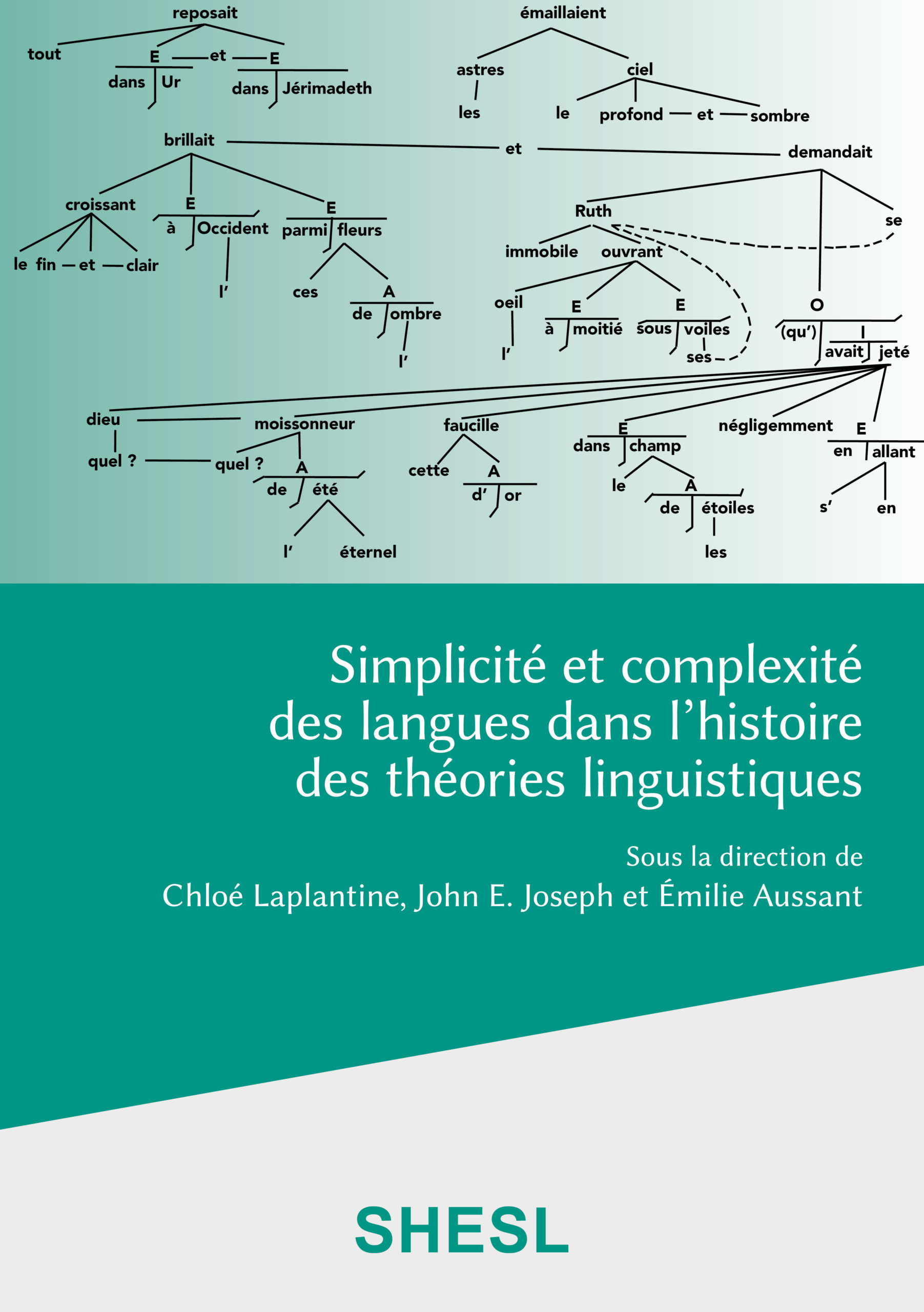
Laplantine, Chloé, John E. Joseph & Émilie Aussant, ed. 2023. Simplicité et complexité des langues dans l’histoire des théories linguistiques. Paris: SHESL (HEL Livres, 3). 486 p. ISBN 979-10-91587-21-1. DOI : 10.5281/zenodo.8098638
Publisher’s website
Book in Open access

« Toutes les langues et toutes les cultures sont également complexes ! ». Cette position a été, à travers le XXe siècle, la réplique des linguistes et des ethnologues aux théories jugées intenables de leurs prédécesseurs, qui avaient produit des classifications hiérarchisantes de l’humanité et des langues. Après une période d’interdit scientifique, des mesures de complexité linguistique, non suspectes de propager des idées racistes ont été de nouveau proposées
Les contributions rassemblées dans ce volume abordent les représentations de la simplicité / complexité linguistique dans le temps long d’une histoire des idées et rendent compte d’une diversité de perspectives. On est ainsi amené à suivre les raisonnements des grammairiens et des théoriciens du langage de l’Antiquité jusqu’à la période contemporaine, en parcourant des thèmes tels l’ordre naturel, la naïveté, l’abondance, etc. Des motivations théologiques, idéologiques, pédagogiques, des critiques sociales apparaissent comme les soubassements des évaluations de simplicité ou de complexité linguistiques et des hiérarchisations. Des modèles de théories biologiques, psychologiques, philosophiques semblent encore avoir servi d’appui à la formulation de ces évaluations.

Read more ›
Posted in Publications

Podcast episode 34: Interview with Mary Laughren on Central Australia languages and Ken Hale

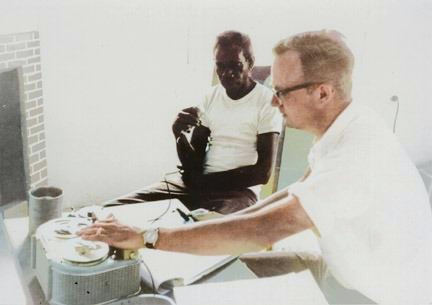
Ken Hale and Mick Connell Jupurrula, 1966–67

In this episode, we talk to Mary Laughren about research into the languages of Central Australia in the mid-twentieth century, with a focus on the contributions of American linguist Ken Hale.

Read more ›
Posted in Podcast

Recent publications in the history and philosophy of the language sciences – June 2023

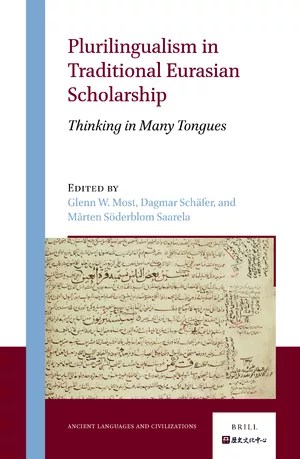
Most, Glenn W., Dagmar Schäfer & Mårten Söderblom Saarela, ed. 2023. Plurilingualism in Traditional Eurasian Scholarship. Thinking in Many Tongues. Leiden: Brill. (Ancient Languages and Civilizations, 3). xvi, 484 p. ISBN 978-90-04-46466-7
Publisher’s website
Book in open access

Was plurilingualism the exception or the norm in traditional Eurasian scholarship? This volume presents a selection of primary sources—in many cases translated into English for the first time—with introductions that provide fascinating historical materials for challenging notions of the ways in which traditional Eurasian scholars dealt with plurilingualism and monolingualism. Comparative in approach, global in scope, and historical in orientation, it engages with the growing discussion of plurilingualism and focuses on fundamental scholarly practices in various premodern and early modern societies—Chinese, Indian, Mesopotamian, Jewish, Islamic, Ancient Greek, and Roman—asking how these were conceived by the agents themselves. The volume will be an indispensable resource for courses on these subjects and on the history of scholarship and reflection on language throughout the world.

Read more ›
Posted in Publications, Uncategorized

Podcast episode 33: Formalism and distributionalism

In this episode, we examine the formalist aspects of the linguistic work of Edward Sapir and Leonard Bloomfield, and see how their methods were turned into the doctrines of distributionalism by the following generation.

Read more ›
Posted in Podcast

Recent publications in the history and philosophy of the language sciences – May 2023

Cavaliere, Ricardo. 2023. História da gramática no Brasil, séculos XVI a XIX. São Paulo: Editora Vozes. 656 p. ISBN 9786557136348
Publisher’s website

A origem da gramática está no interesse de compreensão e interpretação do texto, seja o texto poético, o texto religioso ou o texto político. Foi essa motivação, por exemplo, que levou os gramáticos gregos a desenvolverem a arte de gramática ou techne grammatike que daria conta dos textos de Homero e possibilitaria seu melhor entendimento. Assim evoluiu a gramática até nossos dias, ampliando seus domínios e objetivos, mas sempre de alguma forma vinculada à análise do texto como uma forma de entender o mundo. Em sua história, a gramática acompanha os rumos da sociedade, ajusta-se a suas mudanças e a seus novos valores. Este livro trata do papel da gramática na construção da sociedade brasileira a partir do século XVI, como fruto da atividade missionária dos jesuítas, até o final do século XIX, quando expressa o esplendor do cientificismo na seara dos estudos linguísticos. Seu propósito, pois, resume-se a contribuir para melhor entendermos como a sociedade brasileira abriu as sendas de seu caminho mediante análise das obras que cuidaram da língua falada por seu povo.

Read more ›
Posted in Publications

Cfp – SHESL conference 2024 – Ethnolinguistics – Linguistic anthropology: history and current trends

Call for papers
SHESL conference 2024
Ethnolinguistics – Linguistic anthropology: history and current trends
organized by Chloé Laplantine (HTL), Cécile Leguy (Université Sorbonne Nouvelle – LACITO), Valentina Vapnarsky (LESC & EPHE)

Paris, 1-2 February, 2024

Please send abstracts for contributions by 21 July 2023 to shesl2024@listes.u-paris.fr
Abstracts should be around 250 words long and include a bibliography.

Information: https://shesl.org/index.php/en/conference-2024/ and shesl2024@listes.u-paris.fr

Conference description
Linguistic anthropology is one of four research fields belonging to anthropology in the North American tradition, along with archeology, physical anthropology, and socio-cultural anthropology; this organization is commonly recognized as originating with Franz Boas, though the historical situation is in fact somewhat more complex (Hicks 2013).  As a result, the work of linguistic anthropologists has been diffused in conferences and journals devoted to general anthropological study as well as in specialized conferences[1] and in journals such as Anthropological Linguistics (founded in 1959), Language in Society (1972), or The Journal of Linguistic Anthropology (1990).  In France, where the discipline was first called “ethnolinguistics”, works such as those of Geneviève Calame-Griaule or Bernard Pottier, the cross-fertilizations between linguistics and anthropology effected by Émile Benveniste, Roman Jakobson, and Claude Lévi-Strauss, as well as the influence of the British and American traditions, have given rise to a tradition made both specific and complex by the multiple approaches it has interwoven.  The field of ethnolinguistics witnessed important developments in France during the 1970s and 1980s[2], leading to the founding and federating of research groups[3] and journals[4].  At present, at least five research seminars in ethnolinguistics or linguistic anthropology are active in Paris, a sign of the continuing vitality of this field of study.

Read more ›
Posted in Conferences and workshops, Uncategorized

Upcoming events


2-4 September 2026
Nottingham (UK)
Henry Sweet Society Colloquium 2026
(Non-)Native Speakers in the History of Linguistic Ideas


10-11 September 2026
Fribourg (Switzerland)
The Prague Linguistic Circle in Geneva and Paris: Circulations and Decenterings


19-21 November 2026
Sofia (Bulgaria)
La linguistique ‘fonctionnelle’ cent ans après la fondation du Cercle linguistique de Prague


28-29 January 2027
Paris (France)
SHESL Conference 2027
History of terminology – Diachronic terminology The emergence of a terminological conscienceness


31 March–3 April 2027
Vigo (Spain), Vila Real (Portugal)
13th International Conference on Missionary Linguistics


23-27 August 2027
Niterói, Rio de Janeiro (Brazil)
ICHoLS XVII