In this episode, we discuss the leading American linguist Leonard Bloomfield and his connections to the psychological school of behaviourism and the philosophical doctrines of logical positivism.
Read more ›
In this episode, we discuss the leading American linguist Leonard Bloomfield and his connections to the psychological school of behaviourism and the philosophical doctrines of logical positivism.
Read more ›James McElvenny, ed. 2023. The Limits of Structuralism. Forgotten Texts in the History of Modern Linguistics. Oxford: Oxford University Press. 336 p. ISBN 9780192849045
Publisher’s website
Based around seven primary texts spanning 130 years, this volume explores the conceptual boundaries of structuralism, a scholarly movement and associated body of doctrines foundational to modern linguistics and many other humanities and social sciences. Each chapter in the volume presents a classic â and yet today underappreciated â text that addresses questions crucial to the evolution of structuralism. The texts are made accessible to present-day English-speaking readers through translation and extensive critical notes; each text is also accompanied by a detailed introduction that places it in its intellectual and historical context and outlines the insights that it contains. The volume reveals the complex genealogy of our ideas and enriches our understanding of their contemporary form and use.
Read more ›
In this episode, we explore the historical background to linguistic relativity or the so-called ‘Sapir-Whorf hypothesis’.
Read more ›
This clip is a brief audio update on what’s been happening with the podcast, and what’s going to happen in the next few months.
Read more ›Zanna Van Loon, John Steckley, Toon Van Hal, Andy Peetermans, eds. 2023. Anchored in ink: Pierre-Philippe Potierâs Elementa Grammaticae Huronicae (1745), a Jesuit grammar of Wendat. Potsdam: UniversitĂ€tsverlag Potsdam. 446 p.
ISBN 978-3-86956-516-3. DOI : https://doi.org/10.25932/publishup-51306
Book in open access
Publisher’s website
This book serves as a gateway to the Elementa grammaticae Huronicae, an eighteenth-century grammar of the Wendat (âHuronâ) language by Jesuit Pierre-Philippe Potier (1708â1781). The volume falls into three main parts. The first part introduces the grammar and some of its contexts, offering information about the Huron-Wendat and Wyandot, the early modern Jesuit mission in New France and the Jesuitsâ linguistic output. The heart of the volume is made up by its second part, a text edition of the Elementa. The third part presents some avenues of research by way of specific case studies.
Read more ›Lorenzo Cigana & Frans Gregersen, ed. 2023. Structuralism as one â structuralism as many – Studies in Structuralisms. Copenhagen: Gads Forlag. 560 p. ISBN 9788773044476
Publisher’s website
This book includes 14 contributions to the study of structuralism as a historical current in the history of European ideas and more particularly in the study of language. The studies combine to contextualize structuralism in both its unity and its diversity, hence the title. In the first section, the reader is introduced to the broader canvas of disciplines and competing ideas surrounding structuralism, starting with Claude LĂ©vi-Straussâs anthropological structuralism. The second section views structural linguistics from without and investigates its legacy in relation to contemporary linguistics, analyzing its relationship to functionalism and its forerunners. The third section explores structuralism from within, with particular attention to a specific output: Louis Hjelmslevâs theory of glossematics. This constitutes the focus from where the immediate past within the Danish tradition is reanalyzed and its heritage for todayâs semiotics and linguistics is discussed.
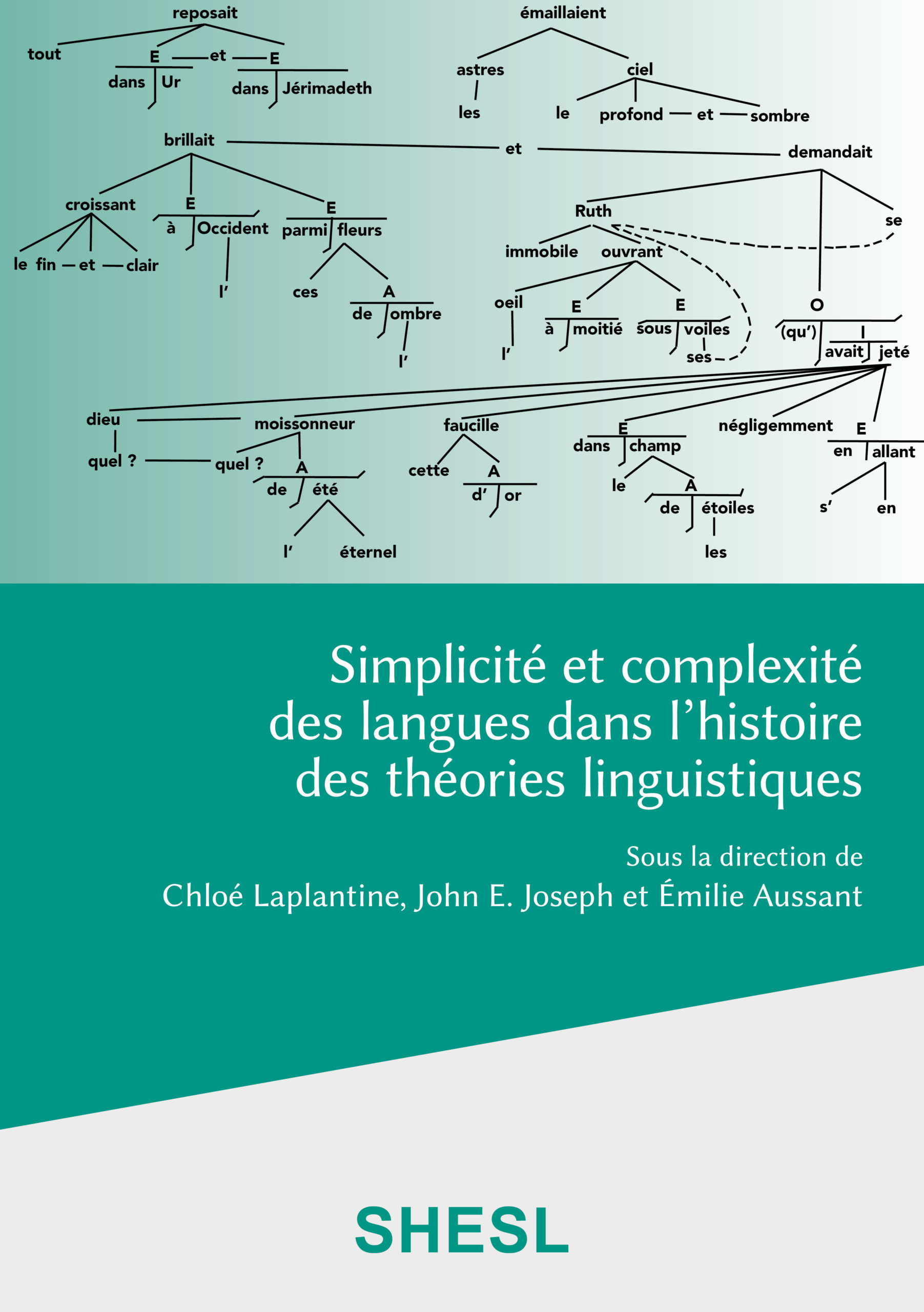
Read more ›Danielle Candel, Didier Samain & Dan Savatovsky, ed. 2023. Eugen WĂŒster et la terminologie de lâĂ©cole de Vienne. Paris : SHESL (HEL Livres, 2). 338 p. ISBN 979-10-91587-18-1. DOI : 10.5281/zenodo.7503185
Book in open access
Publisher’s website
La terminologie, avec ses analyses thĂ©oriques et ses applications, reprĂ©sente un secteur multidisciplinaire, qui sâest dĂ©veloppĂ© parallĂšlement aux progrĂšs scientifiques ou industriels et aux Ă©changes internationaux. Rares restent toutefois les linguistes ou les Ă©pistĂ©mologues et historiens de la linguistique bien au fait des terminologies ou des langues de spĂ©cialitĂ© et de leurs sources. Cet ouvrage rassemble les actes du colloque organisĂ© par la SHESL (Paris, 3-4 fĂ©vrier 2006) oĂč lâon se proposait de faire connaĂźtre plus largement le fondateur de la terminologie contemporaine, Eugen WĂŒster (1898-1977), et de mettre Ă la disposition dâun public plus important une documentation qui Ă©tait et demeure souvent inĂ©dite, ou seulement disponible en allemand.
WĂŒster Ă©tait dâabord un ingĂ©nieur, prĂ©occupĂ© dâobjets industriels et soucieux dâen proposer une description normĂ©e, mais on aurait tort dâimputer une attitude normalisatrice rigide et rĂ©ductrice Ă un terminologue qui inclut au contraire dans sa dĂ©marche des rĂ©flexions linguistiques prenant en compte un large spectre de variations langagiĂšres. Ajoutons que ses Ă©crits signalent un rĂ©el souci pĂ©dagogique, dont il serait dommage de continuer Ă priver les chercheurs. Le prĂ©sent ouvrage dĂ©gage les principales thĂšses linguistiques et Ă©pistĂ©mologiques dĂ©veloppĂ©es par WĂŒster et prĂ©sente lâĂ©cole viennoise de terminologie et sa portĂ©e actuelle.
MichaĂ«l Crevoisier & AurĂ©lien Galateau, ed. 2022. Langage et IdĂ©ologie. Penser le devenir de la langue avec Klemperer. Nice : Ăditions Unes. Unes IdĂ©e. 184 p. ISBN 978-2-87704-251-2,
Publisher’s website
Depuis une vingtaine d’annĂ©es, on commence Ă mieux connaĂźtre en France la vie et l’Ćuvre de Victor Klemperer, ce philologue juif allemand qui a dĂ©cryptĂ© la langue du TroisiĂšme Reich et lui a miraculeusement survĂ©cu. Ses carnets, dans lesquels il a consignĂ© pendant plus d’une dĂ©cennie les distorsions que les nazis faisaient subir Ă la langue allemande, sont devenus un document incontournable pour saisir ce qu’est le totalitarisme.
L’expĂ©rience singuliĂšre et tragique de cet homme qui a trouvĂ© son salut dans l’Ă©tude obsessionnelle de l’idiome nazi est ici le point de dĂ©part d’une rĂ©flexion sur la situation actuelle du langage. Pour peu qu’on l’Ă©coute vraiment, la langue dit toujours la vĂ©ritĂ© d’une Ă©poque. Ă travers ses transformations, dans la confusion des sentiments et lâambiguĂŻtĂ© des mots, s’imposent certaines idĂ©es et reprĂ©sentations qu’on a longtemps qualifiĂ©es d’idĂ©ologie avant que ce terme ne tombe en disgrĂące. Cet ouvrage collectif entreprend de montrer les modalitĂ©s suivant lesquelles l’idĂ©ologie se dĂ©ploie aujourd’hui, en croisant lâapproche linguistique hĂ©ritĂ©e de Klemperer, la tradition critique en sciences sociales qui a su historiquement la conceptualiser, et une problĂ©matisation des systĂšmes techniques qui permet d’analyser l’automatisation du langage.
Faire de Klemperer notre contemporain, c’est nous confronter au discours publicitaire et aux algorithmes du web mondialisĂ© en nous armant du principe d’exactitude qui guidait l’Ă©criture de son journal et « apprendre Ă se colleter Ă sa propre conscience, plutĂŽt que de surveiller celles des autres », comme nous y invite Walser.”
In this episode we talk to Andrew Garrett about the life, work and legacy of American anthropologist Alfred Kroeber. Kroeber achieved a number of firsts in American anthropology: he was Boas’ first Columbia PhD and the first professor of anthropology at the University of California, Berkeley. But Kroeber is not only of historical interest. The recent “denaming” of Kroeber Hall at UC Berkeley illustrates the clash of the past with our present-day social and political concerns.
Read more ›The XXXII International Colloquium of the Studienkreis ‘Geschichte der Sprachwissenschaft'” (SGdS) will be held at the Universidade de TrĂĄs-os-Montes e Alto Douro (UTAD, Vila Real, Portugal) from Wednesday, September 6 to Saturday September 9, 2023.
The general theme of the colloquium is: Controversies in the history of linguistics
From the beginnings of the teaching of classical or even modern languages up to the most recent times, there have always been polemical disputes between individual authors or even among representatives of entire schools, which could be reflected in many ways. Even if, in retrospect, not all controversies necessarily brought about the effects desired by their proponents, the area of conflict between long-established and novel considerations in the history of linguistics seems particularly worthy of investigation.
In addition, we also cordially invite papers dedicated to any topic in the History of Linguistics.
Presentations should not exceed the maximum duration of 20 minutes (allowing afterwards for up to 10 minutes of discussion). Proposals should be submitted to sgdsXXXII@utad.pt by 28 February 2023 and should contain the following information:
Name
Institutional affiliation (if any)
email address
and abstract (ca. 250 words, written in the language the paper will be presented in).
Notification of acceptance will be made by 31 March 2023.
Please note that the 2023 Annual Colloquium 2023 of the Henry Sweet Society for the History of Linguistic Ideas (HSS) will take place in Vila Real from 4-6 September 2023. Active participation in both Colloquia is cordially invited.