In this episode, we talk to Mary Laughren about research into the languages of Central Australia in the mid-twentieth century, with a focus on the contributions of American linguist Ken Hale.
Read more ›
In this episode, we talk to Mary Laughren about research into the languages of Central Australia in the mid-twentieth century, with a focus on the contributions of American linguist Ken Hale.
Read more ›Most, Glenn W., Dagmar Schäfer & Mårten Söderblom Saarela, ed. 2023. Plurilingualism in Traditional Eurasian Scholarship. Thinking in Many Tongues. Leiden: Brill. (Ancient Languages and Civilizations, 3). xvi, 484 p. ISBN 978-90-04-46466-7
Publisher’s website
Book in open access
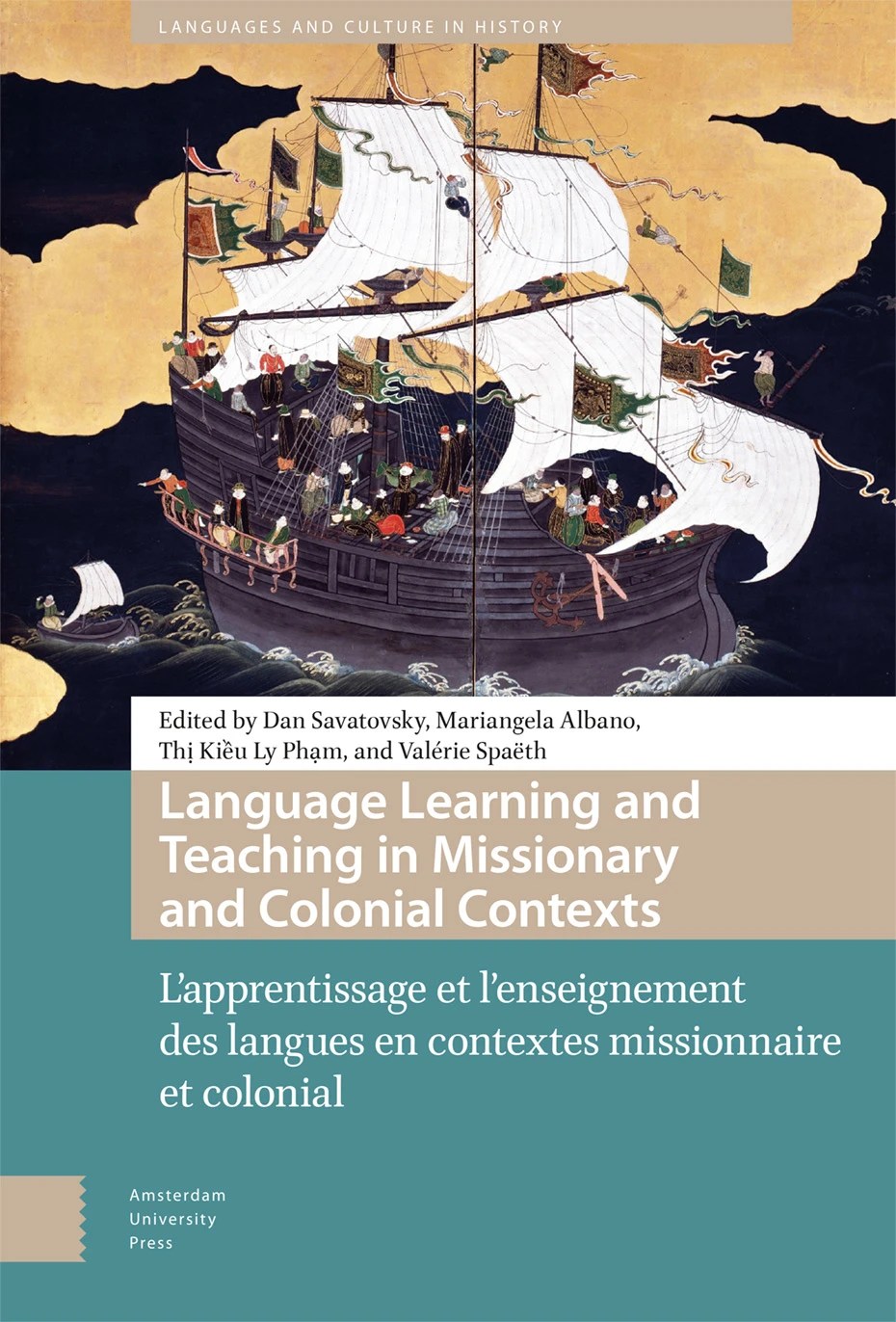
Was plurilingualism the exception or the norm in traditional Eurasian scholarship? This volume presents a selection of primary sources—in many cases translated into English for the first time—with introductions that provide fascinating historical materials for challenging notions of the ways in which traditional Eurasian scholars dealt with plurilingualism and monolingualism. Comparative in approach, global in scope, and historical in orientation, it engages with the growing discussion of plurilingualism and focuses on fundamental scholarly practices in various premodern and early modern societies—Chinese, Indian, Mesopotamian, Jewish, Islamic, Ancient Greek, and Roman—asking how these were conceived by the agents themselves. The volume will be an indispensable resource for courses on these subjects and on the history of scholarship and reflection on language throughout the world.
Read more ›
In this episode, we examine the formalist aspects of the linguistic work of Edward Sapir and Leonard Bloomfield, and see how their methods were turned into the doctrines of distributionalism by the following generation.
Read more ›Cavaliere, Ricardo. 2023. História da gramática no Brasil, séculos XVI a XIX. São Paulo: Editora Vozes. 656 p. ISBN 9786557136348
Publisher’s website
A origem da gramática está no interesse de compreensão e interpretação do texto, seja o texto poético, o texto religioso ou o texto político. Foi essa motivação, por exemplo, que levou os gramáticos gregos a desenvolverem a arte de gramática ou techne grammatike que daria conta dos textos de Homero e possibilitaria seu melhor entendimento. Assim evoluiu a gramática até nossos dias, ampliando seus domínios e objetivos, mas sempre de alguma forma vinculada à análise do texto como uma forma de entender o mundo. Em sua história, a gramática acompanha os rumos da sociedade, ajusta-se a suas mudanças e a seus novos valores. Este livro trata do papel da gramática na construção da sociedade brasileira a partir do século XVI, como fruto da atividade missionária dos jesuítas, até o final do século XIX, quando expressa o esplendor do cientificismo na seara dos estudos linguísticos. Seu propósito, pois, resume-se a contribuir para melhor entendermos como a sociedade brasileira abriu as sendas de seu caminho mediante análise das obras que cuidaram da língua falada por seu povo.
Read more ›Call for papers
SHESL conference 2024
Ethnolinguistics – Linguistic anthropology: history and current trends
organized by Chloé Laplantine (HTL), Cécile Leguy (Université Sorbonne Nouvelle – LACITO), Valentina Vapnarsky (LESC & EPHE)
Paris, 1-2 February, 2024
Please send abstracts for contributions by 21 July 2023 to shesl2024@listes.u-paris.fr
Abstracts should be around 250 words long and include a bibliography.
Information: https://shesl.org/index.php/en/conference-2024/ and shesl2024@listes.u-paris.fr
Conference description
Linguistic anthropology is one of four research fields belonging to anthropology in the North American tradition, along with archeology, physical anthropology, and socio-cultural anthropology; this organization is commonly recognized as originating with Franz Boas, though the historical situation is in fact somewhat more complex (Hicks 2013). As a result, the work of linguistic anthropologists has been diffused in conferences and journals devoted to general anthropological study as well as in specialized conferences[1] and in journals such as Anthropological Linguistics (founded in 1959), Language in Society (1972), or The Journal of Linguistic Anthropology (1990). In France, where the discipline was first called “ethnolinguistics”, works such as those of Geneviève Calame-Griaule or Bernard Pottier, the cross-fertilizations between linguistics and anthropology effected by Émile Benveniste, Roman Jakobson, and Claude Lévi-Strauss, as well as the influence of the British and American traditions, have given rise to a tradition made both specific and complex by the multiple approaches it has interwoven. The field of ethnolinguistics witnessed important developments in France during the 1970s and 1980s[2], leading to the founding and federating of research groups[3] and journals[4]. At present, at least five research seminars in ethnolinguistics or linguistic anthropology are active in Paris, a sign of the continuing vitality of this field of study.
Université Paris Cité, the host institution for the Histoire des théories linguistiques (HTL; https://htl.cnrs.fr/en/home/) research group, has earmarked PhD funding for international students starting this year.
Students will register at the Linguistics Department (https://u-paris.fr/linguistique/en/home/#pll_switcher), and be supervised by a member of HTL.
For some possible PhD (or MA) topics and a list of HTL researchers able to supervise dissertations, please see https://htl.cnrs.fr/formation/theses/ Any other member of the research group (https://htl.cnrs.fr/equipe/) can co-supervise a PhD student. Funding is for 3 years. Knowledge of French is helpful but not necessary. Dissertations can be written in English or French.
Please contact any member of the research group before June 7th if interested. Finalized proposals must be submitted to the doctoral school by June 23rd; interviews (zoom possible) will be held on July 3rd.
In this episode, we discuss the leading American linguist Leonard Bloomfield and his connections to the psychological school of behaviourism and the philosophical doctrines of logical positivism.
Read more ›James McElvenny, ed. 2023. The Limits of Structuralism. Forgotten Texts in the History of Modern Linguistics. Oxford: Oxford University Press. 336 p. ISBN 9780192849045
Publisher’s website
Based around seven primary texts spanning 130 years, this volume explores the conceptual boundaries of structuralism, a scholarly movement and associated body of doctrines foundational to modern linguistics and many other humanities and social sciences. Each chapter in the volume presents a classic — and yet today underappreciated — text that addresses questions crucial to the evolution of structuralism. The texts are made accessible to present-day English-speaking readers through translation and extensive critical notes; each text is also accompanied by a detailed introduction that places it in its intellectual and historical context and outlines the insights that it contains. The volume reveals the complex genealogy of our ideas and enriches our understanding of their contemporary form and use.
Read more ›
In this episode, we explore the historical background to linguistic relativity or the so-called ‘Sapir-Whorf hypothesis’.
Read more ›
This clip is a brief audio update on what’s been happening with the podcast, and what’s going to happen in the next few months.
Read more ›