
Lia Formigari
Sapienza Università di Roma
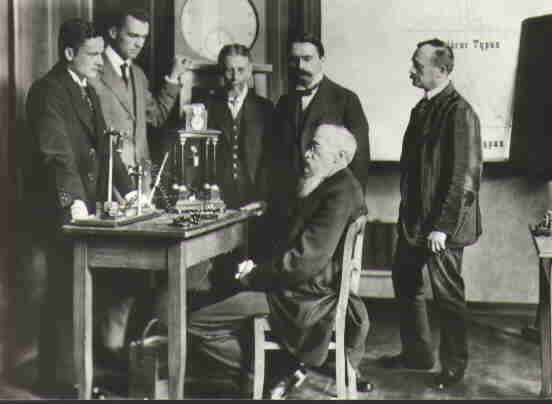
Wilhelm Wundt (centre) with his research group, ca. 1880 (source: Wikimedia Commons)
A long-dominant historiographical tradition, culminating in Hugo Schuchardt’s essay Über die Lautgesetze (1885), depicted the Neogrammarians as the irreducible upholders of the unconditioned validity of phonetic laws. It is my view that, if we reconsider the theories of the Neogrammarians today, this representation should be radically revised. Instead of the long review that would be necessary to document the pros and cons of Schuchardt’s interpretation, I will limit myself to citing August Leskien’s Introduction to his Declination im Slawisch-Litauischen und Germanischen (1876), which contains an early and never disputed enunciation of the principle of the exceptionlessness (Ausnahmslosigkeit) of phonetic laws and of the way it must be understood:
I started […] from the principle according to which the form of a case in the way it has been transmitted to us is never the result of an exception to otherwise valid phonetic laws. To avoid any misunderstanding I would add the following: if by exception we mean the cases in which the expected phonetic change has not occurred due to specific and identifiable causes […] – that is, when a rule interferes to some extent with another one – nothing evidently contradicts the principle that phonetic laws have no exceptions. The law is still present and when this or that disturbing factor – that is, the action of other laws – is not present, it continues to operate as expected. If instead we admit to random exceptions, of whatever nature, that can in no way be related among themselves, we are basically saying that the object at hand, that is language, is not accessible to scientific knowledge. (Leskien 1876: xxviii)
Basically, Leskien is enunciating the principle, shared after him by all Neogrammarians, that there are factors that can interfere with the regularity of phonetic laws. When this happens, these factors can in principle be identified. So long as the exceptions can be explained the law in itself has not been invalidated. The point, therefore, is not that there are no exceptions to sound laws. It is rather that there are no exceptions that cannot be explained in terms of some other cause, at least in principle. Based on this interpretation, the Neogrammarian principle of the exceptionlessness of phonetic laws can be summarized as a methodological principle: the exceptions that systematically interfere with the regularity of a law can also be explained on the basis of other causes. This principle is a necessary condition for any scientific study of language phenomena. In other words, it is the prerequisite for a transition from an historico-descriptive linguistics of individual languages or language families to a general linguistics.
This notion of the relation between regularities and exceptions was not enunciated ad hoc for linguistics. Rather, it was a general epistemological principle common to both the empirical psychology of the first half of the century (see, for example, Eduard Beneke, [1832] 41877: 14) and later scientific philosophical trends. John Stuart Mill’s Logic, popular in Germany, and Ernst Mach’s theories, supported this principle. The validity of a law rests on its heuristic value in a given context and does not exclude exceptions, which must be explained as the result of other laws or causes.
Wilhelm Wundt interprets the position of Neogrammarians well when, in his essay Ueber den Begriff des Gesetzes (1886), he attributes to them this notion of “law”. His essay was a response to Hugo Schuchart, who had extended his attack on Neogrammarians to Wundt as one of their supporters. Schuchardt’s essay established the image of the Neogrammarians as the dogmatic asserters of the exceptionlessness of phonetic laws, an image that remained almost undisputed until the first half of the twentieth century and beyond. But if we read today, with the hindsight that is the privilege of historians, the Neogrammarians’ texts, first and foremost Hermann Paul’s Prinzipien, the impression we get is rather that of a collective elaboration of a method for a general linguistics. Read more ›





 History and Philosophy of the Language Sciences


