Panel proposal for The Making of the Humanities VII, Amsterdam, 15-17 November 2018.
For the upcoming 7thThe Making of the Humanities Conference, to be held in Amsterdam from November 15-17 2018 (link) I am contemplating to submit a panel session under the title “Linguistics as a Go-Between”. The theme of this session will be the interaction of linguistics with other fields of study. While perhaps all academic disciplines have at some point exchanged theories, concepts, metaphors, methods, instruments, etc. with other (proto-) disciplines in the course of their existence, the extent to which this epistemic transfer has occurred with respect to the study of language appears to be exceptional. This has of course not gone unnoticed in the historiography of linguistics, and many cases of the interaction of linguistics with for example biology, anthropology, psychology, chemistry, information science and of course the humanistic disciplines such as philology, history, etc. have been documented. Yet, the vast majority of these studies remain ‘isolated’, in the sense that they are not compared to other case studies of epistemic transfer with the aim to gain a deeper understanding of the phenomenon itself. In this respect a general picture of the history of linguistics is thus lacking. Read more ›
My purpose in this piece is to offer a few brief thoughts on a series of questions with which I have become increasingly interested in recent months. Linguistics, it seems to me, is awash with theories and theoretical work of various sorts, yet it is not all that often that one comes across any critical scrutiny of the theoretical enterprise itself. The basic question motivating my discussion can be put thus: why theorise language? In other words, what motivates the theoretical enterprise in relation to language and what sustains it? This sets in train a series of further questions. Why is there apparently such faith, amongst language scholars at least, in theory? What does theory contribute to our understanding of a human phenomenon? Is it genuine, previously unavailable knowledge or simply a different and perhaps also professionally advantageous way of talking about it? Are theoretical enterprises generated and propelled by genuine intellectual puzzles or anomalies that challenge our settled conception of the world or more by particular ambitions? Or is it the case that where language is concerned theory tends instead to generate merely its own internal puzzles – academic questions in the most pejorative sense of the word? This raises the issue of how, why and by whom particular theories of language come to be valued, which in turn potentially prompts questions which take on a more sceptical tone such as ‘is it possible to theorise language without somehow giving a distorted view or misrepresenting it?’ or even ‘what do we lose sight of by submitting language to theoretical treatment?’ Read more ›
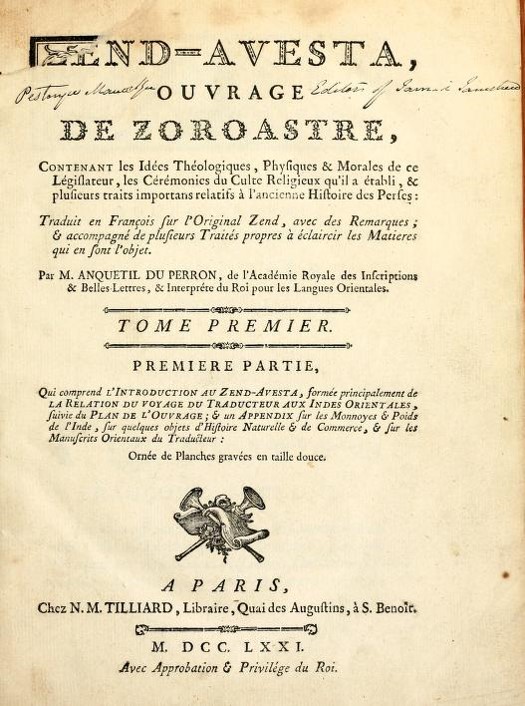
Abraham-Hyacinthe Anquetil-Duperron, Zend-Avesta, ouvrage de Zoroastre, vol. I (1771), title page (source)
In 1771, a French scholarly adventurer by the name of Abraham-Hyacinthe Anquetil-Duperron shocked the Republic of Letters with his translation of Zend-Avesta, Ouvrage de Zoroastre. Published in three volumes with a long series of appendices and a book-length introduction about Anquetil’s travels in India, it offered the first known example of a monotheistic text with no direct relation to Judaism, Christianity, or Islam.
The shock was not that there was a Persian prophet called Zoroaster; his name had been known in Europe since antiquity. (Modern-day readers may know him as Nietzsche’s Zarathustra or Mozart’s Sarastro.) He had been portrayed as an ‘Eastern sage’ from Pico della Mirandola and Marsiliano Ficino to Jacob Brucker’s mid-18th century history of philosophy, and Hyde in Oxford already possessed an Avestan manuscript which had inspired Anquetil’s journey to India in the first place. The shock was that the Zend-Avesta was not a work of prisca theologia or philosophia perennis but a liturgy, at once strangely familiar and uncannily remote, written in a dead language that no one in Europe except Anquetil could read.
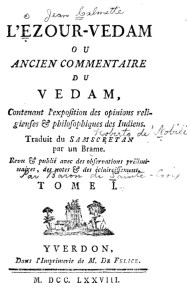
[Jean Calmette], [Guillaume de Sainte-Croix, ed.], Ezour-Védam ou Ancien commentaire du Védam (1778), title page (source)
Anquetil was duly attacked as a fraud. There was reason for scepticism, for the learned world was grappling with other hoaxes. It had been a mere decade since the Scottish crook MacPherson had won literary fame with his volumes of the songs of Ossian, the ‘Nordic Homer’ – and though MacPherson had been discredited and never showed the ‘old manuscripts’ that he had purportedly found in Scotland, he could still count Goethe and Napoleon among his admirers even after his death.[1] Anquetil himself had been led astray, together with Voltaire, by manuscripts of a supposedly ‘Vedic’ text with Christian undertones, fabricated by a Jesuit missionary, which was published in 1778 as L’Ezour-Vedam: ou, Ancien commentaire du Vedam, contenant l’exposition des opinions religieuses & philosophiques des Indiens.[2] The spectacular story of Anquetil’s oriental manuscript hunt, which included a duel, a flight through the jungle, and wheeling and dealing with the English and French in the middle of the Seven Years’ War, also raised eyebrows among more sedentary scholars.
The most malicious attack came from William Jones, then a budding young orientalist who had just finished a Persian grammar. In an anonymous Lettre à M. A*** du P***, he argued a) that Anquetil hardly knew enough modern Persian to communicate with his informants in Surat, and these Parsi priest themselves hardly understood the dead languages of their holy books (this was true); b) that Anquetil was an impolite and unreliable rascal (this was half-true); and c) that what he presented as the Zend-Avesta was too ‘absurd’, ‘tedious’, and ‘repetitive’ to be a genuine holy text. Read more ›
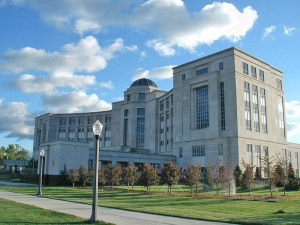
Michigan Supreme Court in the Hall of Justice. Source: Wikimedia Commons
Are lies information? This was the question before the Supreme Court of Michigan in a 2016 case (People v. Harris, based on a 2009 incident). A police officer was charged with pulling a motorist out of his car and beating him; he and two other police officers were charged with obstruction of justice for lying about what happened. Michigan law protects officers from self-incrimination by providing that “an involuntary statement made by a law enforcement officer, and any information derived from that involuntary statement, shall not be used against the law enforcement officer in a criminal proceeding.” The law further defines an involuntary statement as any information that might lead to dismissal from the force or other sanctions. The question before the court was: Are false statements information, and thus protected?
To answer the question the court turned first to dictionaries, following a trend that has increased dramatically since the mid-1980s. In the 1960s dictionaries were referenced in only sixteen opinions of the US Supreme Court; in the decade 2000–2010 dictionaries were cited in 225 opinions (Kirchmeier & Thumma 2010:85). The judicial philosophy of Strict Textualism, also referred to as Originalism and New Originalism, has spurred this lexicological turn. The late Justice Antonin Scalia was a leading proponent of this approach, which claims to seek the “original public meaning” of the Constitution and subsequent statutes. The justices attempt to assess how the public would have understood these texts at the time they were written. The alleged purpose of these efforts is to keep appointed judges from rewriting laws written and voted on by elected representatives (Solum 2011 and 2017 traces the twists and turns of this judicial philosophy). Read more ›
“PLATE: Portrait of Manuel J. Andrade (1885-1941)……Frontispiece” is the caption. This image, included at the beginning of the posthumously published “Materials on the Huastec Language” is the only photograph I have been able to locate of Andrade (Microfilm Collection of Manuscripts on Middle American Cultural Anthropology No. 9, University of Chicago Library, 1946); unfortunately, I cannot locate the manuscript or the original photograph.
While currently nearly unknown, Manuel J. Andrade (1885-1941)[1] is one of the central figures in the history of linguistics in the United States. He was a student of Boas at Columbia and an early methodological innovator in the use of audio recording technology for linguistic fieldwork. Following completion of his doctorate, it appears to have been Edward Sapir who recruited him for a joint position as a researcher with the Carnegie Institution of Washington and as Professor of Anthropology at the University of Chicago. At Chicago, not only did he serve as an intellectual and institutional link between anthropology and the then-emerging discipline of linguistics as organized under Leonard Bloomfield, but he also brought the social scientific study of language into critical relation with the theoretical projects of logical positivists like Carnap and semioticians like Morris. Insofar as he is known today, he is known for his extensive work, carried out under joint Carnegie-Chicago auspices, on the Mayan languages of Mexico and Guatemala. This work has formed the basis of much of subsequent Mayanist linguistics, as inherited through the intellectual lineage of Norman McQuown and those he trained.
This short essay does not provide a full biographic treatment of Andrade, nor does it lay out the full intellectual trajectory of his career as developed across his various projects. Rather, my purpose is to take a single illustrative work of Andrade and suggest how it relates to the contemporary works of his closest intellectual peers, Sapir and Bloomfield. Focusing on Andrade’s grammar of Quileute (1933), a language of the Northwest Coast,[2] this essay examines two particularly emblematic points of contact. The first of these points is clearly addressed to Sapir, and concerns how linguistic “drift” relates to cultural history more broadly; the second point seems implicitly addressed to Bloomfield, and concerns the notion of “function” as employed in the study of language. Both points, I will suggest, bespeak a broader shift of focus that Andrade envisioned for the study of language, a focus that can be found in his Quileute grammar, particularly where he diverges from Sapir and Bloomfield, and that his later (largely unpublished) work greatly elaborates. Most broadly, the analytic perspective that Andrade was developing takes the interactional context of language use as the relational locus between token speech signaling – treated as the historical product of the event-bound, idea-motivated action of speakers – and the sets of linguistic patterns that both orient and are oriented by the signal types so used.[3]Read more ›
‘The Making of the Humanities’ conference returns to Amsterdam! This is the place where the conference series started in 2008, 10 years ago. The University of Amsterdam will host the 7th Making of the Humanities conference at its CREA facilities, from 15 till 17 November 2018.
Goal of the Making of the Humanities (MoH) Conferences
The MoH conferences are organized by the Society for the History of the Humanities and bring together scholars and historians interested in the history of a wide variety of disciplines, including archaeology, art history, historiography, linguistics, literary studies, media studies, musicology, and philology, tracing these fields from their earliest developments to the modern day.
We welcome panels and papers on any period or region.
Deadline for paper and panel submissions: 1 June 2018
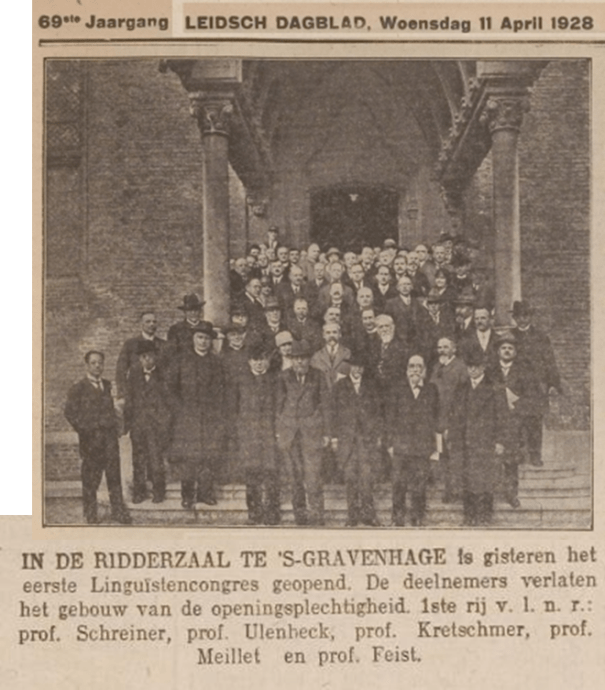
Newspaper cutting from Leidsch Dagblad, 1928, on the opening of the First International Congress of Linguists in The Hague. On the first row, from left to right, J. Schrijnen, C.C. Uhlenbeck, P. Kretschmer, A. Meillet, and S. Feist.
Why congresses?
The organisation of an international congress of a discipline marks a noteworthy stage in the development of a discipline. Taking a broader perspective, the many first disciplinary congresses held around 1900 also mark a significant stage in the institutionalisation and internationalisation of the disciplinary system in general. Historians have signalled a “wave of congresses” being held in numerous disciplines in both the humanities and the sciences throughout the nineteenth century and the start of the twentieth century. [1] Indeed, as Pascale Rabault-Feuerhahn and Wolf Feuerhahn show, the number of congresses in the nineteenth century is dizzying. [2] In another paper, Rabault-Feuerhahn gives an enumeration of reasons for the this phenomenon: improvement of transport and information infrastructure, foundation of intellectual societies on a national level, and rapid specialisations within disciplines. [3] The trend started in 1798 with the Congress on Definitive Metric Standards in Paris and fits in with the processes of modern discipline formation which are commonly attributed to the nineteenth century. [4]
At the congresses of the various disciplines, the scholars of the field from different nationalities would come together and discuss the status, future course and central problems of their discipline. In this way, the congresses were a means to go beyond the national backgrounds of the scholars and start to normalise the methods of the discipline. Certain theories or practices were validated thanks to the gathering of an international community, something which failed in the separate national contexts. The international congress could function as a judge in such cases. [5]
On the other hand, scholars could use the international congresses as a tool to show off not only their scholarship but also their country. Official representatives often honoured the congress with their presence and the hosts organised banquets and excursions to entertain the members of the congress in their country. Unsurprisingly for the prevailing nationalistic tendencies of the nineteenth century, nationalities definitely did play a role at the international congresses. International congresses could become a political tool, to endorse and to advertise national scholarship.
Not only do “the congresses define the discipline by defining who can and who cannot participate”, as Rabault-Feuerhahn and Feuerhahn claim, “but they also have the ambition to bring together once again the various options and subfields of the discipline. The return to an overall perspective is fundamental and studying this gives an insight in processes of professionalisation and discipline formation.” [6] Indeed, the scholars assembling at international congresses came from different backgrounds, both with respect to nationality and disciplinarity. At the congress, scholars from different subfields met and exchanged ideas, research and methods. We can thus see the congress as a site of communication. Even though the congresses played prominent roles in the development of specific disciplines, we need to study the congress from a multidisciplinary point of view to study the influence of cross-disciplinary interactions. As Bart Karstens argued in his post of March 2017, the history of linguistics provides a useful laboratory for this kind of research.
This blog post discusses the first International Congress of Linguists, held in The Hague in 1928. We will look at who organised and who attended the congress, what topics were dealt with, and what the linguists decided as the international organisation of their discipline. This will tell us more about the development of the discipline of general linguistics. As we will see, the scholars gathered from different countries and had different academic backgrounds and interests. These backgrounds ranged from philology to anthropology, and from dialectology to psychology, illustrating the multidisciplinary background of the discipline of general linguistics. Even though the scholars were all working on the study of language, they had different intents for and views of the methods used in the discipline. At the congress, these all came together and were debated. Read more ›
We are pleased to announce that the sixth biennial conference of the Society for the History of Linguistics in the Pacific (SHLP) is to be held on December 13th-14th 2018 at the University of Adelaide. This conference is supported by the Research Unit for Indigenous Language at the University of Melbourne and the Centre of Excellence for the Dynamics of Language.
The theme of the conference – “philological fieldwork” – focuses on the theory, practice and rhetoric surrounding the documentation and analysis of “exotic” languages from the 19th to the early 20th century.
It is expected that invited international researchers will attend this sixth SHLP conference.
Abstracts, of less than 250 words, addressing any historical aspect of the collection and organisation of linguistic data are welcome. Abstracts should be sent to Clara Stockigt at the address below no later than the 30th April.
Selected papers treating the history of the development of linguistic understanding will be published in a collected volume. Read more ›
Der vorliegende Text ist ein Bericht aus den bisherigen Arbeiten und eine Erklärung einiger theoretischer Ansätze zu meiner wissenschaftshistorischen Dissertation, die folgenden Arbeitstitel trägt: “Die Verräumlichung der Sprache. Mundarten zwischen Visualisierung, Repräsentation und Expansion in der Dialektologie des Deutschen von 1918 bis 1955″. Diese Arbeit wird durch ein ÖAW-DOC-Stipendium finanziert, das ich am 1.12.2017 angetreten habe und dessen Laufzeit zwei Jahre beträgt. Zudem ist es mir möglich, im Rahmen des Go! Digital-Projektes Austrian Dialect Cartography 1924-1956. Digitalisation, Contextualisation, Visualisation in nunmehr überwiegend organisatorischer und koordinierender Funktion tätig zu sein, wobei ich dabei an der Abteilung “Variation und Wandel des Deutschen in Österreich” (Österreichische Akademie der Wissenschaften, ACDH) im angegebenen Projekt seit März 2017 arbeite.
Grundsätzliches: fehlende Selbst-Reflexion der (Sprach-)Wissenschaft, Meta-Theorie & Historische Epistemologie
Nicht wenige wissenschaftliche Disziplinen haben ein besonderes Manko, das paradox erscheint, da es eine wesentliche Tugend des Wissenschaftlichen bedeuten könnte, will man das Denken zum Zentrum von Forschung machen: die Wissenschaft reflektiert sich in vielen Punkten als soziales, politisches, bürokratisches, kurz: gesellschaftliches System nicht selbst. Die ebenso populäre wie provokante Einschätzung “Die Wissenschaft denkt nicht”[2] des Philosophen Martin Heidegger bekommt in diesem Zusammenhang einen großen Wahrheitsgehalt[3], fehlt doch in vielen Disziplinen eine grundsätzliche Beschäftigung mit den epistemologischen, also erkenntnistheoretischen Grundlagen von Wissenschaft in ihrer Zeichenhaftigkeit (Semiotizität), Struktur, Sozialität, Institutionalisierung und politischen Dimension, d.i. die kulturelle Praxis “Wissenschaft” in ihrer umfassenden Gesellschaftlichkeit.
“Und dieser Satz ‛Die Wissenschaft denkt nicht’, der viel Aufsehen erregte, […] bedeutet, die Wissenschaft bewegt sich nicht in der Dimension der Philosophie. Sie ist aber, ohne dass sie es weiß, auf diese Dimension angewiesen. Zum Beispiel die Physik. Bewegt sich im Bereich von Raum und Zeit und Bewegung. Was Bewegung, was Raum, was Zeit ist, kann die Wissenschaft als Wissenschaft nicht entscheiden. Die Wissenschaft denkt also nicht, das heißt sie kann gar nicht denken […] mit ihren Methoden. Ich kann nicht zum Beispiel physikalisch oder mit physikalischen Methoden sagen, was die Physik ist. Sondern was die Physik ist, kann ich nur denken, philosophierend sagen. ‛Die Wissenschaft denkt nicht’ ist kein Vorwurf, sondern ist nur eine Feststellung der inneren Struktur der Wissenschaft.” — Heidegger im Interview.
Paradox an diesem Nicht-Reflektieren ist zudem, dass die Wissenschaft sich im Bereich der Geisteswissenschaften aber gleichzeitig weitgehend mit sich selbst beschäftigt[4], jedoch, da staatlich gefördert, den Schritt in die Ökonomisierung der wissenschaftlichen Inhalte und Ergebnisse selten gehen oder wagen muss und somit ständig auf sich selbst referiert[5], ohne ihr Verhältnis zur Gesellschaft wirklich zum Thema zu machen.[6] Tagungen, Vorträge, Institute sind hauptsächlich für die scientific community und für Studenten bestimmt, selten für andere soziale Gruppen, die die einfache aber unangenehme Frage nach dem “Warum?” der Forschung stellen könnten. In den Fällen, in denen Forschung augenscheinlich auf und in die Gesellschaft wirkt (Medizin, Ingenieurwesen, Biotechnologie und andere naturwissenschaftliche Disziplinen) transzendiert Wissenschaft natürlich den eigenen Bereich. In vielen anderen Fällen “nützt” die Wissenschaft jedoch am meisten der Gesellschaft der Forschenden, womit sich das Paradoxon (zumindest teilweise) auflöst: wissenschaftliche Inhalte dienen als soziale Konvention[7] und Paradigmen in vielerlei Hinsicht besonders dem Erhalt, der Stabilisierung und Perpetuierung der eigenen sozialen Gruppe.[8]Read more ›



 History and Philosophy of the Language Sciences
