

In this episode, we talk to Jürgen Trabant about Wilhelm von Humboldt. Read more ›
In this episode, we talk to Jürgen Trabant about Wilhelm von Humboldt. Read more ›
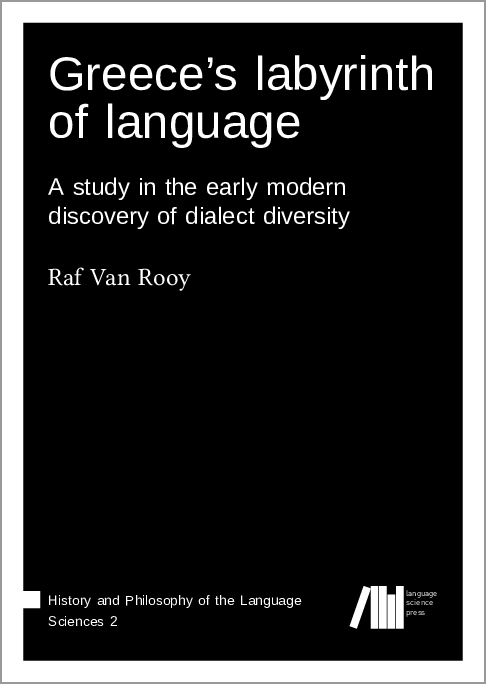
The latest book in the open access series History and Philosophy of the Language Sciences at Language Science Press is Raf Van Rooy’s Greece’s labyrinth of language: A study in the early modern discovery of dialect diversity.
This book can be downloaded for free from the Language Science Press website: Read more ›
Margherita Farina
Histoire des Théories Linguistiques (Paris)
What is Aramaic? In modern linguistic terms, we can say that Aramaic is a linguistic group, composed by dialectal varieties defined on a geographical, chronological and socio-cultural basis. For example, we speak about Imperial (or Official) Aramaic (6th-3rd cent. B.C.), for the Aramaic used at the Achemenid court and in the official documents of the Achemenid Empire, of Christian Palestinian Aramaic for the language spoken by the Chalcedonian Christian community of Palestine and Transjordan between the 5th-14th cent. A.D.[1]
When we say “Aramaic”, we make an abstraction on the basis of a number of common linguistic features, that are defined in opposition to other surrounding North-West Semitic languages and that cluster together, such as the form bar to say “son” as opposed to Hebrew and Phoenician ben or to Arabic bin/ibn, or the suffix form definite article –ā against the prefix definite article ha– in Hebrew or al– in Arabic, and so forth.[2]
However, Aramaic has accumulated through the centuries Read more ›
Jacques FRANCOIS (dir.). 2019. Les linguistes allemands du XIXème siècle et leurs interlocuteurs étrangers. Paris: Société de Linguistique de Paris. 220 p. ISBN: 978-2957089406
 Un siècle avant la parution posthume du Cours de linguistique générale de Ferdinand de Saussure, la linguistique moderne a émergé en Allemagne avec les études de Wilhelm von Humboldt pour la linguistique générale et (entre autres) de Franz Bopp, Jacob Grimm, August Schleicher et Karl Brugmann pour la grammaire historico-comparative des langues indo-européennes. Dès les années 1830, les instituts allemands de philologie et de linguistique ont attiré nombre de jeunes chercheurs de Scandinavie, de France, de Suisse, de Pologne, des USA, etc. Et avec la diffusion de la nouvelle “Science allemande” à l’étranger des échanges intenses se sont épanouis tout au long du XIXe siècle. Ce volume collectif, riche de neuf contributions d’historiens de la linguistique de France, d’Allemagne, de Suisse et des Pays-Bas, vise à retracer certains de ces échanges parmi les plus instructifs, notamment entre Franz Bopp et Michel Bréal, Max Müller et William Whitney, le psychologue Wilhelm Wundt et Albert Sechehaye ou Georg von der Gabelentz et Antoine Meillet. Des voies fécondes étaient ainsi ouvertes à la linguistique du XXe siècle en Europe et en Amérique. Read more ›

In this episode, we look at language classification in the first half of the nineteenth century and at some key ideas in the work of Wilhelm von Humboldt. Read more ›
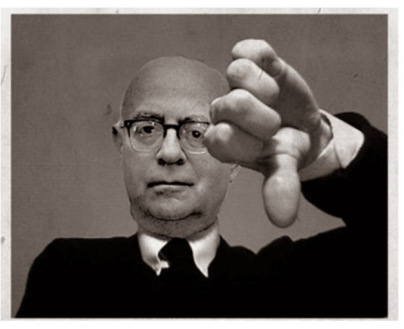
Diego Romeo
University of Edinburgh
The constellation of linguistic research broadly labelled as Critical Discourse Analysis (CDA) can hardly be understood as the homogeneous product of a monolithic theory or methodology. The variety of approaches employed by critical discourse analysts has in fact induced several scholars to prefer the term Critical Discourse Studies (CDS), which ceases to imply the existence of a methodological unity and hints instead at the diversity that characterises this kind of research. Indeed, as van Dijk (2013) has pointed out, “CDA is not a method of critical discourse analysis. […] Methodologically, CDA is as diverse as DA in general.”
This lack of clarity as to what really defines CDS may be due to its elusive object of study, as scholars in this tradition are “not interested in investigating a linguistic unit per se but in studying social phenomena which are necessarily complex and thus require a multi-disciplinary and multi-methodical approach” (Wodak & Meyer 2016: 2). Consequently, Wodak chooses to refer to CDS as a school or programme, instead of a discipline or method, but affirms that its research is nevertheless “derived from quite different theoretical backgrounds” (ibid.: 5). All of this seems to beg the question: What unifying elements tend to be shared by all CDS research? What makes the existence of a single label not just possible, but meaningful?
In contrast to other areas of linguistic study, CDS aims to explain linguistic facts and conventions “as the product of relations of power and struggles for power” (Fairclough 2001: 1). In this, CDS needs always to be goal- or problem-oriented, meaning that the research question determines the method that is selected to address it. If it is not a method or theory that unites scholars across CDS, then it must be the critical perspective from which problems are addressed. But what exactly does it mean to be ‘critical’? Should this term be seen in toto as a legacy of the work of the Frankfurt School or simply as a generic residue thereof which is shared with critical approaches in other disciplines? This uncertainty is a consequence of the variable emphasis placed on Critical Theory by different scholars. For van Dijk (2013), for example, “being critical […] is a state of mind, an attitude, a way of dissenting,” a definition that is so simplistic that it lacks an explicit connection to any theory, critical or not. On the other hand, McKenna (2004: 10) attributes to the “Frankfurt and neo-Marxian tradition” a foundational role in the formation of CDS, as do Wodak and Meyer (2016: 6), who openly acknowledge the influence of the work of the Institute for Social Research on CDS by pointing out its crucial role in shaping a “shared perspective,” and list two “core concepts” of Critical Theory that are relevant in the context of discourse analysis: the necessity to direct it at the totality of society in its historical specificity and the aim to ameliorate the understanding of society by integrating all the major social sciences. Read more ›
Friedemann Vogel, Fabian Deus & Clemens Knobloch
Universität Siegen
Der “Diskursmonitor” (www.diskursmonitor.de) ist ein disziplinenübergreifendes, webbasiertes Informations- und Dokumentationsportal zur strategischen Kommunikation in öffentlichen Diskursen.[1]
Das Portal richtet sich nicht nur an die Fachcommunity der Diskursforschung sowie verwandter Fachbereiche (etwa Sozial- und Kulturwissenschaften), sondern vor allem auch an PraktikerInnen aus Politik, Medien, Bildung, Justiz und Zivilgesellschaft. Sein Ziel ist erstens die bislang verstreute und nur innerakademisch zugängliche Diskursforschung aus verschiedenen Disziplinen im Hinblick auf ihre Essenz systematisch aufzubereiten und leichter zugänglich zu machen; zweitens sollen aktuelle diskursive Entwicklungen auf Basis qualitativer und computergestützter Verfahren aufgezeigt und damit verhandelbar werden; drittens werden Materialien und Handreichungen für den Einsatz in Lehr-Lern-Kontexten (Schulen, NGOs usw.) bereitgestellt.
Das Portal umfasst die folgenden vier Kernmodule: Read more ›
Simone AURORA (ed.). 2019. Acta Structuralica 4.
Publisher’s website
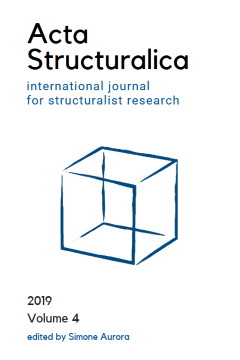
The fourth issue of Acta Structuralica contains new source materials from major figures: an unknown short publication by Saussure from 1896, edited and commented by Alesandro Chidichimo, as well 35 letters between Jakobson and Lévi-Strauss from the MIT Jakobson Papers, selected and commented by Pierre-Yves Testenoire. In addition, it offers the English translation of a key work by Hendrik Pos, “The notion of opposition in linguistics”, along with the (original) English version of an article by Patrick Flack available untilnow only in its German translation, and a new contribution on Tran Duc Thao by Jacopo D’Alonzo.

In this episode, we look at the emergence of comparative-historical grammar, focusing on the work of Franz Bopp and Jacob Grimm. Read more ›
Frederick J. Newmeyer
University of British Columbia, Simon Fraser University, and University of Washington
There are two stories about how the field of linguistics (at least in the United States) reacted sociologically to the advent of generative grammar. I call them the ‘historiographers’ story’ and the ‘official MIT story’. According to the historiographers’ story, Chomsky and Halle succeeded because they were able to capture the organs of power in the field, in particular, the Linguistic Society of America (LSA). Starting in the mid 1970s, quotations like the following became commonplace: Read more ›

 History and Philosophy of the Language Sciences