In this interview, we talk to Michael Ashby about the emergence and development of phonetics in the 19th and early 20th century.
Read more ›
In this interview, we talk to Michael Ashby about the emergence and development of phonetics in the 19th and early 20th century.
Read more ›

The 2021 annual colloquium of the Henry Sweet Society for the History of Linguistic Ideas will be held online on the 22-23 April 2021, hosted by the University of Westminster, London.
The programme is available here.
Registration (as an audience member) : LAS-exec-asst@westminster.ac.uk by Sunday 11th April 2021.
Website : https://www.henrysweet.org/2021-annual-colloquium
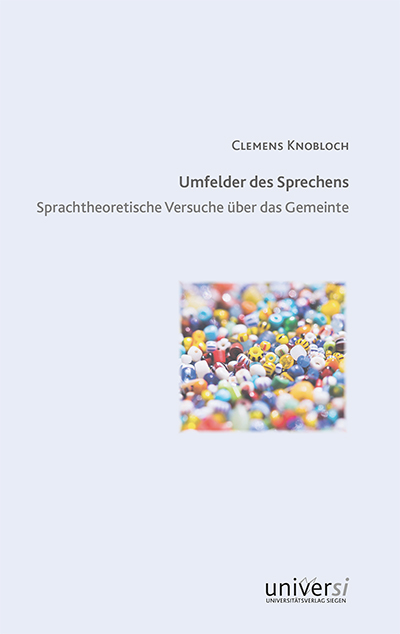
Knobloch, Clemens. 2020. Umfelder des Sprechens. Sprachtheoretische Versuche ĂŒber das Gemeinte. Siegen: universi. 360 p. ISBN : 978-3-96182-068-9
Publisher’s website

So lange man uns nicht danach fragt, können wir mit dem Gemeinten umgehen. Wenn wir es aber explizieren oder definieren sollen, geraten wir in Schwierigkeiten.
Die linguistische Semantik belehrt uns, dass es in keiner Sprache Zeichen gibt, die exakt den Zeichen einer anderen Sprache entsprechen. Sprachliche Bedeutungen sind es jedenfalls nicht, die wir meinen, sondern mit ihnen und durch sie hindurch immer etwas anderes, das selbst nicht zur Sprache gehört. Die Semantiker nennen es gern âReferenzâ und modellieren es als auĂersprachlichen Bezug der sprachlichen Kommunikation auf reale Dinge. Aber geht das Gemeinte wirklich auf in der Adresse eines singulĂ€ren Objekts der AuĂenwelt?
Der Band versucht, die sprach- und kommunikationswissenschaftliche Frage nach dem Gemeinten in der Tradition einer âLinguistik des Sprechensâ zu beantworten.
The book is available here.
The following are a selection of three talks on the history of linguistics in Australia originally delivered at the meeting of the Society for the History of Linguistics in the Pacific, December 2020.
Jane Simpson, Grammars for analysis, grammars for learners
William McGregor, From Herman Nekes notebooks to Nekes & Worms 1853
David Moore, Developments in grammatical analysis of Central Australian languages 1890â1910
In this interview, we talk to John Joseph about Ferdinand de Saussure.
Read more ›
The Paris Graduate School of Linguistics (PGSL) is a newly-formed Paris-area graduate program covering all areas of language science. It offers a comprehensive curriculum integrating advanced study and research, in close connection with PhD programs as well as with the Empirical Foundations of Linguistics consortium. Research plays a central part in the program, and students also take elective courses to develop an interdisciplinary outlook. Prior knowledge of French is not required (except for two MA specialties: ‘Teaching French as a Foreign Language’ and ‘Signs, Discourse, Society’.)
There will be five international student scholarships for 2021-2022 of 8000 euros/year for 1st or 2nd year MA students in linguistics (requirements: not having French nationality and not holding a French university degree). Depending on performance, 1st year MA students may be awarded a scholarship for their second year as well.
Read more ›
In this talk, Penny Lee presents some preliminary results from her research into the personal diaries of Benjamin Lee Whorf (1897â1941).
Read more ›
In this episode, we look at Ferdinand de Saussure’s contributions to linguistics, which are widely considered to be foundational to the later movement of structuralism.
Read more ›
In the excellent Abralin ao vivo series of online lectures, there have recently been a number of contributions that deal with the history of linguistics. Here is a selection for your edification and entertainment.
James McElvenny
Typology and the history of linguistics
Gonçalo Fernandes, Rogelio Ponce de Leon Roméo, Alessandro Jocelito Beccari
Historiografia LinguĂstica
John Goldsmith
Where did generative grammar come from, anyway?
Ămilie AUSSANT et Jean-Michel FORTIS, ed. 2021. Historical journey in a linguistic archipelago: Descriptive concepts and case studies. Berlin : Language Science Press. (History and Philosophy of the Language Sciences, 3). 212 p. ISBN : 978-3-96110-292-1
Publisher’s website
This volume offers a selection of papers presented during the 14th International Conference on the History of the Language Sciences (ICHoLS XIV, Paris, 2017). Part I brings together studies dealing with descriptive concepts. First examined is the notion of âaccidensâ in Latin grammar and its Greek counterparts. Other papers address questions with a strong echo in todayâs linguistics: localism and its revival in recent semantics and syntax, the origin of the term âpolysemyâ and its adoption through BrĂ©al, and the difficulties attending the description of prefabs, idioms and other âfixed expressionsâ. This first part also includes studies dealing with representations of linguistic phenomena, whether these concern the treatment of local varieties (so-called patois) in French research, or the import and epistemological function of spatial representations in descriptions of linguistic time. Or again, now taking the word ârepresentationâ literally, the visual display of grammatical relations, in the form of the first syntactic diagrams. Part II presents case studies which involve wider concerns, of a social nature: the âfrom belowâ approach to the history of Chinese Pidgin English underlines the social roles of speakers and the diversity of speech situations, while the scrutiny of Lhomondâs Latin and French textbooks demonstrates the interplay of pedagogical practice, cross-linguistic comparison and descriptive innovation. An overview of early descriptions of Central Australian languages reveals a whole spectrum of humanist to positivist and antihumanist stances during the colonial age. An overarching framework is also at play in the anthropological perspective championed by Meillet, whose socially and culturally oriented semantics is shown to live on in Benveniste. The volume ends with a paper on Tráș§n Äức TháșŁo, whose work is an original synthesis between phenomenology and Marxist semiology, wielded against the âidealisticâ doctrine of Saussure.
Read more ›