
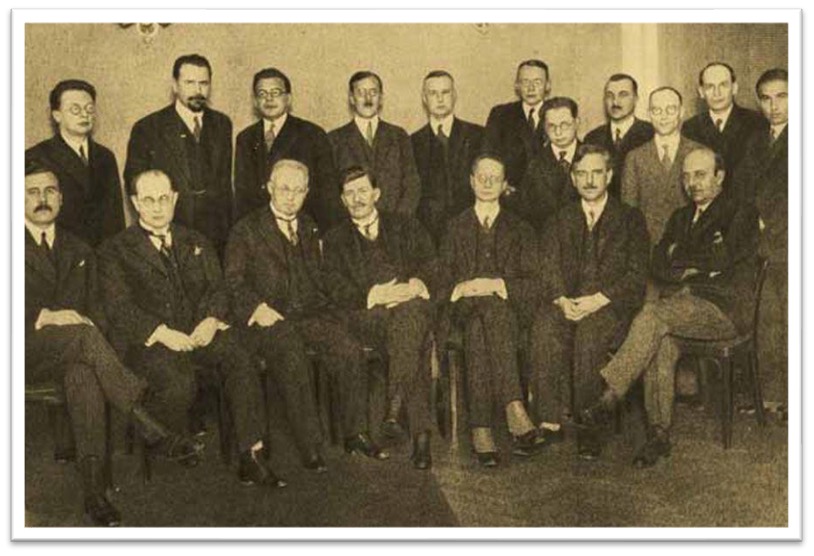
organised to celebrate the centenary of the Prague Linguistic Circle (1926-2026)
by the Europe-Eurasia Research Center (CREE-EA 4513) of INALCO
and
the History of Linguistic Theories Laboratory (HTL-UMR 7597, University of Paris, CNRS),
with the scientific support of the Institute for the Czech Language and Theory of Communication, Charles University (ÚČJTK).
10-11 December 2026
Paris, Inalco
To celebrate the centenary of the Prague Linguistic Circle, an international conference is being held at INALCO. Focusing on the relationships between language, norm and society, the conference will build on the Prague theoretical tradition while engaging with contemporary research in sociolinguistics, glottopolitics, language teaching, language contact, variation and typology. The aim is to examine how these notions have evolved since their initial formulation, and to evaluate their continued relevance in the context of contemporary linguistic studies.
Although the Prague Linguistic Circle is well known for its contributions to phonology, sign theory and poetics, its sustained attention to the relationships between language and society, and more specifically to the mechanisms of norm, standardisation, evaluation of correctness and language cultivation, has received less attention in international accounts (CLP; Havránek & Weingart, eds., 1932; Horálek & Scharnhorst, eds., 1976–82; Garvin, 1983, 1993a; Nebeská, 2003; Daneš, 2008; Raynaud, 2014; Vuković, 2015; Pešek, 2016).
During the interwar period, the Prague Linguistic Circle developed a set of concepts and theoretical tools aimed at understanding how a community shapes its language and how a language, conceived as a functional system, contributes to the organisation of cultural, political, educational and administrative life. This approach emerged at a time when Prague linguistics did not view itself merely as a descriptive science, but also as a form of interventionist linguistics. The focus was on the hierarchisation, stabilisation, transmission, correction and legitimisation of language use, and on how linguistic knowledge could shed light on these processes and participate in them (Havránek, 1929a; Havránek, 1929b; CLP, 1929a; CLP, 1929b; CLP; Havránek & Weingart, eds., 1932; Havránek, 1936; Havránek, 1938; Havránek, 1942; Jakobson, 1937; Mathesius 1933, 1935, 1941, 1942, Vočadlo, 1939; etc.). These orientations encourage us to reconsider the scope and limits of this interventionist stance and the changes it has undergone in subsequent linguistic traditions.
Within this framework, the Prague Linguistic Circle assigns a central role to a specific variety of Czech, taken as the basis of these reflections. This variety is referred to in Czech as spisovný jazyk, and is translated into English as either standard language or literary language. More recently, the term adopted here is literary standard language. The Circle emphasises the specific status of literary standard language as a codified and cultivated language defined primarily by its functions. It is intended to express cultural and intellectual life (scientific, philosophical and religious), as well as legal, administrative, political and social life within a given linguistic community. The aim is to achieve the highest possible degree of precision and functional universality, understood as the ability to operate across diverse domains.
However, this linguistic variety is not conceived as a homogeneous entity; rather, it is embedded within a broader theory of language as a system of variants structured by functions. The Prague Linguistic Circle thus distinguishes between functional languages, which are defined by the general purpose of a set of normative linguistic means, and functional styles, which are defined by the specific purpose of an utterance and its mode of expression. This distinction has direct consequences for the notion of correctness: it is impossible to establish a single variety or linguistic instrument as a universal model of correctness for all others since the relevant criterion is adequacy to purpose. This raises the question of how this functional conception of norm has been adopted, adapted, or debated in contemporary discussions on linguistic pluralism.
From this perspective, the norm is not merely a survival of tradition; it is the result of a process involving cultivated usage, shared implicit norms, collective refinement and codification in reference works. The Prague Linguistic Circle thus provides a framework for understanding standardisation as not only a top-down imposition, but also a socially constructed process articulated with practices and conscious intervention conceptualised as language cultivation. The evolution of this notion, its adaptations in different political contexts, and its possible reformulations in a context shaped by globalisation and digitalisation also constitute avenues for current reflection.
Another essential contribution of the Prague Linguistic Circle to discussions on ‘language and society’ concerns relations between languages. The Circle explores the tension between genetic relationships and structural similarities, developing a theory of linguistic affinities and associations, particularly in the works of Jakobson and Trubetzkoy. The central idea is that structural convergences may be independent of historical lineage, arising from proximity, coexistence or internal developmental tendencies. This approach offers a renewed perspective on contact, transfer and convergence (and thus, in contemporary terms, on the reconfiguration of norms and legitimations in multilingual contexts). These proposals can now be placed in dialogue with contemporary theories of language contact, areal convergence, and multilingual dynamics.
These reflections ultimately connect to a broader comparative dimension: the Prague perspective does not treat synchrony as a static snapshot, but rather mobilises it as the basis for characterology — a hierarchical identification of a language’s structural features — which may lead to a linguistic typology. This approach aims to compare languages regardless of genetic relationship in order to identify the principles that govern the functioning of linguistic systems, and to understand how analogous needs can result in similar structural solutions (Mathesius, 1927; Mathesius, 1928; Skalička, 1951). From this perspective, one can examine the continuities and shifts between this framework and current approaches to linguistic typology.
The theoretical elements put forward by the Prague Linguistic Circle did not remain confined to the scholarly domain. Some of these elements, particularly the approaches to convergence and affinities between languages, took root somewhat paradoxically in the identity-based reflections of Eurasianism. This is an intellectual and political movement that seeks to conceptualise the Russo-Soviet space as a distinct supranational entity in opposition to the West (see Sériot, 1999). Conversely, the Prague Linguistic Circle adopted these concepts to take strong positions in two significant areas of public life in interwar Czechoslovakia: pedagogy, particularly the teaching of the mother tongue in schools, and debates about the legitimacy and characteristics of standard (or cultural) language. These debates unfolded within a context of ethnosocial reconfigurations and rivalries between Czech- and German-speaking populations. This was against the backdrop of purist controversies within the Czech philological community and the radicalisation of nationalism in certain German-speaking circles, which was particularly pronounced in the 1930s (see Sinzelle Poňavičová, 2022).
These configurations encourage us to consider the issues at stake from a broader perspective, including current debates on language and norms. Depending on the situation in a given country, language is either the subject of visible controversies and explicit public debates, particularly in contexts of enduring multilingualism where the standardised koine does not command sufficiently broad adherence, or it functions as a practical given and an institutional ‘normality’. It forms part of the mechanisms continuously in place with which societies must contend, such as in education, administration, access to rights, evaluation of competencies, practices of correction, construction of hierarchies between varieties and the distribution of communicative legitimacy.
However, precisely because these mechanisms often remain implicit, they are no less decisive: they structure forms of belonging, produce security or exclusion, and shape the everyday linguistic experience of speakers. Returning to the Prague Linguistic Circle therefore means re-examining a tradition that sought to consider issues holistically. (1) language as a structured and dynamic system; (2) internal plurality of usage (varieties/styles); (3) convergences between languages (affinities); (4) typological comparison; and (5) modes of transmission (schooling, codification and language culture).
Thematic Areas
Axis 1 – Norms, standardisation and codification – rethinking the ‘literary standard language’
• The standard language as a social and functional construct
• The usage–norm–codification process and the role of reference works
• ‘Language culture’: institutions, experts, schools, literature and the media
• Reception, transformations and critiques of the model (Central Europe, the Eastern Bloc, etc.)
Axis 2 – Linguistic correction, purism and legitimacy
• Purism versus functional correction: criteria, debates and rationales
• Correction as an instrument of social distinction, control and integration
• Linguistics and prescription: tensions between description and intervention
• Linguistic authority, ‘good usage’ and ideologies of the standard
Axis 3 – Functional languages, functional styles and variation
• Language as a system of functionally oriented variants
• Functional styles and the hierarchy of uses
• Evaluation of usage based on adequacy to purpose (rather than a single model)
Axis 4 – Language and education
• Standardisation and teaching the mother tongue
• Gradual progression in learning and the articulation between ‘natural’ competence and school norms.
• Functional stylistics and the development of writing and public speaking practices.
Axis 5 – Languages in Contact, Affinities and Language Groupings
• Language contact and structural convergences
• Contiguous languages vs. genetic relationships; dynamics of adaptation
• Dialogue with contemporary theories of contact, convergence and change.
Axis 6 – Prague Linguistic Cercle, political crisis and public uses of theory
• Functional linguistics and discourse on the collective
• Prague School responses to linguistic nationalism
• Linguistics and ‘self-determination’: languages of science in the public sphere
Axis 7 – Circulations, Appropriations, Decenterings: ‘Bottom-up’ intellectual transfers
• Peripheral readings, partial appropriations or local reinterpretations
• Reception in non-European or non-Indo-European traditions
• PLP and universities: translations, mediations and ‘blind spots’
Submission guidelines
Proposals (in French or English) should include the following:
• Title
• An abstract of 300–500 words
• Five keywords
• A short bio (100–150 words)
• Affiliation and email address
Format: 20 minutes + 10 minutes for discussion
Dates
Submission deadline: 1 June 2026
• Notification: 15 July 2026
• Conference: 10-11 December 2026, Inalco
Organizing Committee
Ilona SINZELLE POŇAVIČOVÁ (INALCO), Snejana GADJEVA (INALCO) & Svetlana KRYLOSOVA (INALCO), with the participation of Master’s and PhD students Furkan SEMIZ (INALCO) & Adelina KALININA (INALCO).
Contact
Scientific Committee
Guy ACHARD-BAYLE (Université de Lorraine) – Alena ANDRLOVÁ FIDLEROVÁ (Univerzita Karlova, CZ) – Olga ARTYUSKHINA (Sorbonne Université) – Daniel BARIC (Sorbonne Université) – Natalia BERNITSKAYA (Inalco) – Cécile CANUT (Université Paris Cité) – Oleg CHINKAROUK (Inalco) – Robert DITTMANN (Univerzita Karlova, CZ) – Hélène DE PENANROS (INALCO) – Outi DUVALLON (Inalco) – Narcís IGLÉSIAS (Universitat de Girona, ES) – Irina NESTERENKO (Inalco) – Anna PERISSUTTI (Università degli Studi di Udine, IT) – Ondřej PEŠEK (Jihočeská univerzita, CZ) – Olena SAINT-JOANIS (Inalco) – Ivan ŠMILAUER (Inalco) – Pierre-Yves TESTENOIRE (Université Sorbonne Nouvelle) – Sophie VASSILAKI (Inalco) – Ekaterina VELMEZOVA (Université de Lausanne, CH) – Bohumil VYKYPĚL (Akademie věd České republiky, CZ) – Miloš ZELENKA (Jihočeská univerzita, CZ)
Indicative Bibliography
Pražský linguistický kroužek. Havránek, Bohuslav, Weingart, Miloš, éds. (1932). Spisovná čeština a jazyková kultura. Praha : Melantrich.
Havránek, Bohuslav. (1929a). « Funkce spisovného jazyka ». In Sborník přednášek pronesených na Prvém sjezdu československých profesorů filozofie, filologie a historie v Praze 3.-7. dubna 1929, Praha : Stálý přípravný výbor sjezdový, p. 130-138.
Havránek, Bohuslav. (1929b). « Influence de la fonction de la langue littéraire sur la structure phonologique et grammaticale du tchèque littéraire ». In TCLP 1, Praha : Jednota československých matematiků a fysiků, p. 106-120.
Havránek, Bohuslav. (1932). « Úkoly spisovného jazyka a jeho kultura ». In Havránek, B. & Weingart, M. (éds.), Spisovná čeština a jazyková kultura, 1932, p. 32-84.
Havránek, Bohuslav. (1936). « Vývoj spisovného jazyka českého ». In Československá vlastivěda. Řada II. Spisovný jazyk český a slovenský. Praha : Sfinx Bohumil Janda, p. 1-144.
Havránek, Bohuslav. (1938). « Zum Problem der Norm in der heutigen Sprachwissenschaft und Sprachkultur ». In Actes du IVe Congrès de Linguistes. Copenhague 1938, p. 151-156.
Jakobson, Roman. (1931a). К характеристике евразийского языкового союза. Paris : Издание Евразийцев.
Jakobson, Roman (1931b). « Über die phonologischen Sprachbünde ». In Travaux du Cercle linguistique de Prague IV : Réunion phonologique internationale tenue à Prague (18–21/XII 1930).
Jakobson, Roman. (1938). « Sur la théorie des affinités phonologiques entre les langues ». Actes du IVe Congrès international de linguistes, Copenhague, 1936. Copenhague : Einar Munksgaard, 1938, p. 48-58.
Mathesius, Vilém. (1927). « Linguistická charakteristika a její místo v moderním jazykozpytu ». Časopis pro moderní filologii, p. 35-40.
Mathesius, Vilém. (1928). [paru 1930]. « On linguistic characterology with illustrations from modern English [= Propositions 28-34] ». In Actes du Premier congrès international des linguistes à la Haye du 10-15 avril 1928, 56–63. A. W. Sijthoff, Leiden.
Mathesius, Vilém. (1933). « Probleme der tschechischen Sprachkultur ». Slavische Rundschau. 5, 1933, février, p : 69-85.
Mathesius, Vilém. (1935). « O aktuálních problémech jazykové kultury ». Listy pro umění a kritiku 2, 1934, n° 19/20, 4.1., p. 436-437.
Mathesius, Vilém. (1941). « O jazykové normě a jazykové kultuře ». Slovo a slovesnost, Vol. 7 (1941), n° 2 – Kronika
Pražský linguistický kroužek – Cercle linguistique de Prague. (1929a). These k diskuzi. – Propositions. Section 2. Praha : Státní tiskárna. (Fac-similé in : Čermák, Poeta, Čermák, éds., 2012, p. 682-707).
Pražský linguistický kroužek – Cercle linguistique de Prague. (1929b). « Thèses ». In Travaux du Cercle Linguistique de Prague I., Mélanges dédiés au Premier congrès des philologue slaves, Prague : Jednota československých matematiků a fysiků. Fac-similé in : Čermák, Poeta, Čermák, éds., 2012, p. 708-744.
Troubetzkoy, Nikolaï. (1927).« Общеславянский элемент в русской культуре » (L’élément slave commun dans la culture russe), Русская речь I, 1927, p. 84.
Troubetzkoy, Nikolaï. (1928). « Proposition 16 ». In Actes du Premier congrès international de linguistes [tenu à La Haye du 10 au 15 avril 1928]. Leiden, Sijthoff [s.a.], p. 17-18.
Troubetzkoy, Nikolaï. (1935). Participation à la discussion « Il problema delle parentele tra i grandi gruppi linguistici ». In : Atti del III Congresso internazionale dei linguisti, Roma, 19- 26 settembre 1933-XI. Firenze : Le Monnier, 1935, p. 326-327.
Vočadlo, Otokar. (1939). « Integration and Desintegration of Standard Languages ». In Actes Congrès Bruxelles, p. 48.
Vinokur, Grigorij. (1923). « Культура языка (Задачи современного языкознания) ». Печать и революция no 5, 1923, p. 100-111.
Archaimbault, Sylvie. (2013). « Du bon usage à la culture linguistique: la persistance d’une norme de langue littéraire en Russie ». In W. Ayres-Bennett & M. Seijido (éds.), Bon usage et variation sociolinguistique (1‑). ENS Éditions. https://doi-org.bsg-ezproxy.univ-paris3.fr/10.4000/books.enseditions.31890
Baggioni, Daniel. (1986). « Préhistoire de la glottopolitique dans la linguistique européenne, de J. G. Herder au Cercle linguistique de Prague ». In: Langages, 21ᵉ année, n°83, Glottopolitique. pp. 35-51.
Bochmann Klaus.(1986). « La glottopolitique dans les pays socialistes. Quelques traits caractéristiques ». Langages, 21ᵉ année, n°83. Glottopolitique. pp. 87-99.
Garvin, Paul Lician.(1974, repr. 2011) « General Principles for the Cultivation of Good Language », in Fishman, J. A. (éd.) Advances in Language Planning, The Hague, Mouton De Gruyter, 417-426.
Garvin, Paul Lician. (1983). « Le rôle des linguistes de lʼÉcole de Prague dans le développement de la norme linguistique tchèque » in BÉDARD É. & MAURAIS J. (dir.), La norme linguistique, Direction générale des publications gouvernementales du ministère des Communications, Québec.
Garvin, Paul Lician. (1993). « A Conceptual Framework for the Study of Language Standardization ». International Journal of the Sociology of Language, 100, p. 37–54.
Havránek, Bohuslav. (1964). « Trubeckoys Bedeutung für die Entwicklung der Theorie der Schriftsprache ». Wiener slawistisches Jahrbuch, 11 (1964), p. 31-36.
Horálek, Karel, Scharnhorst, Jürgen,éds. (1976-1982). Grundlagen der Sprachkultur. Beiträge der Prager Linguistik zur Sprachtheorie und Sprachpflege, vol. 1-2. Berlin: Akademie Verlag.
Nebeská, Iva. (2003), rééd. de 1996). Jazyk, norma, spisovnost. Praha: Univerzita Karlova.
Pešek, Ondřej. (2016). « La culture de la langue selon Vilém Mathesius – principes et conséquences d’une approche structurale et fonctionnelle globale » In : La linguistique 2016/1 (Vol. 52), p. 5 à 20. DOI 10.3917/ling.521.0005. https://www.cairn.info/revue-la-linguistique-2016-1-page-5.htm.
Raynaud, Savina. (2014). « The Prague Linguistic Circle, its founder Vilem Mathesius and its commitment to developing linguistic culture from linguistic theory ». In: Dossiers d’HEL, SHESL, Linguistiques d’intervention. Des usages socio-politiques des savoirs sur le langage et les langues, ⟨halshs-01115236⟩.
Schoenenberger, Margarita.(2004). « Une sociolinguistique prescriptive: la théorie des langues “littéraires” dans la linguistique soviétique des années 60-90 ». In : Langage et société 2004/4 (n° 110), p. 25-51. https://www-cairn-info.bsg-ezproxy.univ-paris3.fr/revue-langage-et-societe-2004-4-page-25.htm.
Sériot Patrick. (1999). Structure et totalité. Les origines intellectuelles du structuralisme en Europe centrale et orientale. Paris: PUF.
Sinzelle Poňavičová, Ilona. (2022). « Positionnement du Cercle linguistique de Prague vis-à-vis de la langue standard et son rôle dans la vie publique de la Tchécoslovaquie de l’entre-deux-guerres ». Dans Ghidali, I., et al., éds. DU LINGUISTE À SON OBJET : LA DISTANCE EN QUESTION(S). Actes des 24èmes Rencontres des Jeunes Chercheurs en Sciences du Langage, 2022, p. 6-45.
Starý, Zdeněk. (1995). Ve jménu funkce a intervence. Praha: Karolinum.
Толстой, Никита Ильич. (1988). « Славянские литературные языки и их отношение к другим языковым идиомам (стратам) ». История и структура славянских литературных языков. Москва : Наука, 1988, p. 6–27.
Vuković, Petar. (2015). Jezična kultura : program i naslijeđe Praške škole. Zagreb: Srednja Europa.


Leave a comment