

Interview recorded by Zoom on 11 June, 2022.
Music: Chief Dan Cranmer, “Feast Song”, recorded by Franz Boas and George Herzog in 1938, in New York. National Recording Registry, Librarian of Congress, 54-235-F.
Interview recorded by Zoom on 11 June, 2022.
Music: Chief Dan Cranmer, “Feast Song”, recorded by Franz Boas and George Herzog in 1938, in New York. National Recording Registry, Librarian of Congress, 54-235-F.
Zwartjes, Otto. 2024. Missionary Grammars and Dictionaries of Chinese: The contribution of seventeenth century Spanish Dominicans. Amsterdam: John Benjamins (Studies in the History of the Language Sciences, 131). 381 p. ISBN 9789027214881. DOI: https://doi.org/10.1075/sihols.131
Publisher’s websit
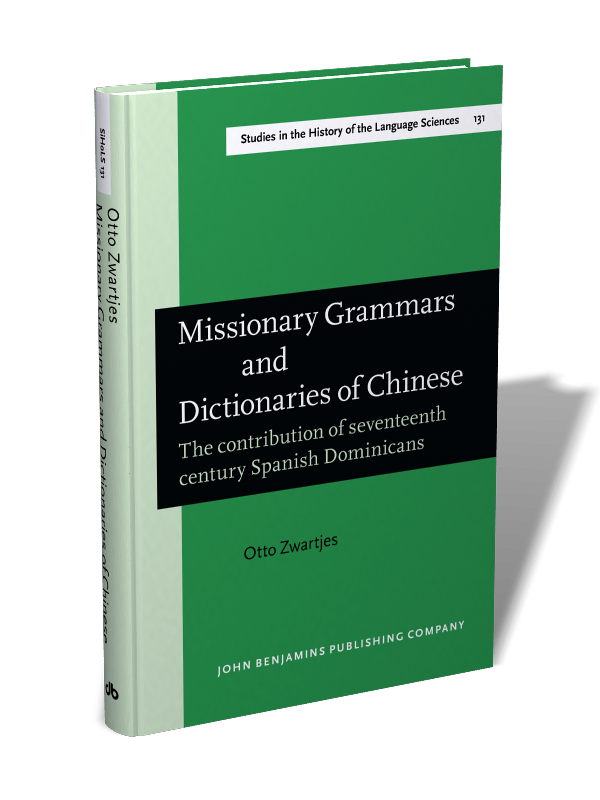
This monograph aims to shed light on the linguistic endeavors and educational practices employed by 17th century Spanish Dominicans in their efforts to understand and disseminate knowledge of the Chinese language during this historical period. Ample attention is dedicated to the evolution of Chinese grammars and dictionaries by these authors. Central to the monograph is the manuscript “Marsh 696”, which comprises a Chinese-Spanish dictionary and a fragmentary Spanish grammar of Mandarin Chinese, a hitherto unknown and unpublished anonymous and undated text entitled Arte de lengua mandarina. This text is probably a fragment of the earliest grammar written by a Westerner of Mandarin Chinese (completed in Manila in c.1641), previously presumed lost. It is presented here as a facsimile, a transcription of the Spanish text and an English translation alongside a detailed linguistic analysis. The historical framework outlined in this monograph spans from the predecessors of Francisco Díaz (1606–1646) around 1620, including the Jesuit linguistic production in mainland China and Early Manila Hokkien sources, to the era wherein Antonio Díaz (1667–1715) finalized his revised version of Francisco Díaz’s dictionary. The monograph scrutinizes these texts in relation to the linguistic contributions of Francisco Varo (1627–1687). Additionally, the monograph incorporates other unpublished texts that are significant for reconstructing the educational curriculum for teaching and learning Chinese by Dominican friars during this period.
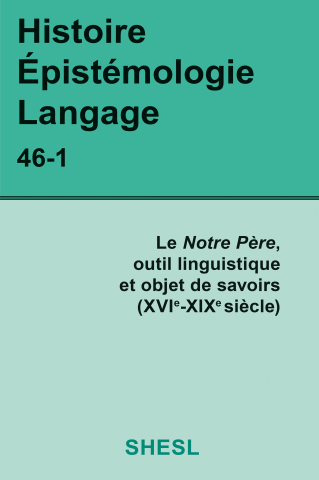
Read more ›Histoire Épistémologie Langage 46(1). 2024. Le Notre Père, outil linguistique et objet de savoirs (XVIe-XIXe siècle), dir. par Fabien Simon. Paris: SHESL. 256 p. ISSN 0750-8069
Publisher’s webpage
Open access
Hommage
Irène Rosier-Catach
C. H. J. M. Kneepkens (1944-2023)
Le Notre Père, outil linguistique et objet de savoirs (XVIe-XIXe siècle)
Dossier thématique dirigé par Fabien Simon
Fabien Simon
Présentation
Capucine Boidin, Cândida Barros & Ruth Monserrat
« Tupi or not guarani ». Les Notre Père des XVIe -XVIIe siècles. Entre corpus brésilien et paraguayen
Charlotte de Castelnau L’Estoile
Le Notre Père en langue amérindienne dans le Brésil des XVIe et XVIIe siècles : interactions, circulations, usages
Bernard Colombat
Le Notre Père est-il un bon échantillon linguistique ? (d’après le Mithridates de Conrad Gessner)
Sven Osterkamp
East Asian Languages in Lord’s Prayer Collections, ca. 1600–1900
Michail Sergeev & Toon Van Hal
Un spécimen qui parle de lui-même : les fonctions des collections multilingues du Notre Père au XVIe siècle
Fabien Simon
Une oraison mobile : itinéraire d’un Notre Père en « langue des Sauvages ». De la Cosmographie universelle d’André Thevet (1575) au Mithridates d’Adelung et Vater (1806-1817)
Language & History 67(2). 2024. Philosophical Language Schemes: Crossroads for Study, ed. David Cram. Abingdon-on-Thames: Taylor and Francis. Online ISSN: 1759-7544
Publisher’s website
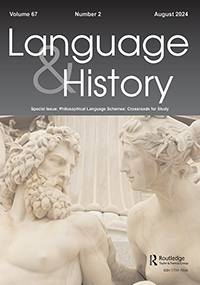
Philosophical language schemes: crossroads for study
David Cram
Word as definition. A key principle of the Comenian project for universal language: its sources and contexts
Petr Pavlas
John Wallis on sound symbolism
David Cram
Early modern Europe’s other real characters
Sean O’Neil
Effable characters: the problem of language and its media in seventeenth-century linguistic thought
Kelly Minot McCay
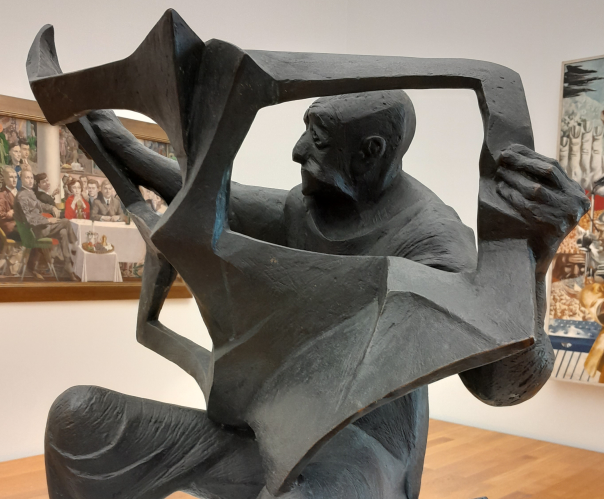
In this interview, we talk to Nick Riemer about how linguistic theory and political ideology can interact.
Read more ›Université Paris Cité, the host institution for the Histoire des théories linguistiques (HTL; https://htl.cnrs.fr/) research group, has earmarked PhD funding for international students starting this year.
Students will enroll in the Linguistics Department (https://u-paris.fr/linguistique/en/home/) and be supervised by a member of HTL.
For some possible PhD (or MA) topics and a list of HTL researchers able to supervise dissertations, please see https://htl.cnrs.fr/formation/theses/
Any other member of the research group (https://htl.cnrs.fr/equipe/) can co-supervise a PhD student.
Funding is for 3 years. Knowledge of French is helpful but not necessary. Dissertations can be written in English or French.
Please contact any member of the research group before June 7th if interested.
Finalized proposals must be submitted to the doctoral school by June 23rd; interviews (zoom possible) will be held on July 1st.
Minervini, Laura & Frank Savelsberg, ed. 2024. New Perspectives on Judeo-Spanish and the Linguistic History of the Sephardic Jews. Leiden: Brill. (Brill’s Studies in Language, Cognition and Culture, 41). 335 p. + index. ISBN 978-90-04-68502-4. DOI: https://doi.org/10.1163/9789004685062
Publisher’s website

At the intersection of Jewish studies and linguistic research, the essays assembled in this book approach the topic of the languages of Sephardic Jews from different perspectives, spanning chronologically from the Middle Ages to the present day. Drawing on diverse sources – from medical glossaries to inquisition archives, from rabbinic responsa to recordings of today’s speakers – the scholars collaborating on this project have endeavoured to reconstruct fragments of a complex and elusive linguistic reality, which over the centuries has been shaped by the historical experience of its speakers. An innovative collection of rigorously conducted synchronic and diachronic studies that contributes to expanding our knowledge and opening new perspectives on crucial issues, such as the effects of contact on the linguistic structures, the possibility of a norm for polycentric languages, the relationship between the lexicon of a language and the vitality of its speech community.
Read more ›
In this interview, we talk to Ingrid Piller about her forthcoming co-authored book Life in a New Language.
Read more ›
Floris Solleveld
University of Bristol
Linguistic fieldwork in the Indonesian archipelago, throughout the 19th century, was largely the province of the Dutch Bible Society (NBG). Two Bible translators stand out for their contributions to linguistic scholarship: J.F.C. Gericke on Javanese in the late 1820s-1850s, and Herman Neubronner van der Tuuk on Toba Batak, Malay, Lampung, Balinese, and various other languages in the second half of the century. Their methods were as similar as their personalities were different. Gericke was pious, deferential, a bit naïve, and well liked by the colonial and Javanese elites; Van der Tuuk was an inveterate polemicist and open atheist who went half native, and whose eccentricities and vituperative letters earned him something of a legendary status. Here he is pouring out his heart to liberal theologian and orientalist Pieter Veth:
It is very sad that the bigoted part of the nation has to pay for the study of languages, the knowledge of which is of such interest to us. […] After all I was in the pay of a bunch of saints, who don’t give a cuss about study, and speculate on the pockets of the pious cheese-buyers.
I gave up, and hold my mission for a complete failure, even if we may have learned something. All that has been done so far for indigenous languages I hold for trash, and this will not change as long as languages are not studied for their own sake. Whoever studies a language to translate the Bible into it is a miserable wretch, and so I despise myself more than anyone else. It was a cruel twist of fate that drove me into the arms of the Bible Society. […] In the Indies the Bible translator’s job is anything but a honourable profession, as they always confuse you with a missionary, that is, a guy who has escaped from behind a counter; they even think you a pious figure, when they hear about your Biblical task. I don’t need to tell you that I am not at all flattered by the predicate pious, and hold it for a swear word.[Van der Tuuk to Pieter Veth, Amsterdam, 14 June 1864]
Both Gericke and Van der Tuuk figure prominently in J.L. Swellengrebel’s history of the NBG in Indonesia, In Leijdeckers Voetspoor (2 vols., 1974-78); but while little has been written about Gericke since, Van der Tuuk’s correspondence as preserved in the NBG archives has been edited not once but twice. The titles of both collections are telling: Rob Nieuwenhuis’ pocket volume of letters selected for their historical or literary merit is called De Pen in Gal Gedoopt (the pen dipped in bile, 1962/82), while Kees Groeneboer’s near-exhaustive annotated edition bears the title Een Vorst onder de Taalgeleerden (a king among linguists, 2002). Annoyingly enough, the sole passages that Groeneboer sometimes intentionally omits are about linguistic details.
Read more ›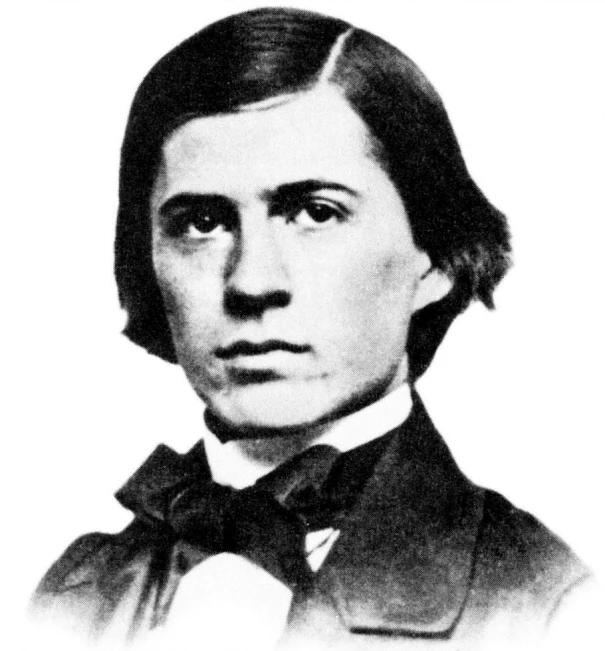
In this interview, we talk to Dan Everett about the life and work of the American pragmatist philosopher Charles Sanders Peirce and Everett’s application of Peirce’s ideas to create a Peircean linguistics.
Read more ›
 History and Philosophy of the Language Sciences