
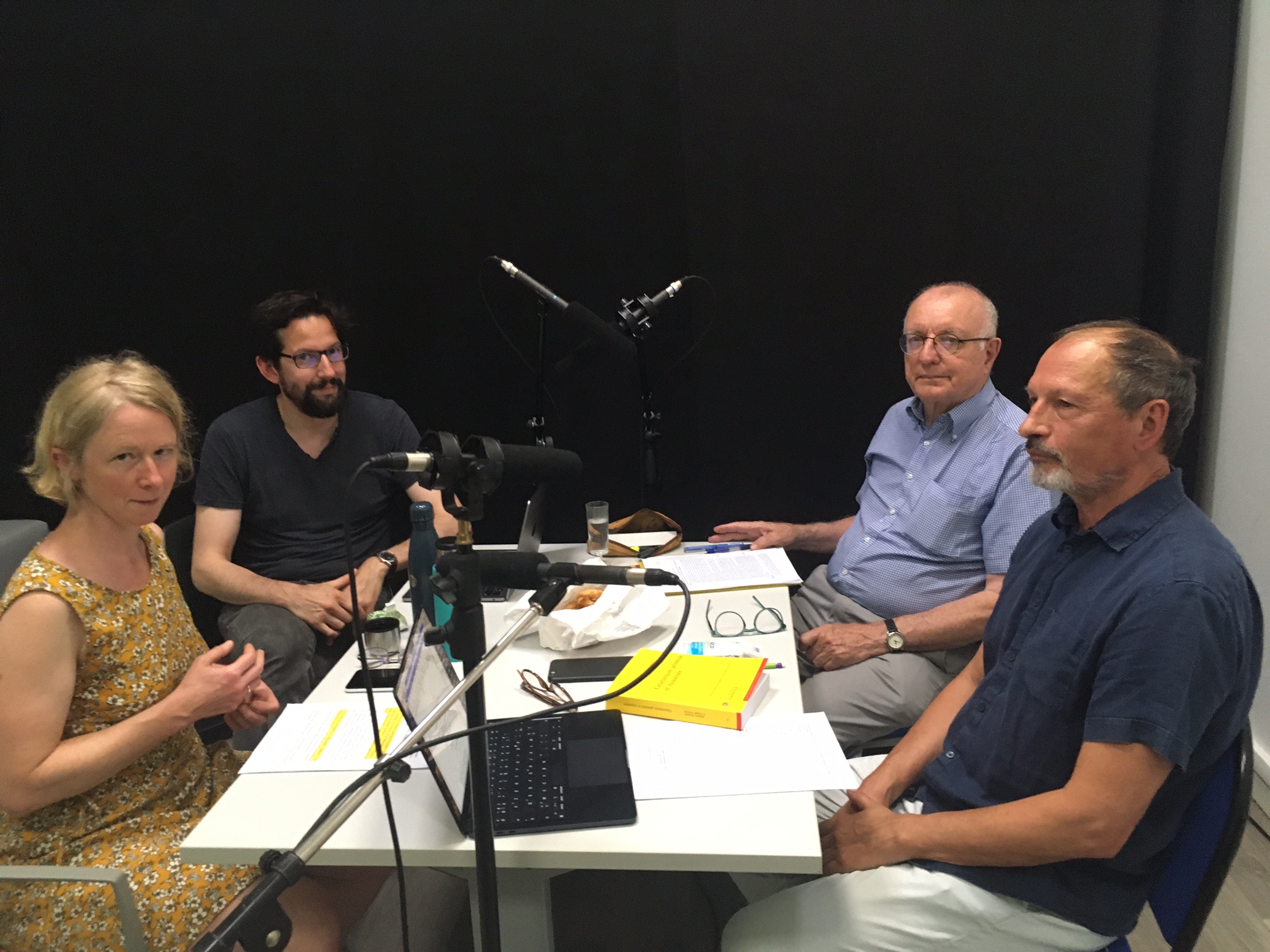

Interview préparée par Lionel Dumarty et Chloé Laplantine
enregistrée à Paris le 27 juin 2024 à l’université Paris Cité par Thomas Zoritchak
(version PDF)
Interview préparée par Lionel Dumarty et Chloé Laplantine
enregistrée à Paris le 27 juin 2024 à l’université Paris Cité par Thomas Zoritchak
(version PDF)
Reimann, Daniel, ed. 2024. Geschichte und Gegenwart der romanistischen Fachdidaktik und Lehrkräftebildung. Tübingen: Narr Francke Attempto Verlag. 548 p. ISBN 978-3-8233-8578-3
Publisher’s website

Die Fachdidaktik hat sich in den letzten Jahrzehnten in der deutschsprachigen Romanistik als eigenständige Teildisziplin neben Linguistik, Literatur- und Kulturwissenschaft etablieren können. Die Fachgeschichte dieser Teildisziplin bleibt indes zu schreiben. Während die Geschichte des Fremdsprachenunterrichts selbst – die bis ins 19. Jhd. hinein ganz überwiegend eine Geschichte des Unterrichts der romanischen Sprachen, insbesondere des Französischen, war – bereits relativ gut erforscht ist, bestehen im Bereich der Erforschung der Geschichte der Lehrkräftebildung in den romanischen Sprachen und der Geschichte der akademischen Disziplin Fachdidaktik noch große Lücken. Diesen Desiderata möchte der vorliegende Band begegnen, indem er unterschiedliche Untersuchungen und Einzelfallstudien zur Geschichte der romanistischen Fachdidaktik und Lehrkräftebildung seit dem 19. Jhd. vereint.
Read more ›Otto Zwartjes presents his new book on Mandarin Chinese studies by Spanish Dominicans, the oldest known sources to date.
Read more ›
In this interview, we talk to Chris Knight about Chomsky, pure science and the US military-industrial complex.
Read more ›
Interview recorded by Zoom on 11 June, 2022.
Music: Chief Dan Cranmer, “Feast Song”, recorded by Franz Boas and George Herzog in 1938, in New York. National Recording Registry, Librarian of Congress, 54-235-F.
Zwartjes, Otto. 2024. Missionary Grammars and Dictionaries of Chinese: The contribution of seventeenth century Spanish Dominicans. Amsterdam: John Benjamins (Studies in the History of the Language Sciences, 131). 381 p. ISBN 9789027214881. DOI: https://doi.org/10.1075/sihols.131
Publisher’s websit
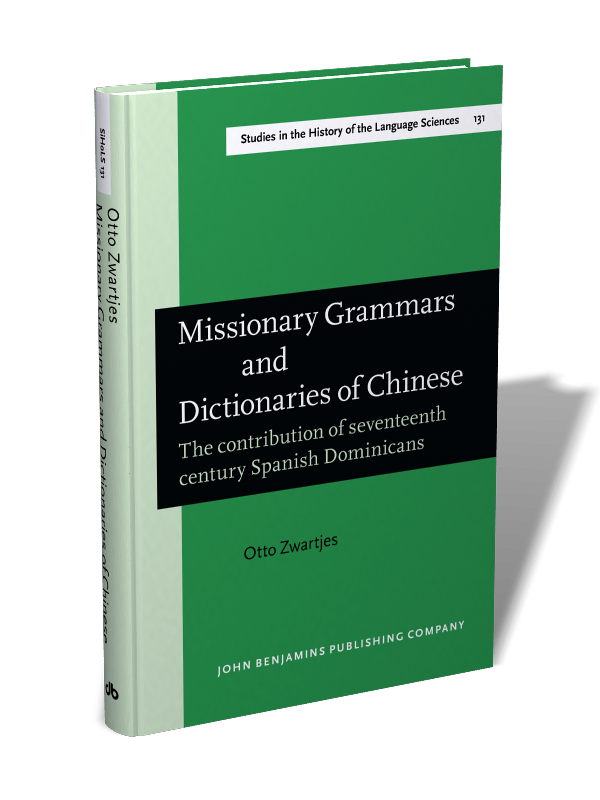
This monograph aims to shed light on the linguistic endeavors and educational practices employed by 17th century Spanish Dominicans in their efforts to understand and disseminate knowledge of the Chinese language during this historical period. Ample attention is dedicated to the evolution of Chinese grammars and dictionaries by these authors. Central to the monograph is the manuscript “Marsh 696”, which comprises a Chinese-Spanish dictionary and a fragmentary Spanish grammar of Mandarin Chinese, a hitherto unknown and unpublished anonymous and undated text entitled Arte de lengua mandarina. This text is probably a fragment of the earliest grammar written by a Westerner of Mandarin Chinese (completed in Manila in c.1641), previously presumed lost. It is presented here as a facsimile, a transcription of the Spanish text and an English translation alongside a detailed linguistic analysis. The historical framework outlined in this monograph spans from the predecessors of Francisco Díaz (1606–1646) around 1620, including the Jesuit linguistic production in mainland China and Early Manila Hokkien sources, to the era wherein Antonio Díaz (1667–1715) finalized his revised version of Francisco Díaz’s dictionary. The monograph scrutinizes these texts in relation to the linguistic contributions of Francisco Varo (1627–1687). Additionally, the monograph incorporates other unpublished texts that are significant for reconstructing the educational curriculum for teaching and learning Chinese by Dominican friars during this period.
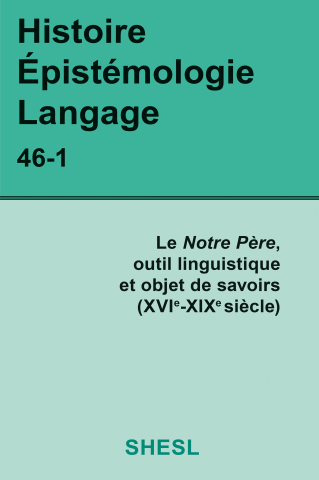
Read more ›Histoire Épistémologie Langage 46(1). 2024. Le Notre Père, outil linguistique et objet de savoirs (XVIe-XIXe siècle), dir. par Fabien Simon. Paris: SHESL. 256 p. ISSN 0750-8069
Publisher’s webpage
Open access
Hommage
Irène Rosier-Catach
C. H. J. M. Kneepkens (1944-2023)
Le Notre Père, outil linguistique et objet de savoirs (XVIe-XIXe siècle)
Dossier thématique dirigé par Fabien Simon
Fabien Simon
Présentation
Capucine Boidin, Cândida Barros & Ruth Monserrat
« Tupi or not guarani ». Les Notre Père des XVIe -XVIIe siècles. Entre corpus brésilien et paraguayen
Charlotte de Castelnau L’Estoile
Le Notre Père en langue amérindienne dans le Brésil des XVIe et XVIIe siècles : interactions, circulations, usages
Bernard Colombat
Le Notre Père est-il un bon échantillon linguistique ? (d’après le Mithridates de Conrad Gessner)
Sven Osterkamp
East Asian Languages in Lord’s Prayer Collections, ca. 1600–1900
Michail Sergeev & Toon Van Hal
Un spécimen qui parle de lui-même : les fonctions des collections multilingues du Notre Père au XVIe siècle
Fabien Simon
Une oraison mobile : itinéraire d’un Notre Père en « langue des Sauvages ». De la Cosmographie universelle d’André Thevet (1575) au Mithridates d’Adelung et Vater (1806-1817)
Language & History 67(2). 2024. Philosophical Language Schemes: Crossroads for Study, ed. David Cram. Abingdon-on-Thames: Taylor and Francis. Online ISSN: 1759-7544
Publisher’s website
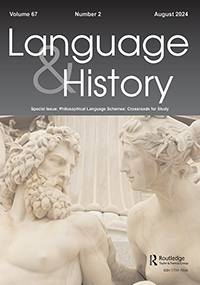
Philosophical language schemes: crossroads for study
David Cram
Word as definition. A key principle of the Comenian project for universal language: its sources and contexts
Petr Pavlas
John Wallis on sound symbolism
David Cram
Early modern Europe’s other real characters
Sean O’Neil
Effable characters: the problem of language and its media in seventeenth-century linguistic thought
Kelly Minot McCay
In this interview, we talk to Nick Riemer about how linguistic theory and political ideology can interact.
Read more ›Université Paris Cité, the host institution for the Histoire des théories linguistiques (HTL; https://htl.cnrs.fr/) research group, has earmarked PhD funding for international students starting this year.
Students will enroll in the Linguistics Department (https://u-paris.fr/linguistique/en/home/) and be supervised by a member of HTL.
For some possible PhD (or MA) topics and a list of HTL researchers able to supervise dissertations, please see https://htl.cnrs.fr/formation/theses/
Any other member of the research group (https://htl.cnrs.fr/equipe/) can co-supervise a PhD student.
Funding is for 3 years. Knowledge of French is helpful but not necessary. Dissertations can be written in English or French.
Please contact any member of the research group before June 7th if interested.
Finalized proposals must be submitted to the doctoral school by June 23rd; interviews (zoom possible) will be held on July 1st.

 History and Philosophy of the Language Sciences