In this interview, Gerda Haßler discusses her career in Romanistik and the history of linguistics in the DDR and re-united Germany.
Read more ›
In this interview, Gerda Haßler discusses her career in Romanistik and the history of linguistics in the DDR and re-united Germany.
Read more ›
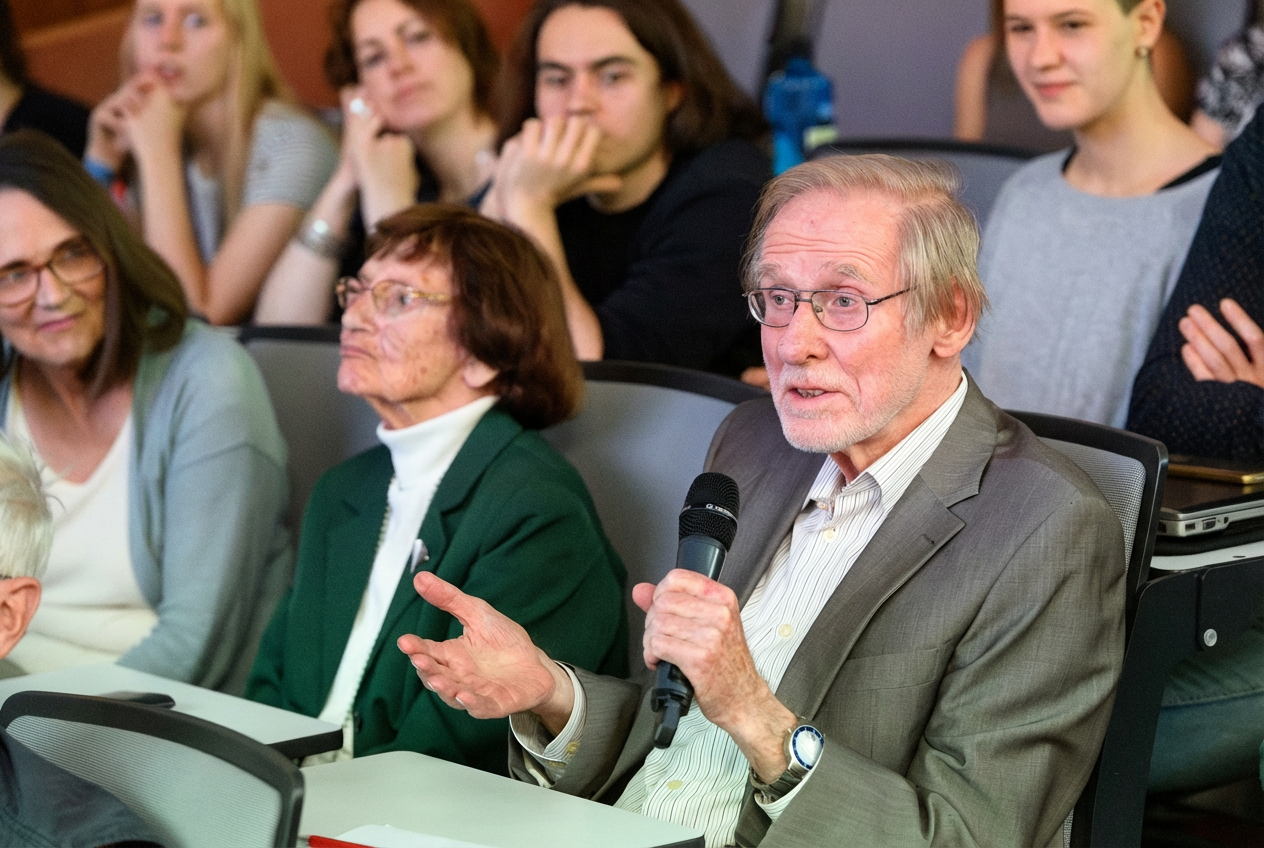
In this interview, Fritz Newmeyer discusses linguistics, history of linguistics, and politics.
Read more ›The Cluster of Excellence Cross-Cultural Philology has just been launched at the LMU in Munich. The research cluster takes a cross-cultural approach to the study of philological practices and cultural dynamics over a 5,000-year period.
They are now advertising a staggering number of doctoral and postdoctoral positions: https://www.lmu.de/crossculturalphilology/en/research/research-areas/all-projects/
CHSTM Working group History of the Language Sciences. Meetings online, September 2025–May 2026
The CHSTM working group on the history of the language sciences holds online seminars every month on topics related to the history of linguistics and neighbouring fields. Our program for autumn 2025 begins next week, on 23 Sept. The planned meetings are
23 Sept – John Goldsmith (U Chicago)
14 Oct – Gonçalo Fernandes (UTAD: Universidade de Trás-os-Montes e Alto Douro)
11 Nov – Adrianna Link (American Philosophical Society)
9 Dec – Bernhard Hurch (Graz University)
Full details and information on how to join the meetings can be found
on the group’s webpage: https://www.chstm.org/group/history-language-sciences
In this interview, Randy Harris interviews James McElvenny about his recent book A History of Modern Linguistics.
Read more ›
In this interview, we talk to Geoff Pullum about his career, his contributions to linguistics, and how he sees the future of the field.
Read more ›Iulianus Toletanus. Opera III: Ars grammatica. Ed. by José Carracedo Fraga, Turnhout, Brepols (Corpus Christianorum. Series Latina, vol. 115C). 2025. cxx + 608 p. ISBN 978-2-503-61423-6
Publisher’s website: https://www.brepols.net/products/IS-9782503614236-1
Review by Anne Grondeux (Université Paris Cité and Université Sorbonne Nouvelle, CNRS, Laboratoire d’histoire des théories linguistiques, F-75013 Paris, France)

The Ars attributed to Julian, Bishop of Toledo in the second half of the 7th century, is the last major grammar produced in Visigothic Spain. It has now been published in the Corpus Christianorum, Series Latina collection by José Carracedo Fraga (hereafter JCF), a specialist on this author (Carracedo Fraga 2005, 2006, 2013, 2014, 2015, 2016, 2021).
All evidence points to this treatise being a product of Visigothic Spain, and more precisely of Toledo (pp. VIII–X). Its origin is confirmed by proper names, both names of people and toponyms; by Hispanic sources; by examples specifically drawn from Hispano-Visigothic poetry (Juvencus, Prudentius, and especially Eugenius of Toledo, cf. Alberto 2016); by hymns unique to the Visigothic liturgy; and by variants of the Vetus Latina characteristic of Visigothic Spain. The dating is established by references to Visigothic rulers (which appear only in recension β, see below), namely Kings Ervigius (680–687, cited on pp. 35, 346 and pp. 63, 155) and Egica (687–701, cited on p. 447, 21). Since Julian himself died in 690, recension β would be situated toward the end of his life, between 687 and 690. Based on an Iberian tradition of the Ars Donati, Julian’s treatise follows the structure described as typically Spanish by Louis Holtz (1981, pp. 453–474).
Read more ›CHSTM Working group History of the Language Sciences. Meetings online, September 2025–May 2026
Archives scaffold research in both history and the sciences. Far from passive repositories, they assert order and give shape to the world. In the midst of what feels like daily media revolutions, archives have attracted widespread interest from historians of science in recent years. “The archive” has been newly re-conceptualized as a cross-disciplinary focus of reflection and analysis. At the same time, political impulses to de-colonize the archive, alongside the ambitions and anxieties made possible by new media, have motivated highly specific interventions in the discipline of linguistics. From the corpora of computational linguistics to the digitization of resources documenting endangered languages, linguists have reckoned explicitly and enthusiastically with the affordances of their collections.
In the 2025-26 academic year, our working group will explore the relationship between these two traditions of thinking with and about archives. What can a cross-disciplinary perspective bring to bear on the uniqueness of archival practices in linguistics? Reciprocally, how might the particularities of linguistics inform the broader historiographic conversation around archives in the sciences? Do examples of linguistic corpora, for example, resist the notion that archives are inherently historical or not? How might conversations about governance in other fields—botany, for instance—relate to practices in linguistics? We look forward to exploring such questions with interested scholars from any disciplinary background.
We welcome proposals for presentations in the next season of our working group. If you would like to present, please get in contact with Judy Kaplan (jrk@chstm.org), Raúl Aranovich (raranovich@ucdavis.edu) or James McElvenny (james.mcelvenny@mailbox.org). Thanks!
Date: 8-11 January 2026
Place: New Orleans, Louisiana
Deadline for submission: 1 September 2025
Information: https://naahols.wordpress.com/annual-meeting/
The North American Association for the History of the Language Sciences (NAAHoLS) will hold its 2026 Annual Meeting in conjunction with the Linguistic Society of America (LSA) Annual Meeting in New Orleans, LA, from 8-11 January 2026. Founded in 1987, NAAHoLS has been meeting as a sister society of the LSA since 1989. We invite papers relating to any aspect of the history of the language sciences. Participants should plan for a 20 minute presentation, followed by 10 minutes for questions and discussion.
Abstracts should be submitted via EasyAbs (https://easyabs.linguistlist.org/conference/NAAHoLS2026/) following the directions below. Note that we ask you include both a longer 250-500 word abstract and a short (max 100 word) abstract; if accepted, the shorter abstract will be published in the LSA meeting handbook.
1. Authors: Enter author name(s) and affiliation(s)
2. Title: Enter the full title of your submission
3. Document: Upload a file (PDF is preferred) that includes 1) your title; 2) a 250-500 word abstract; and 3) a second short abstract of no more than 100 words. Please do not include your name or any identifying information in this document.
All presenters must be members of NAAHoLS as of the conference date, and will register using the LSA conference registration process. NAAHoLS members are able to register for and attend the full LSA meeting at a discounted member rate, whether or not they are members of the LSA.
The deadline for submission of abstracts is September 1, 2025 and
notification of acceptance can be expected by September 22, 2025.
Date: 10-11 September 2026
Place: Fribourg (Switzerland)
Organizers: Pierre-Yves Testenoire & Patrick Flack
Information: https://comdial.sdvigpress.org/event-100897
The Prague Linguistic Circle holds a clearly defined place in the historiography of the language sciences: it is recognized as an institutional and localized “hub” (Hoskovec 2011) of programmatic innovation, representing a pivotal moment in the broad transition from 19th-century philological models to the new paradigms of 20th-century linguistics. While the Circle’s European and international influence—particularly the fundamental impact of its contributions to the development of structural phonology—is well known, most of its historians and commentators have focused primarily on its specific context in Prague itself (e.g., Vachek 1966, Viel 1984, Raynaud 1990, Toman 1995, Sériot 2012). In line with a certain cliché that casts the city of Prague as a “golem-like” site of magical encounters (Ripellino 1973, Flusser 1991), the Circle and its theoretical originality are often presented as the product of syncretism, or even as the precipitate of a kind of fusion between different traditions suddenly brought together in the capital of the new Czechoslovak state.
Read more ›