
Stockigt, Clara. 2024. Australian Pama-Nyungan languages: Lineages of early description. Berlin: Language Science Press (History and Philosophy of the Language Sciences). 520 p. ISBN 978-3-96110-488-8. DOI: 10.5281/zenodo.13880534
Publisher’s website
Book in open access
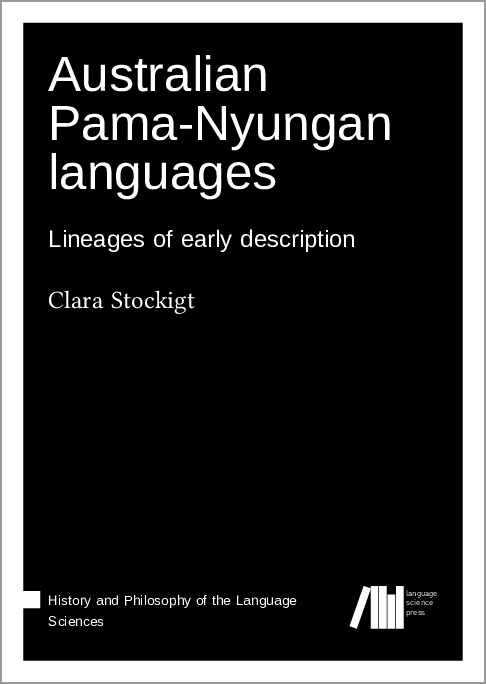
A substantial proportion of what is discoverable about the structure of many Aboriginal languages spoken on the vast Australian continent before their decimation through colonial invasion is contained in nineteenth-century grammars. Many were written by fervent young missionaries who traversed the globe intent on describing the languages spoken by “heathens”, whom they hoped to convert to Christianity. Some of these documents, written before Australian or international academic institutions expressed any interest in Aboriginal languages, are the sole record of some of the hundreds of languages spoken by the first Australians, and many are the most comprehensive. These grammars resulted from prolonged engagement and exchange across a cultural and linguistic divide that is atypical of other early encounters between colonised and colonisers in Australia. Although the Aboriginal contributors to the grammars are frequently unacknowledged and unnamed, their agency is incontrovertible.
This history of the early description of Australian Aboriginal languages traces a developing understanding and ability to describe Australian morphosyntax. Focus on grammatical structures that challenged the classically trained missionary-grammarians – the description of the case systems, ergativity, bound pronouns, and processes of clause subordination – identifies the provenance of analyses, development of descriptive techniques, and paths of intellectual descent. The corpus of early grammatical description written between 1834 and 1910 is identified in Chapter 1. Chapter 2 discusses the philological methodology of retrieving data from these grammars. Chapters 3–10 consider the grammars in an order determined both by chronology and by the region in which the languages were spoken, since colonial borders regulated the development of the three schools of descriptive practice that are found to have developed in the pre-academic era of Australian linguistic description.
Herkel, Jan. 2024 [1826]. Elementa universalis linguae Slavicae. Annotated translation with introductory essays by Raf Van Rooy & Alexander Maxwell. Berlin: Language Science Press (History and Philosophy of the Language Sciences). 220p. ISBN 978-3-96110-484-0. DOI: 10.5281/zenodo.13773949
Publisher’s website
Book in open access
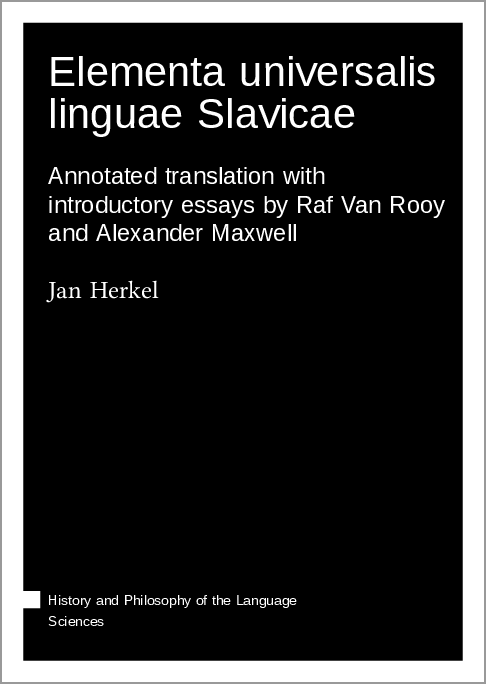
In 1826, as nationalism first began percolating through the Habsburg lands, Jan Herkel published a Latin-language Slavic grammar. Herkel, a lawyer and amateur linguist, came from the northern counties the Kingdom of Hungary which now form the Slovak Republic. Though he was inspired by a romantic love of his native language, Herkel imagined a single “Slavic language,” divided into various “dialects.” He proposed a single grammar for the whole Slavic world, attempting to encompass and yet restrain the diversity of orthography, morphology, phonology, and so forth found across Slavic varieties. Herkel was also the coiner of the term “panslavism”, which he used to describe his efforts. This book provides the first English translation of Herkel’s noteworthy grammar, with short notes. The book also contains a preface and explanatory essays by co-translators Raf Van Rooy and Alexander Maxwell. The preface introduces the topic of the book. Maxwell then gives a biography of Herkel, discusses linguistic nationalism in Slavic northern Hungary, and the legacy of panslavism. Van Rooy explores Herkel’s key notion of the “genius” of the Slavic language as the legacy of early modern linguistic thought.
Historiographia Linguistica 50(2-3). 2024. Amsterdam: John Benjamins. 232 p. ISSN 0302-5160. DOI: https://doi.org/10.1075/hl.50.2-3
Publisher’s website
Editors’ notes
Articles
The Περὶ ἀντιστοίχων in MS. Barocci 10 and MS. Barocci 48: An indirect witness to Pseudo-Zonaras’ Lexicon?
Stephanie Roussou
Anachronistic bias in the study of Arabic grammatical tradition: The case of the term ḥarf in Sībawayhi’s al-Kitāb
Almog Kasher
Jacques van Ginneken and Significs
Els Elffers
Aux origines du Cercle linguistique de New York
Pierre-Yves Testenoire
Strukturalismus und kein Ende?
Jörn Albrecht
Reviews
John Walker. 2022. Wilhelm von Humboldt and Transcultural Communication in a Multicultural World: Translating Humanity
Rezensiert von Cord-Friedrich Berghahn
Jean-Paul Bronckart & Ecaterina Bulea Bronckart. 2022. Ferdinand de Saussure. Une science du langage pour une science de l’humain
Compte rendu par Pierre-Yves Testenoire
James McElvenny. 2023. The Limits of Structuralism. Forgotten Texts in the History of Modern Linguistics
Rezensiert von Clemens Knobloch
Christopher Rundle. 2022. The Routledge Handbook of Translation History
Reviewed by Wei Chen & Yue Liu
Anne Aarssen, René Genis & Eline van der Veken. 2018. Bibliographie Linguistique de l’année 2017 et complément des années précédentes / Linguistic Bibliography for the Year 2017 and supplement for previous years, Anne Aarssen, René Genis & Eline van der Veken. 2019 Bibliographie Linguistique de l’année 2018 et complément des années précédentes / Linguistic Bibliography for the Year 2018 and supplement for previous years & Anne Aarssen, René Genis & Eline van der Veken. 2020 Bibliographie Linguistique de l’année 2019 et complément des années précédentes / Linguistic Bibliography for the Year 2019 and supplement for previous years
Reviewed by Pierre Swiggers
H. Ekkehard Wolff. 2019. A history of African linguistics
Reviewed by Cécile Van den Avenne
Viti, Carlotta, ed. 2024. Ancient Greek and Latin in the linguistic context of the Ancient Mediterranean. Tübingen: Narr. 460 p. ISBN 978-3-8233-8585-1
Publisher’s website
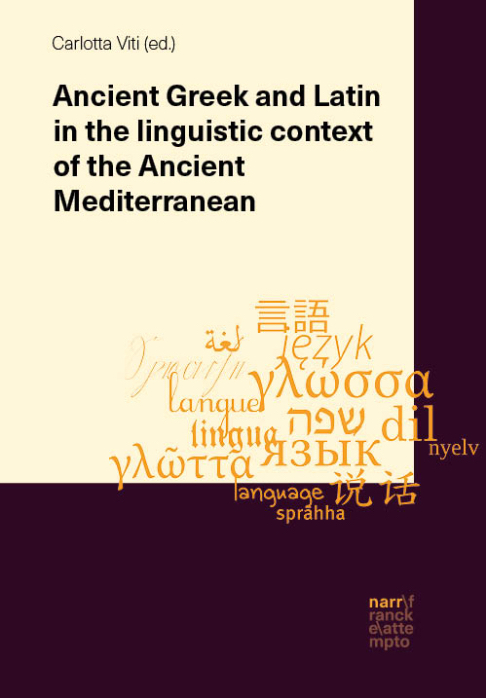
This collective volume examines Latin and Ancient Greek from the perspective of language contact, a topic that is particularly relevant in our globalized and multi-ethnic society. Specialists from various
universities and countries investigate, among other things, the linguistic variation of the Greek dialects, Greek-Latin bilingualism, language contact in ancient Italy, in the Near East and in the Mediterranean, as well as problems of translations and glosses. Maps and images of old inscriptions and manuscripts enrich the discussion. From an interdisciplinary point of view, Greek and Latin linguistics is also discussed in relation to epigraphy, philology, textual criticism and grammatical theory. In addition to Latin and Greek, data from numerous ancient and modern languages are presented.
Aarnes, Jørgen Røysland, Jean Lassègue & Ingmar Meland, eds. 2024. Cahiers de sémiotique des cultures 2(2): Hundred Years of Symbolic Forms – From Cassirer to Contemporary Research / Les Formes Symboliques ont cent ans – De Cassirer à la recherche contemporaine. Paris: Classiques Garnier. 181 p. ISBN 978-2-406-17533-9
Publisher’s website

Éditorial
Lia Kurts-Wöste
A Hundred Years of Symbolic Forms – From Cassirer to Contemporary Research – Introduction
Les formes symboliques ont cent ans – De Cassirer à la recherche contemporaine – Introduction
Ingmar Meland, Jørgen Røysland Aarnes & Jean Lassègue
Cassirer et le problème du langage
Arild Utaker
The Question of Universal Grammar: Cassirer’s Philosophy of Language in Light of Contemporary Theories
Luigi Laino
Linguistic or Symbolic Turn?: A Reconstruction of the Habermas-Krois Debate on Cassirer’s Philosophy of Symbolic Forms
Rafael Garcia
Ernst Cassirer’s Philosophical StyleA Synthesis of Form and Thought
Alex Seuthe
L’unité des sciences et l’idéal fonctionnel de la vérité
Tobias Endres
Ernst Cassirer and Structural Realism
Jørgen Røysland Aarnes
Signification, forme symbolique et art des cavernes revisités
Mats Rosengren
Austin, John Langshaw. 2024 [1962). Quand dire, c’est faire. Traduction par Bruno Ambroise. Paris: Seuil (L’Ordre philosophique). 264 p. EAN 9782021560299
Publisher’s website

Quand dire, c’est faire est un ouvrage majeur de philosophie contemporaine et fait figure de « classique ». Dans ce texte vif et fondateur, Austin a montré comment le discours peut « faire ». À rebours d’une grande partie de la tradition, il a révolutionné l’approche du langage en introduisant les concepts d’« énoncé performatif » et « d’acte de discours ». Le déplacement théorique qu’opère l’ouvrage en mettant au jour les différentes formes d’actions accomplies par le langage scelle en effet l’originalité et l’importance tant philosophiques qu’historiques de ce texte pour la pensée en général : découvrir ce que le langage accomplit et ainsi ce que nous accomplissons en tant qu’individu parlant, agissant du fait même de parler, au sein d’une société, c’est comprendre la responsabilité de nos paroles.
Cette traduction inédite du texte définitif d’Austin entend rendre en français la subtilité du texte original et tous ses enjeux conceptuels, mais aussi l’humour d’Austin et sa volonté de s’exprimer dans un langage clair et accessible à tous. Voici donc enfin disponible ce qui doit tenir lieu dorénavant d’édition de référence.


Leave a Reply