
Carla Umbach (University of Cologne)
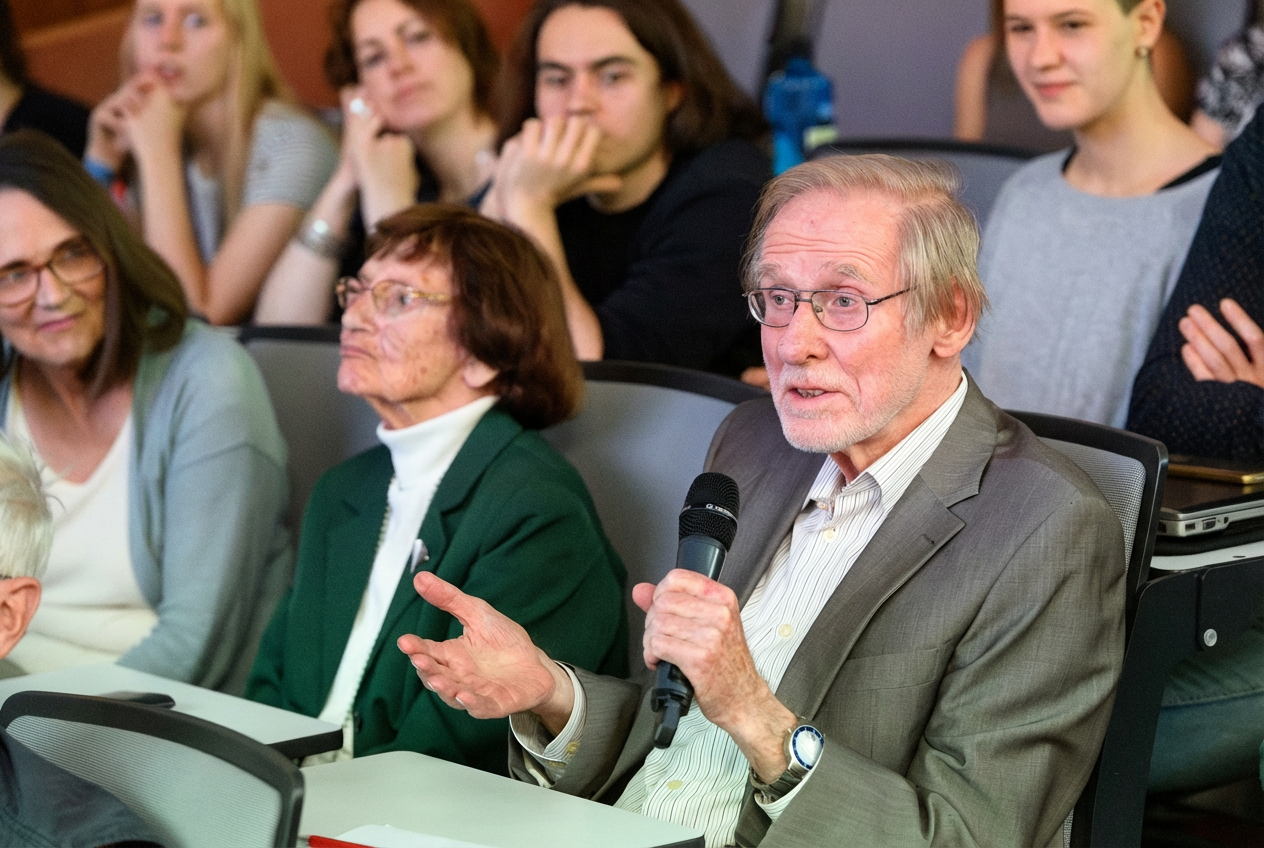
I would like to draw attention to an article by Manfred Bierwisch, who was a very prominent German linguist and did most of his scientific work in GDR. The article appeared recently in Annual Review of Linguistics. A brief summary is given below.
Linguistics in Germany: A Fresh Start After a Great Tradition—and New Enigmas
Manfred Bierwisch (Leibniz-Zentrum Allgemeine Sprachwissenschaft, Berlin, Germany)
Annual Review of Linguistics, Vol. 12 (2026), pp. 17–38,
https://doi.org/10.1146/annurev-linguistics-031125-054905
This autobiographical article describes key elements of Manfred Bierwisch’s scientific work and life. It was completed only after his death and contains a fragment that he wrote for this article supplemented by excerpts from earlier texts and interviews. Compilation was done by Carla Umbach and Manfred Krifka, adding transition passages between sections and footnotes. The article outlines the main features of Manfred Bierwisch’s linguistic work and in addition sheds light on the difficult political circumstances under which it was accomplished.
In the first three sections of the article, Bierwisch describes how he got involved in linguistics and what the scientific situation of linguistics at the University of Leipzig was like when he started (for details see section 4). After his studies, Bierwisch joined a group of young colleagues at the German Department of the Academy of Sciences named Arbeitsgruppe Strukturelle Grammatik (Structural Grammar research group) that was tasked with the development of a new grammar of modern German. The group had been initiated by the Finno-Ugric scholar Wolfgang Steinitz, who hosted Roman Jakobson as an emigrant in Sweden and now as a visiting colleague in Berlin. Jakobson’s visits provided Bierwisch and his colleagues with first-hand insights into the principles of Prague School structuralism such as the phonemic–phonetic distinction and markedness asymmetry.
Shortly before the Berlin Wall was built in 1961, Bierwisch came across Chomsky’s Syntactic Structures, which opened up a new perspective for him and his colleagues in the Structural Grammar research group. The generative perspective led Bierwisch to the nowadays widely accepted insight that, in German, the structure of subordinate clauses—with the verb in final position—is fundamental to sentence structure. At roughly the same time, Fodor and Katz extended the generative perspective in linguistics to the problems of meaning, introducing the notion of semantic markers to identify basic distinctions of meaning. With a related orientation, Bierwisch analyzed dimensional German adjectives by means of markers referring to spatial dimensions in a broad sense. From that point on, the topic of dimensional adjectives runs as a common thread through his scientific work.
This is the end of the text that Manfred Bierwisch was able to write himself. It is suplemented in the article by clips from interviews and from texts he wrote for other occasions. Section 4 describes the highly stimulating intellectual environment in Leipzig during his studies, with academic teachers like Ernst Bloch and Hans Mayer, and a circle of fellow students including Uwe Johnson. It also describes his conviction to a prison term for carrying banned magazines on a train from (West) Berlin to Leipzig. Section 5 continues with an episode of how he managed to escape the pressure from the Stasi (State Security Police of the GDR) trying to recruit him as an informant. The decisive help came from Wolfgang Steinitz, himself a committed communist and a member of the Politbüro (the executive committee of the Socialist Party).
Section 6 reports on the scientific development of the Structural Grammar research group and its end due to political narrow-mindedness. The core of the work was directed at the idea that lexical entries combine phonetic form, and argument structure as well as semantic form, which provided the starting point for Bierwisch’s analysis of event nominalizations. Sections 7 and 8 once again address the situation in the GDR—specifically, the question of why structuralism became a political issue and to what extent linguistics resembles physics. Section 9 is about the Cognitive Linguistics research group (successor of the Structural Grammar research group). Its focus was on the semantics of gradation and resulted in an article which is now considered a classic in the literature on dimensional adjectives. A particularly intriguing issue in this field is the asymmetry of antonym pairs such as ‘long’/’short’ with respect to Normbezug (evaluativity) and their compatibility with measure phrases. Section 10 concludes with a note on the post-reunification period.
The article contains a list of Manfred Bierwisch’s most important publications. For more information on his work and life please take a look at the video interview Structural grammar, semantic universals and arbitrariness: a conversation with Manfred Bierwisch, http://www.gespraech-manfred-bierwisch.de as well as the obituary in https://www.mpi.nl/news/obituary-manfred-bierwisch.

 History and Philosophy of the Language Sciences

Leave a comment