
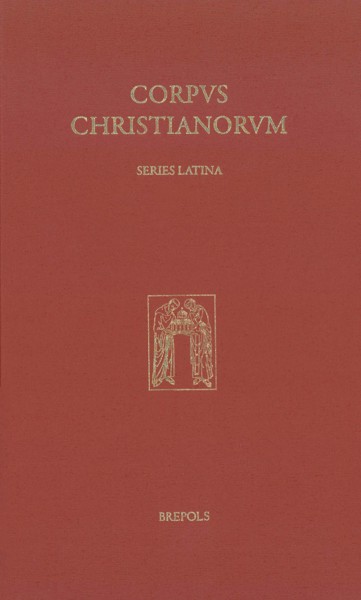
Iulianus Toletanus. Opera III: Ars grammatica. Ed. by José Carracedo Fraga, Turnhout, Brepols (Corpus Christianorum. Series Latina, vol. 115C). 2025. cxx + 608 p. ISBN 978-2-503-61423-6
Publisher’s website: https://www.brepols.net/products/IS-9782503614236-1
Review by Anne Grondeux (Université Paris Cité and Université Sorbonne Nouvelle, CNRS, Laboratoire d’histoire des théories linguistiques, F-75013 Paris, France)
The Ars attributed to Julian, Bishop of Toledo in the second half of the 7th century, is the last major grammar produced in Visigothic Spain. It has now been published in the Corpus Christianorum, Series Latina collection by José Carracedo Fraga (hereafter JCF), a specialist on this author (Carracedo Fraga 2005, 2006, 2013, 2014, 2015, 2016, 2021).
All evidence points to this treatise being a product of Visigothic Spain, and more precisely of Toledo (pp. VIII–X). Its origin is confirmed by proper names, both names of people and toponyms; by Hispanic sources; by examples specifically drawn from Hispano-Visigothic poetry (Juvencus, Prudentius, and especially Eugenius of Toledo, cf. Alberto 2016); by hymns unique to the Visigothic liturgy; and by variants of the Vetus Latina characteristic of Visigothic Spain. The dating is established by references to Visigothic rulers (which appear only in recension β, see below), namely Kings Ervigius (680–687, cited on pp. 35, 346 and pp. 63, 155) and Egica (687–701, cited on p. 447, 21). Since Julian himself died in 690, recension β would be situated toward the end of his life, between 687 and 690. Based on an Iberian tradition of the Ars Donati, Julian’s treatise follows the structure described as typically Spanish by Louis Holtz (1981, pp. 453–474).
What poses a challenge for JCF is the difference in borrowings between Isidore and Julian, brief in the former, extensive in the latter. The author therefore suggests that the De uitiis as we read it today is the result of a Visigothic Spanish reworking carried out in the 6th century, and notes that the original version may also have included sections on barbarism, solecism, and metaplasm. However, this hypothesis is difficult to sustain in light of Olga Spevak’s analyses, which emphasize that if Isidore had had access to a De uitiis containing these sections, his treatment of metaplasm would not have been so deficient. The hypothesis of a reworking is nonetheless quite plausible if it is not placed in the 6th century, as JCF does, but rather in the 7th century, between the composition of the Etymologiae and the Ars Iuliani.
The manuscript records reveal an unusually complex situation (pp. XLI–LXXIII). The Vatican manuscript L is the only one to attribute the text to Julian. The Naples witness N contains only the De uitiis et uirtutibus, while manuscripts R and V (from the Vatican and Valenciennes) include only the Conlatio de generibus metrorum. The Bern 207 witness (designated F) is the only one to preserve the full corpus attributed to Julian of Toledo and corresponds to JCF’s edition:
- I. De partibus orationis
- II. De littera, De syllaba, De finalibus syllabis, De pedibus, De accentibus, De posituris
- III. De uitiis et uirtutibus
- IV. Conlatio de generibus metrorum
- V. (A second) De partibus orationis
This final text had been excluded by the previous editor (Maestre Yenes 1973), but is considered authentic by Louis Holtz (1974) and Luigi Munzi (1980-1981), who produced its first edition, as well as by Paulo Alberto (2018); it indeed contains internal references to the “primus tractatus.” The Erfurt witness omits the treatment of barbarism and solecism, and introduces the figures with the phrase: Incipit tractatus de uitiis a diuersis tractatibus collectus (which JCF does not comment on), as if the scribe were unaware that this section belonged to Julian’s treatise. Moreover, many manuscripts fragment the text into several, sometimes widely separated, sections: in the Erfurt manuscript, sections II and III are separated by excerpts from Cassiodorus and by the Grammatica Quod (Barbero 1993), which ends precisely with a treatment of barbarism and solecism that displaces Julian’s own. Given the complexity of the manuscript tradition, a table like the following would have been helpful:
| B | Bern 123 | I (ending missing due to lost pages) |
| E | Erfurt 2°10 | I, II, III (except barbarism and solecism), IV |
| F | Bern 207 | I, II, III, IV ; Servius, Centimetrum ; V |
| G | Gotha II 193 | (bifolium containing the end of the De uirtutibus) |
| L | Pal. Lat. 1746 | L1 = I, III, IV, family α ; L2 = II, family β ; attribution of the Ars to Julian |
| N | Naples IV.A.34 | De uitiis et uirtutibus |
| P | Paris 18520 | II (De littera, De accentibus, De posituris), III (De barbarismo, De soloecismo, De ceteris uitiis) (end missing owing to the loss of leaves) |
| R | Reg. Lat. 1586 | Conlatio de generibus metrorum |
| T | Paris 7540 | (inserted bifolium containing excerpts on the adverbium) |
| V | Valenciennes 393 | Conlatio de generibus metrorum |
The edition is therefore based, depending on the section, on a necessarily disparate manuscript foundation, especially since the Ars Iuliani exists in two recensions (pp. XII–XX, “1.2. La doble redacción del tratado” and p. LXXXVI “Stemma testium”), designated by JCF as α and β. These are distinguished not only by textual variants but also by clearly distinct editorial elements. JCF made the interesting choice to publish them in parallel: recension α appears on the even-numbered pages, and recension β on the facing odd-numbered pages, with extended characters making it easy to identify elements unique to each version. The Vatican manuscript L is notable for containing sections I, III, and IV copied from a manuscript of recension α, followed by section II copied from a witness of recension β. The witnesses are distributed as follows: FNV, PRT, GL1 belong to α; BEL2 to β. The relationship between the two recensions remains uncertain. According to JCF (p. XVI), this situation reflects the typically fluid nature of school texts: “At a moment very close in time and place to Julian himself, a student or teacher from his scholarly circle introduced reworked elements into certain parts of the original manual.” The two recensions share stylistic features, use the same sources, and include similar examples. They would thus be the product of a single school under Julian’s influence, though it is impossible to determine which version is closer to Julian’s original intent.
At this point, two elements seem likely to shed light on the matter. The first is the intuition, absolutely fundamental in my view, of Cécile Conduché (2016), who argues that the Ars Iuliani necessarily draws on inherited materials from Julian’s predecessors, particularly Eugenius of Toledo: “It is possible that the cathedral library of Toledo housed not only the course by Julian that has come down to us, but also, alongside it, the course of his predecessor Ildephonsus, a course by Eugenius (who, in this hypothesis, would have illustrated his metrics with his own poems, like Servius), or one by a master from their circle, all very close in content and built on the same sources, yet each personal and slightly different.” In this respect, Conduché’s article, though cited in the bibliography, seems underutilized. If one wishes to uphold Julian’s authorship of this grammar, one could plausibly suggest that the two recensions represent two separate courses taught by Julian at different times, developed from older material and drawing on the same locally available sources.
The second element is the connection with the Liber glossarum (pp. LXXII–LXXIV), which uses the same materials as the Ars Iuliani (p. LXXII) and is treated as a prominent representative of the indirect tradition of the Ars. According to JCF, the compilers of the Liber glossarum used a manuscript of recension β. However, several pieces of evidence contradict this claim. First, there is the definition of verb moods, borrowed from Priscian (Ars VIII.63, 421.17), which appears only in recension α; yet it is also found in the Liber glossarum, and in the contemporary Quod Grammar (preserved in one of the Ars Iuliani manuscripts and discussed by JCF on p. XXXIV)
| Ivlian. Tolet., Ars I 3, α175 | Lib. gloss. MO76 | Gramm. Quod (Erfurt 2°10 f. 53r) |
| Quid sunt modi ? Diuersae inclinationes animae uarios eius affectus demonstrantes. | Modi autem sunt diuersae inclinationes animi, uarios eius affectus demonstrantes. | |
| Modi sunt diuerse inclinationes animi uarios eius affectus demonstrantes. Sunt autem quinque, indicatiuus, imperatiuus, obtatibus, subiunctiuus, infinitus. | (followed by) De modis Modi sunt diuersae inclinationes animi, uarios eius affectus demonstrantes. Sunt autem quinque, indicatiuus, imperatiuus, optatiuus, coniunctiuus, infinitus. |
It is worth noting that the Liber glossarum provides a more complete excerpt than the Ars Iuliani. A series of terms with their definitions, stemming from Donatus’s treatment of barbarism, display the same characteristics.
| Ivlian. Tolet., Ars | Lib. gloss. | Gramm. Quod (Erfurt 2°10, f. 60v) |
| III 1, α17 : ‘Mastruca’ enim barbarum nomen est Latinis eloquiis insertum. | MA865 : De glosis : Mastruga, barbarorum nomen est Latinis loquellis insertum. | ‘Mastruga’ barbarum nomen est Latinis loquellis insertum. |
| III 1, α18 : ‘cateiae’ hastae dicuntur in lingua Gallica ; V 1, 5, α517 : ‘Teutonico ritu soliti torquere cateias’. Quid est ‘cateias’ ? Hastas lancearum. Quali lingua ? Gallica. | CA989 : Cateiae, Gallica lingua aste dicuntur. Cum enim carmen totum loquella Romana composuisset Virgilius, hic tamen dixit (Aen. 7, 741) ‘Teutonico ritus soliti torquere cateias’, id est astas mittere consueti. | ‘Cateiae’ autem Gallica lingua ‘hastae’ dicuntur. Cum enim carmen totum loquella Romana conposuisset Vergilius, hic tamen dixit ‘Teutonico ritu soliti torquere cateias’, id est ‘hastas mittere consueti’. |
| III 1, α18 : ‘magalia’ uero lingua Punica casae pastorales dicuntur. | MA162 : Esidori : Magalia, lingua Punica dicuntur case pastorales ; ut Virgilius (Aen. 1, 421) magalia condam ; de Cartagine ubi aliquando magalia fuerunt. | ‘Magalia’ lingua Punica casae pastorales dicuntur. |
| 1, α49 : ‘Leucaten’ uero montem dicit Apuliae, ubi bellum gessit Augustus cum Antonio et Cleopatra. | LE335 : Leucaten mons est in Arabia. | ‘Leucaten’ mons est in Arabia. |
We should perhaps mention in passing that it is evident that the definition of this latter term has led to misreadings. Quod and the Liber glossarum place “Leucaten” in Arabia, whereas Julian locates it in Apulia, although identifying it with the site of the Battle of Actium. These parallel entries suggest access to the same materials by the Grammatica Quod, the Liber glossarum, and Julian of Toledo. This places Quod and the Liber glossarum in the same position relative to the Ars Iuliani. One may also refer to LG’s entries AN467 and AN468, which present the same variant antismos as found in Julian’s FL2 manuscripts, belonging to the α family, noting that this reading also corresponds to that of the sole manuscript of the De uitiis (not recorded by Schindel 1975, 706 p. 240, but cf. Basel, fol. 9ra). The Liber glossarum and Quod may therefore have drawn from the same shared material, well before the two recensions were fixed.
In keeping with the convention that a recension should offer a few critical remarks, we shall now engage in this somewhat tedious task. A first observation concerns orthography. JCF states that he chose to “adopt in the edited text the spelling that appears uniformly or predominantly in the manuscripts.” He adds that he “makes exceptions to this rule when it comes to proper names and technical grammatical terms, especially those derived from Greek.” The result is a semi-diplomatic edition, reproducing forms such as accidentias (specific to recension β), catacrisis, metonomia, sinecdoke, yperbole, etc., which may significantly complicate searches for occurrences of catachresis, metonymia, synecdoche, hyperbole, and others in Julian of Toledo’s works within the LLT database. Fortunately, as kindly indicated by the publisher Brepols, these spellings will be linked in the lemma database to the standardized entries. The decision to forgo normalization of technical terminology also leads to graphic inconsistencies, for example, the spelling metafora, which prevails for the figure, versus the form metaphora adopted here (we reproduce JCF’s apparatus of variants):
II.1, 2-4/2-4 : Quot sunt partes artis grammaticae ? Duae. Quae ? Prima est quae scribitur per metaphorama et antiphoramb, id est per interrogationem et responsionem.
a moforam F P + E, metaforam L P² ; b anteforam F P + E, antiforam L, an antiphonam legend. ?
The author was, in fact, dealing with the rhetorical pair hypophora–anthypophora (FORTVN., Rhet. 2, 27: “Hypophora est intentio adversae partis, anthypophora responsio eius”; and MART. CAP. 5, 563). Related distortions are also found in the Grammaticae artis nomina (Cinato 2019), whose entire manuscript tradition gives the form Prophora; the form Mofora also appears in the Liber glossarum (MO109), though this is not noted. The presence of this rhetorical pair, typical of scholarly lists from Visigothic Spain, might have deserved mention and commentary.
As will be clear, these very humble remarks in no way detract from the major achievement represented by the publication of this monumental work, which (finally !) provides a reliable and complete edition, grounded in a well-curated and solid manuscript base, and accompanied by an exceptionally erudite introduction.
References
Alberto, P., « Poésie wisigothique dans l’exemplification du Liber Glossarum », in A. Grondeux (ed.), Le Liber glossarum (s. VII-VIII). Sources, composition, réception, Dossiers d’HEL 10, 2016, p. 159-176.
Alberto, P., « New evidence of Julian of Toledo’s Ars grammatica », RHT 13 (2018), p. 165-183.
Barbero, G., « Per lo studio delle fonti del Liber Glossarum : il MS. Amploniano F.10 », Aevum 67 (1993), p. 253-278.
Carracedo Fraga, J., « Sobre la autoría del tratado gramatical atribuido a Julián de Toledo », Euphrosyne 33 (2005), p. 189-200.
Carracedo Fraga, J., « Cristianización del capítulo ‘de vitiis et virtutibus orationis’ en las gramáticas visigóticas », Revista de poética medieval 17 (2006), p. 23-47.
Carracedo Fraga, J., « Un capítulo sobre barbarismus y solecismus en el códice CA 2º 10 de Erfurt », Euphrosyne. Revista de filologia clássica 41 (2013), p. 245-258.
Carracedo Fraga, J., « De gramáticas y gramáticos en la Hispania visigótica », in C. Codoñer et p. F. Alberto (ed.), Wisigothica. After M. C. Díaz y Díaz, Firenze, 2014, p. 67-89.
Carracedo Fraga (ed.), J., El tratado De uitiis et uirtutibus orationis de Julián de Toledo. Estudio, edición y traducción, Santiago de Compostela, 2015.
Carracedo Fraga, J., « Isidore de Séville grammairien et le Liber Glossarum », in Le Liber glossarum (s. VII-VIII). Sources, composition, réception, in A. Grondeux (éd.), Le Liber glossarum (s. VII-VIII) : Composition, sources, réception, Dossiers d’HEL 10 (2016), p. 127-140.
Carracedo Fraga, J., « La doble redacción en el Ars grammatica de Julián de Toledo », Emerita 89/1 (2021), p. 127-148.
Cinato, F., « Les listes des grammairiens dans le haut Moyen Age et le témoignage du Liber glossarum », in C. Angotti, P. Chastang, V.A. Debiais, L.J. Kendrick (ed.), Le pouvoir des listes au Moyen Âge. 1. Écritures de la liste, Paris, 2019.
Conduché, C., « Présence de Julien de Tolède dans le Liber glossarum », in A. Grondeux (ed.), Le Liber glossarum (s. VII-VIII). Sources, composition, réception, Dossiers d’HEL 10 (2016), p. 141-157.
Holtz, L., « Édition et tradition des manuels grammaticaux antiques et médiévaux », Revue des études latines 52 (1974), p. 75-82.
Holtz, L., Donat et la tradition de l’enseignement grammatical, Paris, 1981.
Maestre Yenes, M.A.H. (ed.), Ars Iuliani Toletani episcopi. Una gramática latina de la España visigoda, Toledo, 1973.
Munzi, L., « Il De partibus orationis di Giuliano di Toledo », Annali dell’Istituto Universitario Orientale di Napoli (filol.) 2-3 (1980-1981), p. 153-228.
Schindel, U. Die lateinischen Figurenlehren des 5. bis 7. Jahrhunderts und Donats Vergilkommentar, Göttingen, 1975.
Spevak, O., « Les additions dans Isid. Etym. I : témoins d’un travail rédactionnel », ALMA 75 (2017), p. 59-88.
Spevak, O. (ed.), Isidorus Hispalensis, Etymologiae I, Paris, 2020.

 History and Philosophy of the Language Sciences
Leave a comment