
Beijia Chen
Freie Universität Berlin
My dissertation, titled Die Junggrammatiker als wissenschaftliche Schule? – eine wissenschaftssoziologische Untersuchung anhand linguistischer Zeitschriftenzitationen aus einer Netzwerkperspektive (submitted in February 2025, Freie Universität Berlin), was recently discussed in episode 45 of the History and Philosophy of the Language Sciences podcast. However, the conversation primarily focused on the broader concepts and thoughts underpinning the research framework without delving into the details of the project. This post aims to share a more detailed account of the research, including its design, methodology, and key findings.
Introduction
The study examines the Neogrammarians as an example of a scientific school in the history of linguistics. The focus is on illuminating the interconnections within this school as well as those between it and its opponents. By critically reflecting on the concept of “school,” the following research questions are addressed: (1) what kind of school the Junggrammatiker constituted; (2) which characteristics they and linguistic schools in general exhibit, in comparison to those in the natural sciences; and (3) how the historiographical investigation of linguistics, hitherto under the strong influence of the historiography of the natural sciences, can adopt an adaptable alternative perspective.
To answer these questions, this study adopts a network perspective that transcends Thomas Kuhn’s paradigm mentality and the predefined frameworks of natural science historiography, thereby providing an open and adaptable research approach to the history of linguistics. This perspective facilitates an empirically grounded analysis of the interactive relationships within the scholarly community, with citation analyses of linguistic journals serving as the basis for constructing, visualizing, and analyzing academic networks. The structural characteristics of the Neogrammarians were primarily identified in two areas: scientific communication (citations in journals) and scientific organization (editorship in journals and collaboration on multi-volume handbooks).
Corpus
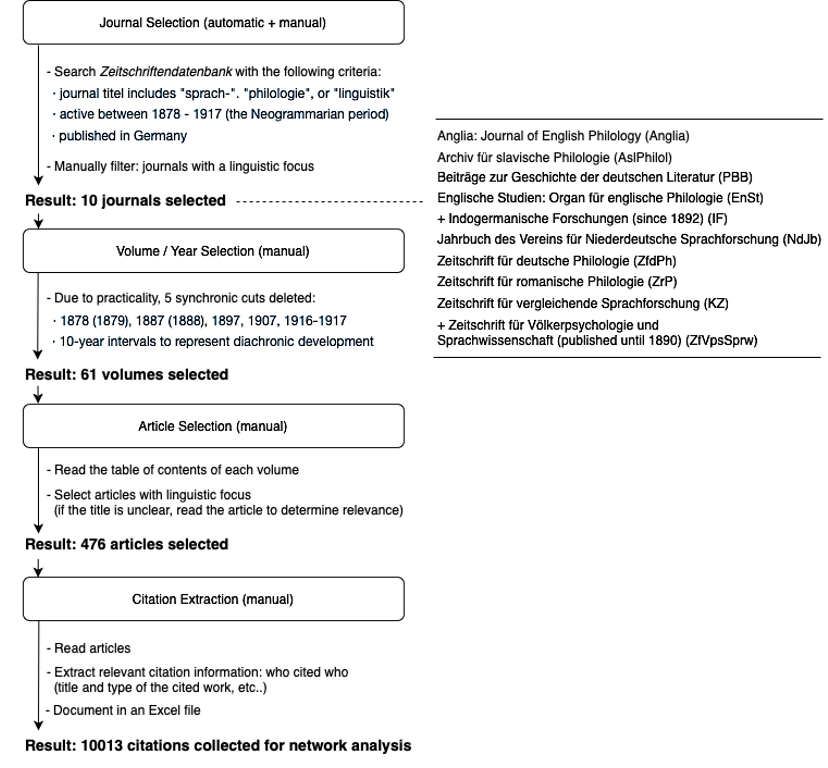
For the citation analysis, all citation data were collected manually. At the time, there were no standardized formats for citations in academic publications – neither in terms of quality nor form – which applied to journal articles as well. As a result, it was not possible to extract citation information automatically. The data collection process was therefore carried out primarily by hand, as outlined below in Figure 1.
Methodology
Based on the collected citation data, the construction, visualization, and analysis of the network was realized using the software tools Gephi (0.10.1) and Cytoscape (3.9.1). The network analysis first provided structural insights into the interactions among the scholars, forming a foundation for further exploration.
The network perspective enables a scalable mode of observation. It not only reveals the structural information (such as citation patterns of scholarly groups) that would be difficult to detect through traditional approaches to the history of linguistics but also allows for an in-depth reading of qualitative characteristics of the nodes and their connections. By combining this perspective with close readings of textual materials – such as the content of citations and related archived documents like scholarly correspondence – the network connections can be interpreted in a nuanced and contextually grounded way.
Results
In terms of scientific communication, the Neogrammarians constituted not so much a tightly organized school as a dynamic, open network of scholars marked by pronounced individuality and diversity. Their approaches were characterized by critical self-reflection, intensive exchange of ideas, and continuous development.
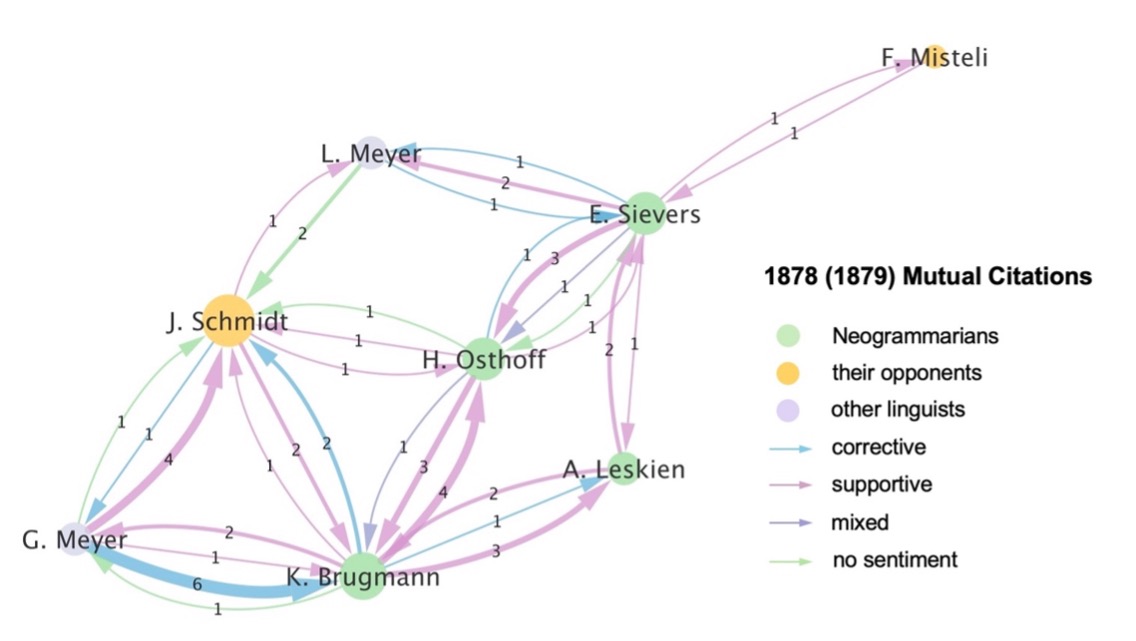
Taking the largest cluster with reciprocal citation relationships from 1878 (1879) as an example (Figure 2), we observe the Neogrammarians (represented as green nodes) – including prominent Indo-Europeanists and the Anglicist Eduard Sievers (1850–1932) – were closely interconnected. Notably, they also maintained strong citation links with their so-called opponents, citing their works with positive sentiment as well (indicated by pink arrows). While the majority of these positive citations concerned linguistic data, language theory was more often cited in a corrective or critical way.
Even within the Neogrammarian School, there were instances of negative citation sentiment (shown in blue and purple arrows), reflecting internal debates and intellectual disagreements. These divergences contributed to the dynamic evolution of the Neogrammarian language theory. While critical self-citations – for instance, by Karl Brugmann (1849–1919) (1879: 92) and Hermann Paul (1846–1921) (1879: 216–217) – also played a role in this development, my dissertation project focuses primarily on the interpersonal scholarly relationships.
Furthermore, the Neogrammarians were interconnected through their involvement in scientific organizations, significantly contributing to the institutionalization of linguistics by standardizing academic journals and structuring sub-areas through handbook publications.
During the institutionalization of linguistics, scholarly collaboration became increasingly common. As more specialized subfields emerged, the need to organize different areas grew accordingly. Instead of solely focusing on their own individual works, linguists began working together on larger projects to cover topics more comprehensively and efficiently. One notable example is Albert Thumb’s (1865–1915) revision of the fourth edition of Brugmann’s Griechische Grammatik (4th ed., 1913). Brugmann entrusted Thumb with this task so that he could concentrate on editing the Grundriss and the newly added section on syntax (Schmitt 2009: 13, footnote 8). Having someone else edit a work was not uncommon at the time, but it usually happened posthumously. The deliberate handover of editorial work, in this case, marks an early step toward modern scholarly collaboration.
Prior to the Neogrammarian period, collaborative efforts in linguistics were rare and mostly confined to large-scale projects, such as Deutsches Wörterbuch (1st ed., 1854) by the Brothers Grimm – Jacob Grimm (1785–1863) and Wilhelm Grimm (1786–1859). During the Neogrammarian era, truly co-authored works remained relatively uncommon, but cooperation became more common in the context of book series, where scholars were increasingly connected through various projects.
During this process, the internal network among the Neogrammarians strengthened, particularly through intergenerational connections. Moreover, the traditional hierarchical structure of teacher-student relationships began to give way to a more open, dynamic, and complex structure.
Conclusion
In conclusion, this study emphasizes that linguistic schools are defined by their interactive and dynamic nature as well as by their openness and diversity. The applied network perspective proves to be a suitable alternative for the explorative and scalable investigation of interrelations among scholars and research groups, as well as their developments within linguistics. It thus moves beyond explanatory models oriented towards natural science, opening up a new perspective for studying the historiography of linguistics.
Afterword
My doctoral thesis also offered a more detailed analysis that extended beyond the Neogrammarians, including the characteristics of the historical journals, articles, and their citation practices. It also placed the interactions of the Neogrammarians within a broader context of academic discourse, shaped by the publication and citation of different types of scholarly works (journal articles, monographs, and handbooks) by scholars of different academic statuses (students, experts, and authorities).
References
For this blog post
Brugmann, Karl. 1879. “Zur Geschichte der Nominalsuffixe –as-, –jas-, –vas-.” Zeitschrift für vergleichende Sprachforschung auf dem Gebiete der Indogermanischen Sprachen 24 (1): 1–99.
Brugmann, Karl. 1913. Griechische Grammatik. 4th ed., edited by Albert Thumb. (In Handbuch der klassischen Altertums-wissenschaft, edited by Iwan von Müller, vol. 2, pt. 1). München: C. H. Beck’sche Verlagsbuchhandlung.
Chen, Beijia. (unpublished manuscript, submitted February 2025). Die Junggrammatiker als wissenschaftliche Schule? – eine wissenschaftssoziologische Untersuchung anhand linguistischer Zeitschriftenzitationen aus einer Netzwerkperspektive. PhD dissertation. Berlin: Freie Universität Berlin.
Grimm, Jacob & Wilhem Grimm. 1854. Deutsches Wörterbuch, Volume 1. Leipzig: Verlag von S. Hirzel.
Paul, Hermann. 1879. “Zur Geschichte des germanischen Vocalismus.” Beiträge zur Geschichte der deutschen Sprache und Literatur 6 (1): 1–256.
Schmitt, Rüdiger. 2009. “Der ‘Junggrammatiker’ Karl Brugmann.” In Aus Karl Brugmanns Jugenderinnerungen, edited by Rüdiger Schmitt & Gerhard Brugmann, 9–27. Wien: Verlag der Österreichischen Akademie der Wissenschaften.
For broader context, please refer to the reference list shared in Podcast Episode 45 on the Neogrammarian networks at https://hiphilangsci.net/2025/04/01/podcast-episode-45/#more-9090
Software
Bastian, Mathieu, Sebastien Heymann & Mathieu Jacomy. 2009. Gephi: an open source software for exploring and manipulating networks. Proceedings of the Third International AAAI Conference on Web and Social Media 3: 361–362. (Version 0.10.1)
Shannon, Paul, Andrew Markiel, Owen Ozier, Nitin S. Baliga, Jonathan T. Wang, Daniel Ramage, Nada Amin, Benno Schwikowski &. Trey Ideker. 2003. Cytoscape: a software environment for integrated models of biomolecular interaction networks. Genome Research 13(11), 2498–2504. (Version 3.9.1)

 History and Philosophy of the Language Sciences
Leave a comment