
Dubourg Glatigny, Pascal, ed. 2024. Esperantists in the Twentieth Century: Making Connections in an Age of Division. [Special issue] Cultural History 13(2). ISSN 2045-290X
Publisher’s website

Introduction: Esperantists in the Twentieth Century: Making Connections in an Age of Division
Pascal Dubourg Glatigny
Two Communist Esperantists: A Bulgarian-Japanese Dialogue
Ulrich Lins
Revolutionary Tongues: Esperanto, Marxist Linguistics, and Anti-imperial Struggles in East Asia, 1930s–1940s
Edwin Michielsen
Facing the Choice of Language in Esperanto Literature: Edwin de Kock, Hasegawa Teru and Julius Balbin between Emotion and Ideology
Pascal Dubourg Glatigny
De Mulder, Walter, Benjamin Fagard & Dejan Stosic, ed. 2024. Polysémie et prépositions. [Special issue] Verbum 46. 260 p. ISSN 0182-5887
Publisher’s website
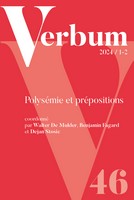
Introduction
Walter De Mulder
Le traitement de la polysémie en sémantique cognitive : retour aux origines dans le contexte américain
Jean-Michel Fortis
Dans, polysémie et réseau sémantique
Walter De Mulder
Prépositions temporelles et polysémie
Dejan Stosic et Myriam Bras
Routines sociales, contextes et corpus. Le cas de à et de en.
Denis Vigier
La grammaticalisation au prisme des prépositions complexes : déréférentialisation et polysémie
Benjamin Fagard
Extension sémantique de la préposition en train de : une perspective quantitative sur l’émergence diachronique de la polysémie
Quentin Feltgen
Iulianus Toletanus. Opera III: Ars grammatica. Edited by José Carracedo-Fraga. Turnhout: Brepols (Corpus Christianorum Series Latina, 115C). 2025. cxx + 608 p. ISBN 978-2-503-61423-6
Publisher’s website
Este volumen incluye el estudio y la edición crítica de toda el Ars grammatica (CPL 1555) del obispo Julián de Toledo (ca. 644-690). Este tratado gramatical es el más completo conservado de la escuela visigótica; pertenece a los llamados manuales avanzados y exegéticos, ya que está concebido como un comentario pormenorizado a los tratados modelo de Donato, el Ars minor y el Ars maior, e incluye todos los principales campos de estudio definidos por la tradición gramatical de la tardía Antigüedad. Es además uno de los primeros y mejores ejemplos del proceso de cristianización de la teoría gramatical latina operado en la escuela medieval. Como suele ser habitual en textos escolares, la obra ha llegado hasta nosotros en dos redacciones distintas, sin que se pueda determinar cuál de las dos es la de Julián o la más próxima a él. Por esa razón la edición ofrece en paralelo el texto de las dos versiones.
Aussant, Émilie & Fabien Simon, ed. 2025. Documenter et décrire les langues d’Asie : histoire et épistémologie. Paris : SHESL (HEL Livres, 4). 570 p. ISBN 979-10-91587-23-5
Publisher’s website
Book in open access

Issu d’un colloque de la Société d’histoire et d’épistémologie des sciences du langage, cet ouvrage aborde, d’un point de vue historique et épistémologique, les activités de documentation et de description des langues d’Asie. Le terme « Asie » y est pris dans l’acception large que lui donne la Société asiatique, c’est-à-dire en tant que désignant une zone allant du Maghreb à l’Extrême-Orient et dont il s’agit aussi, depuis la question linguistique, d’interroger les pourtours. Quant aux activités linguistiques prises en considération, elles incluent, d’une part, la collecte de données linguistiques, sous toutes ses formes (listes de mots, constitution d’archives, de fonds, « linguistic survey », questionnaires, corpus, etc.) et, d’autre part, l’élaboration d’outils permettant de représenter, en synchronie ou en diachronie, une langue : systèmes d’écriture, grammaires, dictionnaires, lexiques, instruments de traduction, manuels, etc.
Au cœur des réflexions donc, une analyse fine du savoir linguistique produit, dans et hors d’Europe, sur les langues asiatiques, avec une attention toute particulière portée aux contextes de production et de circulation de ces savoirs. Sont ainsi abordés l’apport des traditions autochtones dans le processus de grammatisation, la place de l’Asie dans les entreprises de comparaison des langues à l’échelle du monde, ou, parmi d’autres thèmes encore, la matérialité des descriptions (traductions, impressions…).
Gallese, Vittorio & David Romand, ed. 2024. Empathy and the Aesthetics of Language. [Special issue] Texas Studies in Literature and Language 66(4). 467 p. ISSN 1534-7303
Publisher’s website

Introduction: Empathy and the Aesthetics of Language
Vittorio Gallese, David Romand, Hannah Wojciehowski
Narrative Empathy as Animator of the Inanimate
Suzanne Keen
Writing Empathy into the Script: The Aesthetics of Narrative
Shaun Gallagher
Jane, Empathy, and the Between
Siri Hustvedt
Empathic Scaffolding: How Literary Ways of Writing about Experiences Improve Readers’ Empathy
Christiana Werner
The Gorgon Effect: The Witness’s Report as a Device for Multimodal Emotional Engagement
Taylor Enoch, Samuel E. Rasche, Renata Gambino, Grazia Pulvirenti
Enabling Empathy and Interpersonal Understanding: Aesthetics and Effects of Literary Fiction
Keith Oatley
Balnat, Vincent & Barbara Kaltz, ed. 2025. Genus und Geschlecht in europäischen Sprachen. Geschichte und Gegenwart. Tübingen: Narr (Sprachvergleich. Studien zur synchronen und diachronen Sprachwissenschaft, 6). 468 p. ISBN 978-3-381-12301-8
Publisher’s website

Über einen geschlechtergerechten Sprachgebrauch wird in Deutschland seit über 40 Jahren diskutiert. In Folge der Verbreitung gegenderter Formen und grafischer Sonderzeichen ist der Ton der Debatte deutlich rauer geworden; die beiden ‚Lager‘ stehen sich inzwischen nahezu unversöhnlich gegenüber.
Dieser Band vereint Beiträge zu elf europäischen Sprachen, in denen sprachgeschichtliche Aspekte und die gegenwärtige Debatte möglichst wertneutral und ohne Polemik behandelt werden. Ziel ist es, Denkanstöße zum komplexen Verhältnis zwischen Genus und Geschlecht zu geben und zu einer gelasseneren und respektvolleren Debatte beizutragen. Den Einstieg in das Thema bietet der erste Beitrag zum Gendern in der Antike; es folgen Untersuchungen zu den Sprachen Deutsch, Englisch, Niederländisch, Norwegisch, Schwedisch, Französisch, Italienisch, Spanisch, Russisch, Tschechisch und Finnisch.

 History and Philosophy of the Language Sciences
Leave a comment